Karnataka disburses financial assistance for women empowerment
Source:The Hindu ↗
Why It Matters
Highlights the critical need for public-private partnerships in education and skill development. It shows how states are shifting focus toward entrepreneurship and private sector collaboration to solve the employment crisis and boost female labor force participation.
Summary
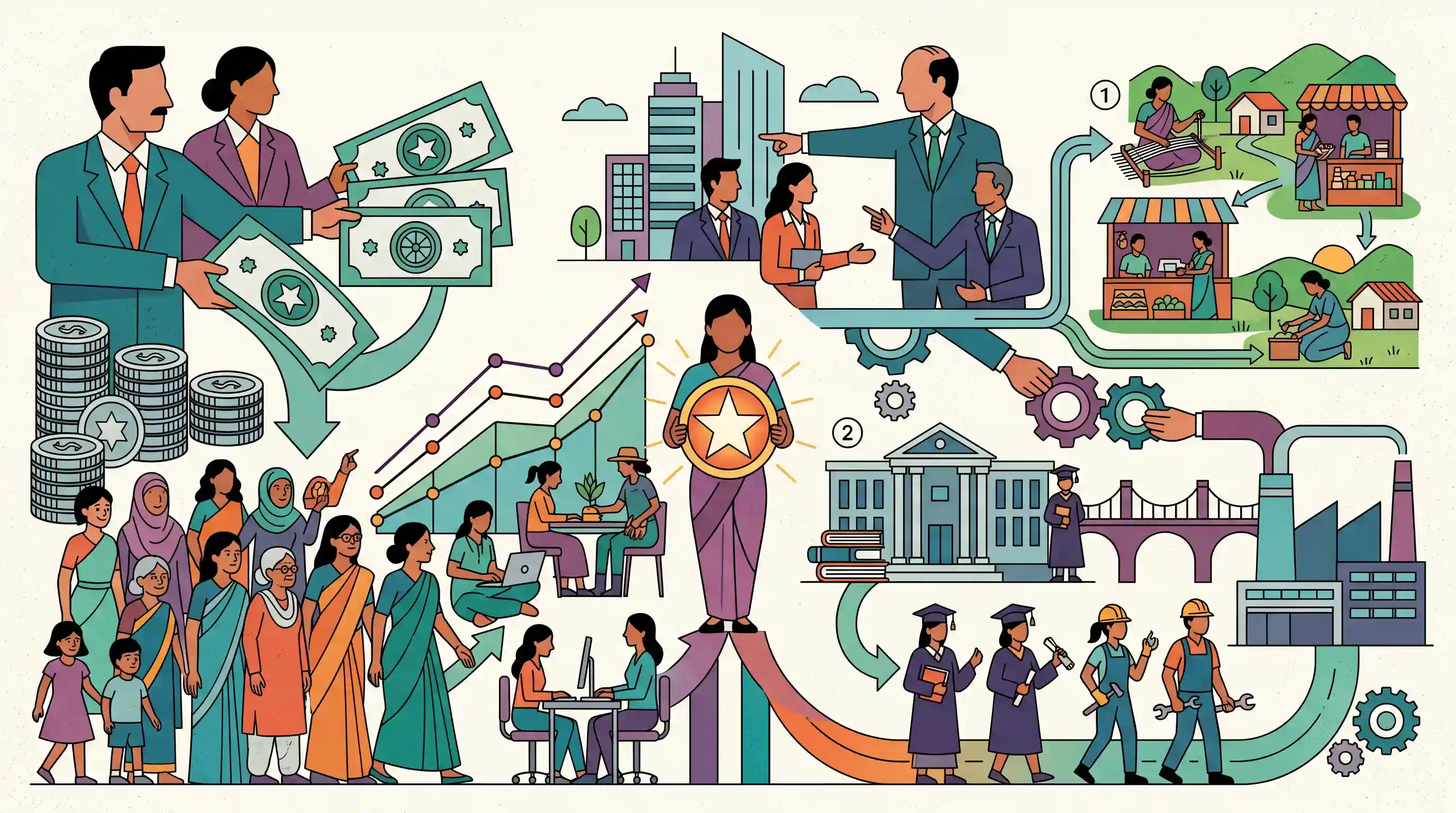
The Karnataka government has empowered 1.2 lakh women over the past two years by providing financial assistance totaling ₹50,000 crore, significantly aiding female labor force participation. Speaking at an event for the Federation of Karnataka Chambers of Commerce & Industry (FKCCI), Chief Secretary Shalini Rajneesh urged the private sector to actively contribute to employment generation and entrepreneurship. Emphasizing the limits of government job creation, she encouraged industry bodies to foster entrepreneurship at the grassroots (zilla and gram panchayat levels) and suggested that companies adopt government educational institutions to bridge the gap between academic training and employable skills.
Key Points
- The Karnataka government has provided ₹50,000 crore in financial assistance over the past two years, empowering 1.2 lakh women and contributing to a 37% female labor force participation rate in the state.
- Chief Secretary Shalini Rajneesh emphasized the limitations of public sector employment, noting the government can only create 20,000 to 30,000 jobs, making private sector collaboration essential.
- Industry bodies like FKCCI are urged to foster grassroots entrepreneurship, specifically at the zilla and gram panchayat levels, to bridge the massive employment gap.
- A key proposal for improving employability is for private companies to adopt government educational institutions, acting as resources to develop entrepreneurship and strengthen the linkage between education, skills, and employment.
Important Terms
Female Labour Force Participation Rate (FLFPR)

The percentage of women in the working-age population (15+) who are either employed or actively seeking work; a key metric for gender-inclusive economic growth.
UPSC context
Relevant for GS3 (Economy) and GS2 (Social Justice). Tests understanding of labor market trends and gender-based economic disparities.
Chief Secretary
The highest-ranking civil servant in an Indian state, serving as the principal advisor to the Chief Minister and administrative head of the State Secretariat.
UPSC context
Crucial for GS2 (Polity and Governance). Tests knowledge of state executive machinery and the role of permanent bureaucracy.
FKCCI
A 108-year-old apex industry body in Karnataka that represents business interests and collaborates with the government to promote trade, commerce, and employment.
UPSC context
Relevant for GS3 (Economy - Industry). Represents the role of business associations in public-private partnerships and policy advocacy.
Industry-Academia Linkage
Strategic collaboration between educational institutions and industries to align curricula and training with market needs, ensuring graduates possess employable, job-ready skills.
UPSC context
Significant for GS3 (Skill Development). Addresses the "employability gap" and the human capital challenges of the demographic dividend.
Gender Budgeting
A governance tool that integrates gender perspectives into the budgetary process, ensuring that resource allocation addresses the specific needs and disparities faced by women.
UPSC context
Important for GS2 (Governance) and GS3 (Economy). Tests the ability to analyze fiscal policy through a social justice lens.
Grassroots Entrepreneurship
The promotion of self-employment and small-scale business ventures at the village or panchayat level to drive local economic growth and decentralized development.
UPSC context
Relevant for GS2 (Panchayati Raj) and GS3 (Inclusive Growth). Focuses on localizing economic empowerment and reducing urban-rural migration.
Prelims Trap
Female Labour Force Participation Rate (FLFPR) strictly excludes women working as unpaid helpers in household enterprises.
FLFPR calculations by the NSO (under PLFS) actually include unpaid family helpers in household enterprises as 'employed'. This inclusion drives much of the recent statistical surge in India's FLFPR.
Static Concepts Connected
How is Labour Force Participation Rate (LFPR) officially measured in India?
- Core Definition: It represents the percentage of persons in the labour force (i.e., those working or seeking/available for work) in the total population.
- PLFS Measurement: The National Statistical Office (NSO) measures it via the Periodic Labour Force Survey (PLFS) using 'Usual Status' (1-year reference) and 'Current Weekly Status'.
- Unpaid Helpers: Women working as unpaid helpers in family enterprises are classified as employed under the Usual Status, directly boosting FLFPR metrics.
How do constitutional provisions empower Panchayati Raj Institutions (PRIs) in grassroots economic generation?
- Article 243G: Mandates state legislatures to endow panchayats with powers and authority necessary to function as institutions of self-government for economic development and social justice.
- 11th Schedule: Lists 29 subjects transferred to Panchayats, explicitly including Small-scale industries, Khadi/village industries, and vocational education—key drivers of local entrepreneurship.
Cross-Topic Patterns
SHG-Panchayat convergence for rural enterprise
Financial assistance to women at grassroots often leverages SHG-Panchayat convergence, mirroring Kerala's Kudumbashree model, directly linking GS2 governance with GS3 inclusive growth.
CSR mandates and industry-academia linkages
Industry adoption of government educational institutes ties into CSR mandates (Companies Act Schedule VII), making private capital a formal tool for bridging the demographic dividend's employability gap.

Mains 2026: Expect a GS3 question linking the recent surge in FLFPR to unpaid household enterprises vs. formal micro-entrepreneurship.
Linked PYQs · 5
Linked PYQs · 5
- 2024MainsGS1
Distinguish between gender equality, gender equity and women's empowerment. Why is it important to take gender concerns into account in programme design and implementation?
- 2023MainsGS3
Distinguish between 'care economy' and 'monetized economy'. How can care economy be brought into monetized economy through women empowerment?
- 2023MainsGS2
Skill development programmes have succeeded in increasing human resources supply to various sectors. In the context of the statement analyse the linkages between education, skill and employment.
- 2014MainsGS3
While we flaunt India's demographic dividend, we ignore the dropping rates of employability. What are we missing while doing so? Where will the jobs that India desperately needs come from? Explain.
- 2021MainsGS2
“Earn while you learn' scheme needs to be strengthened to make vocational education and skill training meaningful.” Comment.
