Karnataka Soft Release Centre to Mitigate Human Elephant Conflict
Source:The Hindu ↗
Why It Matters
Human-animal conflict is a major issue in conservation, especially in states like Karnataka which harbor India's largest elephant population. Mitigation strategies like soft release centres and railway barricades provide practical case studies for wildlife management and environmental governance.
Summary
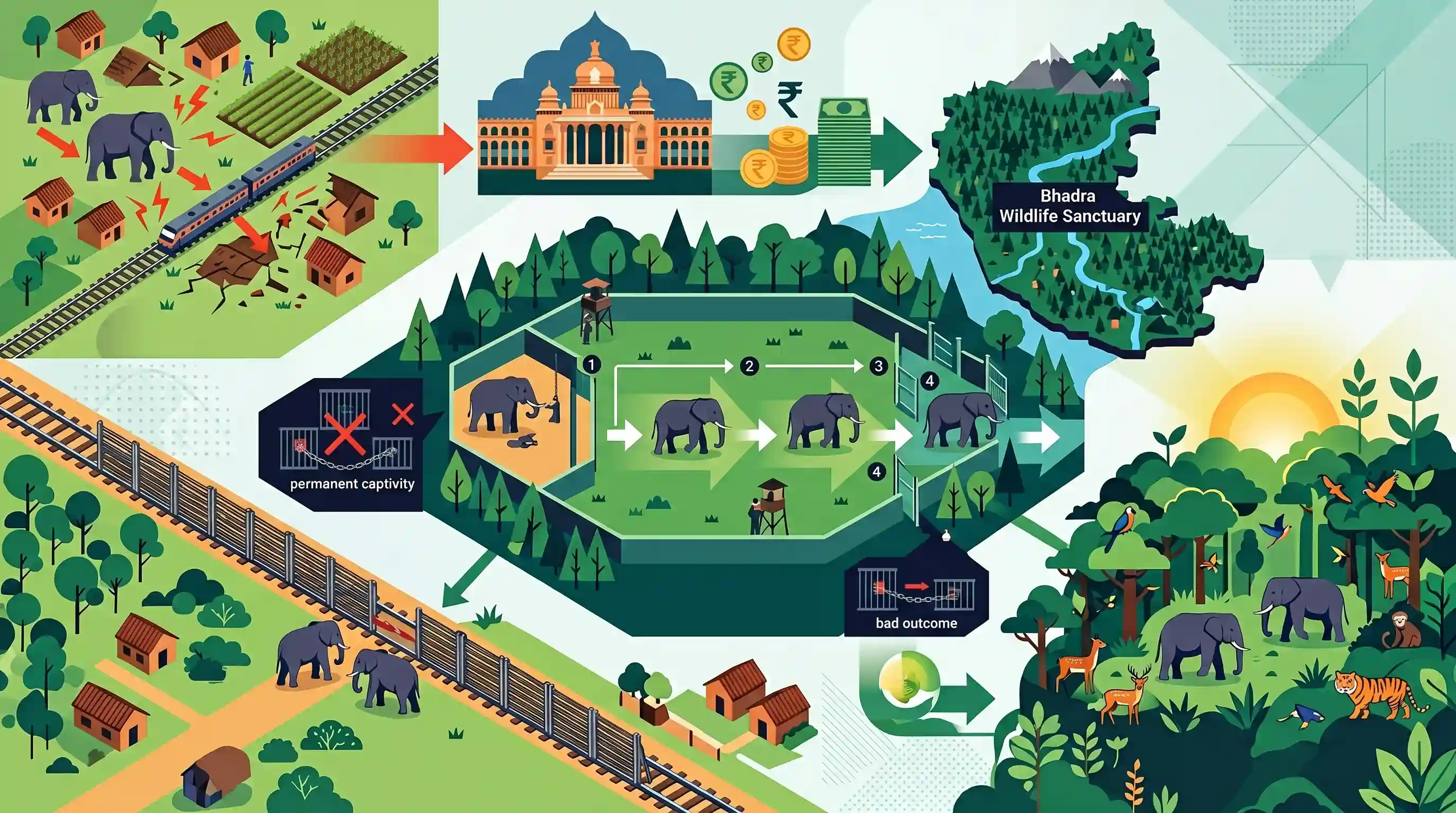
Karnataka is setting up a 'soft release centre' in the Bhadra Wildlife Sanctuary to address escalating human-elephant conflict. Supported by a ₹53 crore grant, the centre will temporarily house problem elephants in a large enclosure before gradually releasing them back into the wild, serving as an alternative to permanent captivity. Alongside this, the state is constructing extensive railway barricades to prevent elephants from entering human settlements.
Key Points
- The Karnataka government is establishing a 'soft release centre' to mitigate severe human-elephant conflict, which causes 65-70 human deaths annually in the state.
- Proposed to be located in the Bhadra Wildlife Sanctuary with a ₹53 crore budget, the centre will feature a 20-sq-km enclosure to hold 'trouble-causing' wild elephants.
- Instead of permanent captivity in camps, captured elephants will be temporarily housed and acclimatized before being released back into the wild in a phased manner.
- The state is also advancing other mitigation measures, including the construction of 140 km of railway barricades, for which ₹100 crore has been released.
Important Terms
Soft Release Centre

A conservation facility providing temporary, large-scale enclosures for conflict-prone animals to acclimatize and undergo health checks before gradual reintroduction into the wild, rather than permanent captivity.
UPSC context
GS III (Environment). Tests knowledge of innovative, humane rewilding techniques and wildlife management strategies for conflict mitigation.
Human-Elephant Conflict (HEC)
Adverse interactions between humans and elephants caused by habitat loss or fragmentation, leading to crop raiding, property destruction, and fatalities for both species.
UPSC context
GS III (Environment/Agriculture). A core theme focusing on the socio-economic and ecological challenges of wildlife conservation in human-dominated landscapes.
Bhadra Wildlife Sanctuary
A protected area and Tiger Reserve in Karnataka's Western Ghats (Chikkamagaluru), also known as Muthodi Wildlife Sanctuary; it serves as a critical habitat for elephants, tigers, and diverse shola ecosystems.
UPSC context
GS III (Biodiversity). Tests geographical knowledge of India’s protected areas, Tiger Reserves, and specific regional conservation initiatives.
Railway Barricades
Physical deterrents constructed using recycled steel rails to block elephant movement into human settlements or farmlands, regarded as an effective non-lethal mitigation measure.
UPSC context
GS III (Conservation/Infrastructure). Evaluates understanding of technology-based and physical infrastructure solutions to mitigate man-animal conflict.
Project Elephant
A centrally sponsored scheme launched in 1992 to provide financial and technical support to states for protecting elephants, their habitats, and migratory corridors.
UPSC context
GS III (Conservation). Essential for understanding the administrative and legal frameworks governing species-specific conservation in India.
Prelims Trap
"A 'soft release' centre implies the permanent captivity of problem animals in designated camps."
Soft release involves temporary acclimatization in a natural enclosure before phased release into the wild. It is an alternative to, not a form of, permanent captivity.
Static Concepts Connected
What is the conservation status and protection framework for the Asian Elephant?
- IUCN Status: Classified as Endangered on the IUCN Red List due to habitat loss, fragmentation, and poaching.
- WPA 1972: Listed under Schedule I of the Wildlife (Protection) Act, 1972, granting it the highest legal protection.
- Project Elephant: Launched in 1992 as a Centrally Sponsored Scheme to protect elephants, their habitats, and critical corridors.
- MIKE Programme: Monitoring of Illegal Killing of Elephants (MIKE) is a CITES-mandated program to measure and track poaching levels.
What are the key ecological features of the Bhadra Wildlife Sanctuary?
- Location: Situated in the biodiversity hotspot of the Western Ghats in Karnataka, spanning Chikkamagaluru and Shivamogga districts.
- Dual Status: It is officially designated as both a Project Tiger Reserve and an Elephant Reserve.
- Drainage: The sanctuary is drained by the Bhadra River, a major tributary of the Tungabhadra River.
Cross-Topic Patterns
Linear infrastructure & corridor fragmentation
The use of railway barricades highlights the clash between linear infrastructure (railways, highways) and wildlife corridors, a recurring theme linked to eco-sensitive zone (ESZ) guidelines and infrastructure planning.
Invasive alien species driving wildlife conflict
The spread of invasive species (like Lantana camara) in the Western Ghats destroys native fodder, acting as a push factor that drives elephants into human settlements and exacerbates conflict.

Expect a 2026 multi-statement question pairing human-elephant conflict mitigation (soft release, barricades) with Elephant Corridor rules.
Linked PYQs · 1
Linked PYQs · 1
- 2020PrelimsGS1
With reference to Indian elephants, consider the following statements: 1. The leader of an elephant group is a female. 2. The maximum gestation period can be 22 months. 3. An elephant can normally go on calving till the age of 40 years only. 4. Among the States in India, the highest elephant population is in Kerala. Which of the statements given above is/are correct?
