Karnataka orders flood rescue operations in Kalyana districts
Source:The Hindu ↗
Why It Matters
The situation exemplifies the localized disaster management challenges created by inter-state river basin dynamics. It is highly relevant for UPSC aspirants studying disaster mitigation (GS3), geographic features (GS1), and the practical roles of district administration in crisis management (GS2/GS3).
Summary
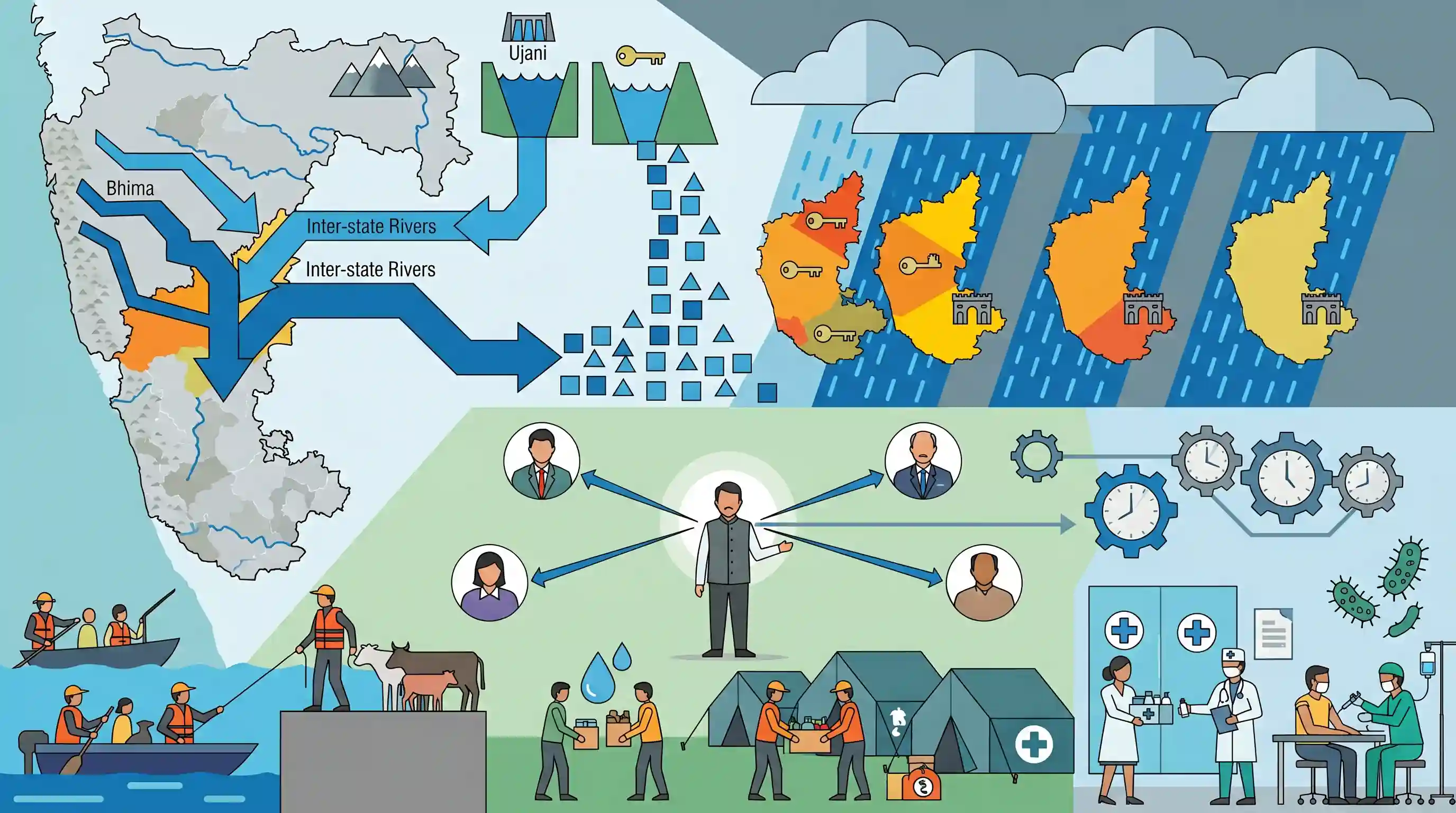
Karnataka Chief Minister Siddaramaiah has directed district administrators in four Kalyana Karnataka districts to initiate immediate rescue and relief operations in response to impending flood threats. The flooding risk is heightened by heavy local rainfall combined with the downstream release of water from Maharashtra's Ujani and Neera reservoirs into the inter-state Krishna and Bhima rivers. To mitigate the crisis, the administration has mandated strict inter-departmental coordination to establish relief centers, prevent the loss of human and livestock lives, and proactively manage the risk of post-flood communicable diseases.
Key Points
- Four districts in the Kalyana Karnataka region (Kalaburagi, Bidar, Yadgir, and Vijayapura) are facing severe flood threats due to heavy rainfall.
- The flood situation is aggravated by the release of water from Maharashtra's Ujani and Neera reservoirs into the Krishna and Bhima rivers.
- The Karnataka government has emphasized proactive disaster management, mandating coordinated efforts across Revenue, Health, Agriculture, and Public Works departments.
- Key administrative priorities include preventing loss of life and livestock, setting up relief centers, and checking the spread of waterborne communicable diseases.
Important Terms
Revenue Department

The nodal agency for disaster management at the state and district levels, responsible for emergency relief, damage assessment, and the disbursement of compensation.
UPSC context
GS Paper III: Disaster Management; essential for understanding the administrative hierarchy and financial disbursement during calamities.
Zilla Panchayat
The highest tier of the Panchayati Raj system at the district level, crucial for grassroot-level planning, resource mobilization, and managing local relief centers.
UPSC context
GS Paper II: Governance/Polity; tests knowledge of decentralization and the role of PRIs in crisis response.
Animal Husbandry Department
The department tasked with protecting livestock during disasters by establishing cattle camps, providing fodder, and managing animal disease outbreaks.
UPSC context
GS Paper III: Disaster Management; specifically relevant for livestock-dependent rural economies and post-disaster recovery.
Health Department
The administrative body responsible for monitoring post-flood communicable diseases, deploying medical units, and ensuring sanitation and safe drinking water in affected areas.
UPSC context
GS Paper III: Disaster Management/Public Health; focuses on the biological risks and health infrastructure resilience during floods.
Agriculture Department
The agency responsible for assessing agricultural crop loss, facilitating insurance claims under PMFBY, and providing inputs like seeds for post-flood replanting.
UPSC context
GS Paper III: Agriculture/Disaster Management; critical for understanding economic impact assessments and farmer support mechanisms.
Prelims Trap
"The Bhima River is a right-bank tributary of the Krishna river originating in Karnataka."
Bhima is actually a major left-bank tributary of the Krishna River, and it originates in the Bhimashankar hills of Maharashtra, not Karnataka.
Static Concepts Connected
What are the key geographical features of the Krishna River system?
- Origin: It originates near Mahabaleshwar in the Western Ghats of Maharashtra.
- Left-bank tributaries: Bhima, Musi, Dindi, and Munneru. The Bhima is a major tributary bringing water from Maharashtra.
- Right-bank tributaries: Tungabhadra, Ghataprabha, Malaprabha, Venna, and Koyna.
What are the special provisions for Kalyana-Karnataka under Article 371-J?
- Constitutional Amendment: Inserted by the 98th Constitutional Amendment Act, 2012, to promote equitable regional development.
- Development Board: Mandates the establishment of a separate development board for the Kalyana-Karnataka region.
- Reservations: Provides for equitable allocation of funds and reservation in public employment and education for local residents.
Cross-Topic Patterns
Upstream Dam Releases + Downstream Floods
Recurrent inter-state flooding due to sudden dam discharges (Maharashtra to Karnataka) highlights the urgent need for Integrated River Basin Management (IRBM) and strict adherence to scientific rule curves.
Article 371-J + Disaster Vulnerability
The Kalyana-Karnataka region's special constitutional status reflects historical underdevelopment, which inherently limits local administrative capacity and compounds the region's structural vulnerability to climate shocks and disasters.

Expect a Prelims mapping question pairing dams (Ujani, Koyna) with their specific tributaries (Bhima) rather than the main Krishna river.
Linked PYQs · 4
Linked PYQs · 4
- 2020MainsGS3
Discuss the recent measures initiated in disaster management by the Government of India departing from the earlier reactive approach.
- 2023PrelimsGS1
Consider the following statements: 1. Jhelum River passes through Wular Lake. 2. Krishna River directly feeds Kolleru Lake. 3. Meandering of Gandak River formed Kanwar Lake. How many of the statements given above are correct?
- 2016MainsGS1
The effective management of land and water resources will drastically reduce the human miseries. Explain.
- 2020MainsGS1
The interlinking of rivers can provide viable solutions to the multi-dimensional inter-related problems of droughts, floods and interrupted navigation. Critically examine.
