Passage of Anti-Hate Speech Legislation in Karnataka
Source:Indian Express ↗
Why It Matters
The development provides a contemporary case study for the persistent constitutional tension between the state's mandate to maintain public order and the citizen's fundamental right to free speech, a core area of UPSC's syllabus on Polity and Governance.
Summary
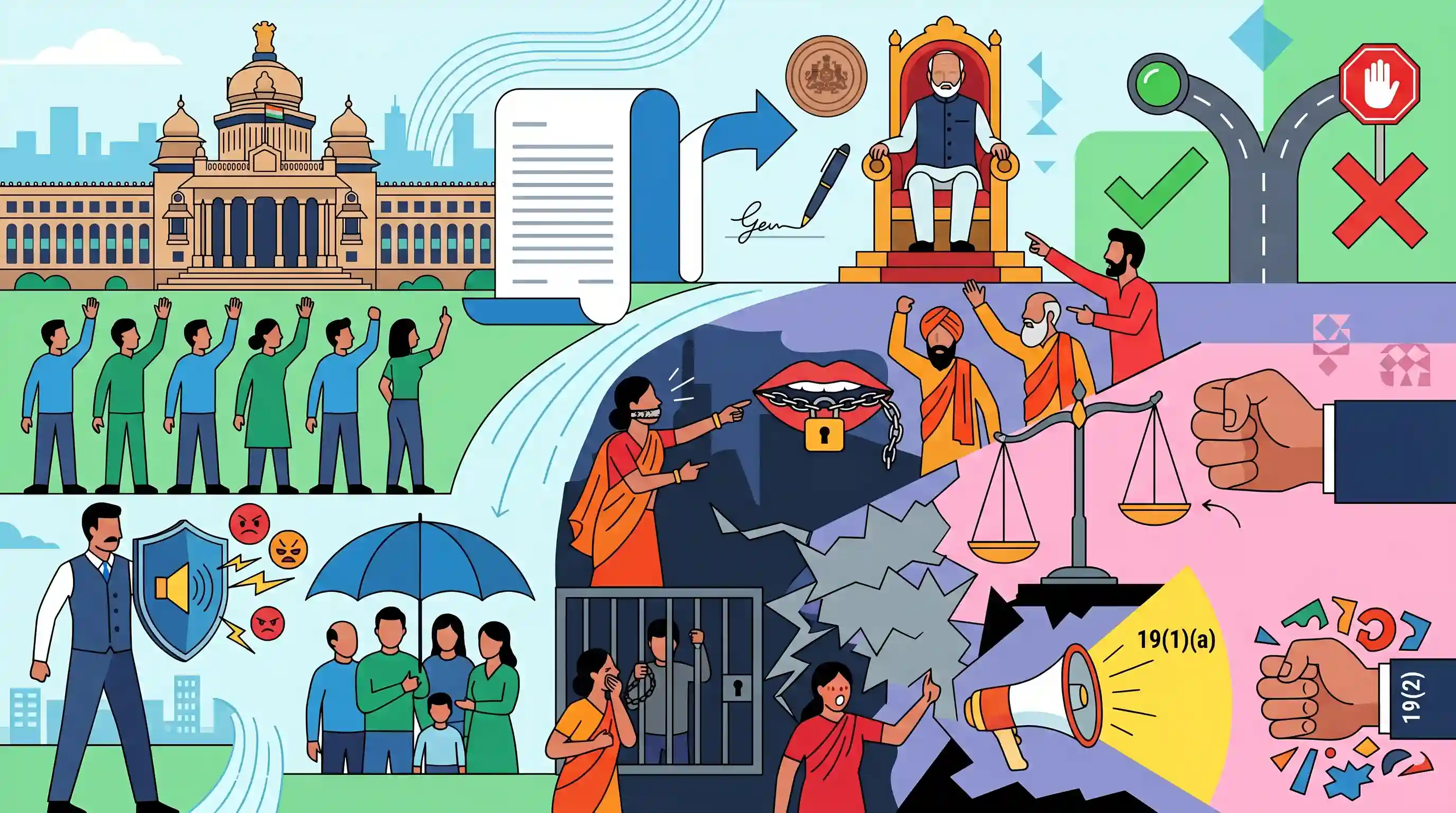
The Karnataka Legislative Council has passed the Karnataka Hate Speech and Hate Crimes (Prevention) Bill, 2025, which the ruling Congress government claims is necessary to curb hate speech and preserve public order. The opposition, including the BJP and JD(S), strongly contested the bill, labeling it a direct attack on freedom of speech and a tool for political vendetta reminiscent of the Emergency. Opposition leaders have appealed to the Governor to withhold assent, arguing that the bill's vague terminology, such as 'disharmony' and 'ill-will', confers excessive discretion to the executive and violates the constitutional guarantee of freedom of speech and expression under Article 19(1)(a), failing to fall neatly within the reasonable restrictions of Article 19(2).
Key Points
- The Karnataka Legislative Council passed the Karnataka Hate Speech and Hate Crimes (Prevention) Bill, 2025 amidst heavy protests.
- Opposition parties BJP and JD(S) argued the bill is a political tool to suppress dissent, likening it to the Emergency.
- Critics contend the bill violates Article 19(1)(a) by using vague terms like 'disharmony' and 'ill-will' that grant excessive discretionary power to the executive.
- The state government defended the bill, citing similar legislation in states like Maharashtra, arguing it is necessary to maintain public order.
- Union Minister Shobha Karandlaje wrote to Karnataka Governor Thaawarchand Gehlot urging him to withhold assent to the bill.
Important Terms
Karnataka Hate Speech and Hate Crimes (Prevention) Bill, 2025

A landmark state-level legislation proposing to explicitly define and penalize hate speech and crimes with 2-10 years of imprisonment and collective liability for organizations.
UPSC context
GS II: Polity; tests ability to analyze state-specific laws vs. national frameworks (BNS) and Fundamental Rights.
Hate Speech
Expression intended to incite hatred or marginalize groups based on identity (religion, caste, gender, etc.). Though not defined in the BNS, it is regulated via Article 19(2).
UPSC context
GS II: Governance; involves Law Commission reports (267th) and judicial doctrines like the 'vagueness test'.
Article 19(1)(a)
A Fundamental Right guaranteeing freedom of speech and expression. It is not absolute and is subject to state-imposed reasonable restrictions to preserve public order.
UPSC context
GS II: Fundamental Rights; core concept for Mains regarding individual liberty vs. social stability.
Reasonable Restrictions
Constitutional limits on free speech under Article 19(2) based on grounds like public order, security of the state, and incitement to an offense.
UPSC context
GS II: Indian Constitution; tests the balance between democratic freedom and executive authority.
Legislative Council
The upper house of a bicameral state legislature (Vidhan Parishad). In Karnataka, it acts as a permanent, revisory body with 75 members.
UPSC context
GS II: State Legislature; tests knowledge of bicameralism, Article 169, and legislative procedure.
Governor's Assent
The final constitutional stage under Article 200 where the Governor signs, withholds, or refers a state bill to the President.
UPSC context
GS II: Executive; critical for questions on federalism and Governor-State Government relations.
Collective Liability
A legal provision in the Bill holding an organization's leadership responsible for hate crimes committed through or by the entity.
UPSC context
GS II: Governance/Law; a specific feature testing understanding of modern legal accountability mechanisms.
Prelims Trap
The Constitution explicitly lists 'hate speech' as a reasonable restriction under Article 19(2).
The Constitution does not define or mention 'hate speech'. Article 19(2) specifies grounds like 'public order' and 'incitement to an offence', under which hate speech is penalized.
Static Concepts Connected
What options does a Governor have under Article 200 when a Bill is presented?
- Assent or Withhold: The Governor may grant assent to the Bill or explicitly withhold assent, effectively ending it.
- Return for Reconsideration: Can return non-Money Bills to the legislature. If the legislature passes it again, giving assent becomes mandatory.
- Reserve for President: Obligatory if the Bill threatens High Court powers; discretionary for broader constitutional conflicts.
What are the explicit grounds for reasonable restrictions on Free Speech under Article 19(2)?
- National Interests: Sovereignty and integrity of India, security of the State, and friendly relations with foreign States.
- Public Order & Morality: Public order, decency, or morality. Hate speech regulations are primarily defended under the 'public order' restriction.
- Legal Protections: Contempt of court, defamation, and incitement to an offence.
Cross-Topic Patterns
Vagueness & The Chilling Effect
The opposition's criticism of vague terms like 'ill-will' mirrors the Supreme Court's Shreya Singhal ruling, which struck down Section 66A of the IT Act for causing a 'chilling effect' on free speech.
Article 254 Repugnancy in Criminal Law
Since criminal law is on the Concurrent List, a State's hate speech law conflicting with central statutes (like the new BNS) requires Presidential assent to survive a repugnancy challenge.

Expect a 2026 Mains question analyzing the tension between state-led 'hate speech' regulations and the chilling effect on Article 19.
Linked PYQs · 1
Linked PYQs · 1
- 2014MainsGS2
What do you understand by the concept "freedom of speech and expression"? Does it cover hate speech also ? Why do the films in India stand on a slightly different plane from other forms of expression ? Discuss.
