Bengaluru Demolition Drive and Urban Migrant Shelter Debate
Source:Indian Express ↗
Why It Matters
The conflict raises pertinent questions regarding urbanization, forced evictions, and the right to shelter under Article 21. It exemplifies the governance challenges metropolises face in managing slums, ensuring due process before displacement, and mitigating the marginalization of the urban poor and migrant workforce.
Summary
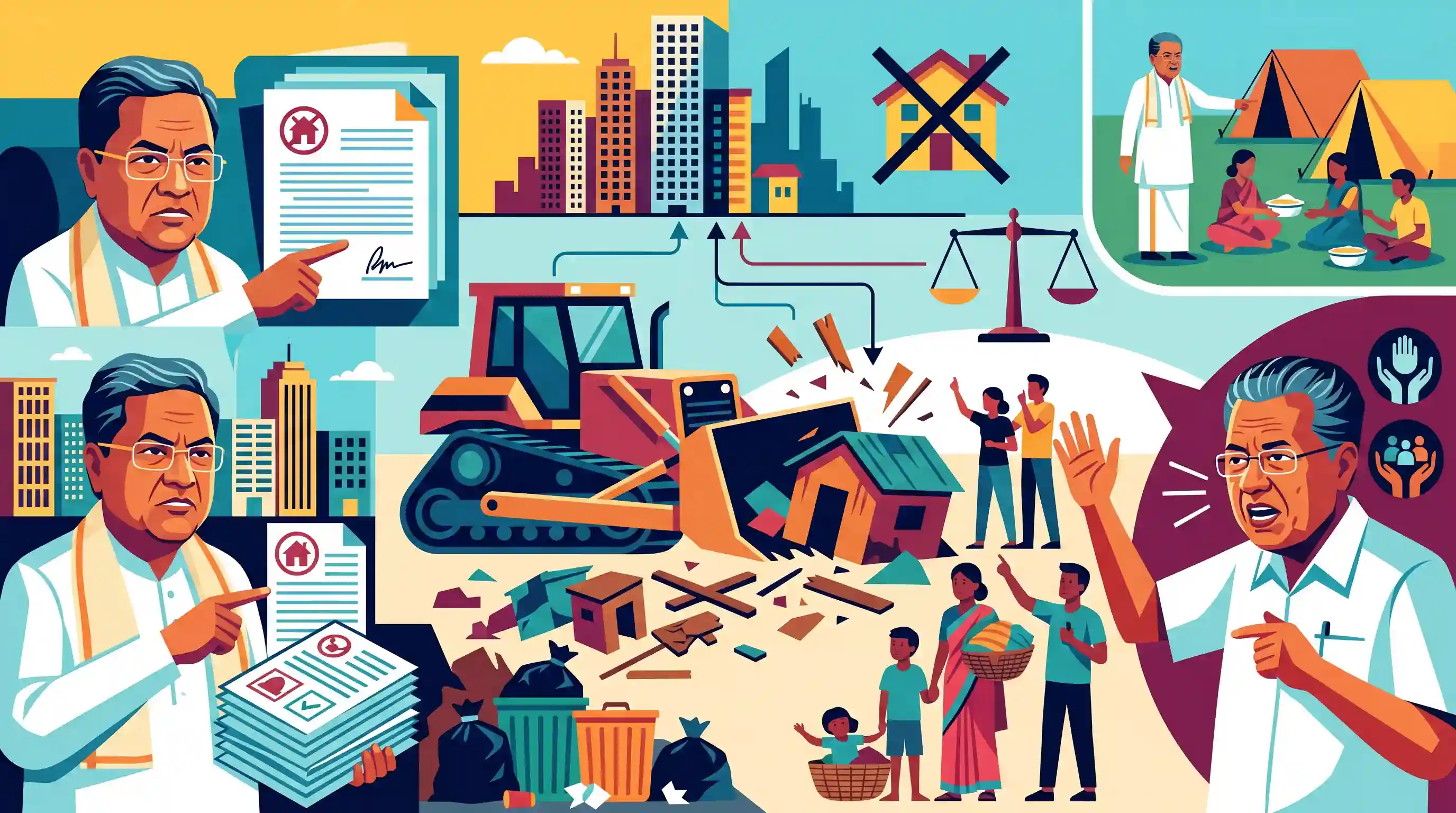
A political dispute arose between Karnataka CM Siddaramaiah and Kerala CM Pinarayi Vijayan over a demolition drive in Bengaluru’s Kogilu Layout. While Vijayan criticized the eviction of 188 impoverished families as "bulldozer justice," Siddaramaiah defended the action, stating the settlements were illegal, makeshift shelters built on private property near a waste dump. Despite the government's claim that notices were issued, activists argue the residents, many of whom are migrant workers, were evicted without warning. The Karnataka CM has since ordered temporary shelter and food for the displaced on humanitarian grounds. The event highlights systemic issues regarding the marginalization of the urban poor, affordable housing deficits, and the rights of migrant workers in Indian metropolises.
Key Points
- Karnataka CM Siddaramaiah rebutted Kerala CM Pinarayi Vijayan's characterization of a recent demolition drive in Bengaluru as 'bulldozer justice'.
- The eviction cleared illegal, makeshift shelters of 188 families on private property in Kogilu Layout, which authorities stated was unfit for human habitation.
- While the government claims notices were issued before the encroachment clearance, activists and affected residents assert that no prior warning was given.
- Many of the displaced individuals are impoverished migrant workers; Siddaramaiah has directed the Greater Bengaluru Authority to provide temporary food and shelter on humanitarian grounds.
- The incident underscores broader issues of rapid urbanization, housing shortages for the urban poor, and the challenges of balancing municipal enforcement with the basic rights of marginalized communities.
Important Terms
Dhudiyuva Janara Vedike

A Karnataka-based collective advocating for the rights of informal sector workers, including migrants and domestic laborers. It frequently monitors urban evictions and labor law compliance.
UPSC context
GS 2: Role of NGOs and civil society in representing vulnerable sections; GS 3: Inclusive growth and informal labor.
Greater Bengaluru Authority (GBA)
The apex planning and coordinating body for Bengaluru, established under the Greater Bengaluru Governance Act, 2024, to oversee municipal corporations and parastatal agencies like BWSSB and BDA.
UPSC context
GS 2: Urban governance, 74th Amendment, and institutional structures for managing metropolitan areas.
Bulldozer Justice
The summary demolition of property by executive authorities, often as a punitive measure against accused individuals. The Supreme Court (2024) mandated strict due process to prevent such arbitrary actions.
UPSC context
GS 2: Rule of Law, Separation of Powers, and judicial oversight of executive overreach.
Right to Shelter
Interpreted by the Supreme Court as a fundamental right under Article 21, it ensures citizens have access to a dignified, secure home and protection from forced evictions without rehabilitation.
UPSC context
GS 2: Fundamental Rights (Art 21) and the judiciary’s role in expanding socio-economic protections.
Inter-State Migrant Workmen Act, 1979
A 1979 legislation regulating the employment of workers who move between states. It mandates registration of establishments and ensures workers receive equal wages, housing, and medical facilities.
UPSC context
GS 2: Welfare schemes for vulnerable sections; GS 3: Labor rights and the challenge of inter-state migration.
CPI(M)
A national political party in India (Communist Party of India (Marxist)) that governs Kerala. It frequently clashes with other parties on issues of social justice and executive power.
UPSC context
GS 2: Pressure groups and political movements; Inter-state relations and political dynamics.
Prelims Trap
The Supreme Court has completely prohibited all administrative demolitions, including encroachments on public land, without strict prior notice.
The SC guidelines against 'bulldozer justice' mandate notice/hearing for punitive demolitions, but explicitly exempt unauthorized structures on public spaces like footpaths, roads, or water bodies from this specific protective framework.
Static Concepts Connected
How has the Supreme Court interpreted the Right to Shelter and slum evictions?
- Olga Tellis (1985): Expanded Article 21 to include Right to Livelihood; ruled that evicting slum dwellers without procedural safeguards (like prior notice) is unconstitutional.
- Chameli Singh (1995): Ruled that the Right to Shelter requires adequate living space, safe structures, and basic civic amenities, not merely a roof over one's head.
What schemes specifically address the housing deficit for urban migrant workers?
- ARHCs Scheme: A sub-scheme of PMAY-U leveraging vacant government-funded houses or private lands to create affordable rental clusters for urban migrants near their workplaces.
- PMAY-Urban: Focuses on 'Housing for All' through mechanisms like In-situ Slum Redevelopment (ISSR), utilizing land as a resource to integrate marginalized communities formally.
Cross-Topic Patterns
Executive overreach + Separation of Powers
Arbitrary municipal demolitions highlight a breach of Separation of Powers, where executive actions bypass judicial determination of legality, directly impacting Article 14 (Equality) and Article 21 (Due Process).
Urban Slums + Climate Refugees
Slum proliferation is increasingly driven by climate-induced rural agricultural distress. Eviction drives without structural rehabilitation exacerbate the vulnerability of these internal climate migrants in metropolises.

Expect a GS2 Mains question linking the SC's recent guidelines on punitive demolitions with the Olga Tellis doctrine on Right to Life.
Linked PYQs · 3
Linked PYQs · 3
- 2023MainsGS1
Does urbanization lead to more segregation and/or marginalization of the poor in Indian metropolises?
- 2013MainsGS1
Discuss the various social problems which originated out of the speedy process of urbanization in India.
- 2023MainsGS2
“The Constitution of India is a living instrument with capabilities of enormous dynamism. It is a constitution made for a progressive society.” Illustrate with special reference to the expanding horizons of the right to life and personal liberty.
