Karnataka Socio Economic and Educational Survey Report Timeline
Source:Indian Express ↗
Why It Matters
Caste surveys and the demand for a nationwide Socio-Economic Caste Census (SECC) are central to the contemporary discourse on social justice, equitable distribution of resources, and the restructuring of reservation policies. State-level surveys like Karnataka's provide empirical foundations for policymaking and highlight the political dimensions of demographic data.
Summary
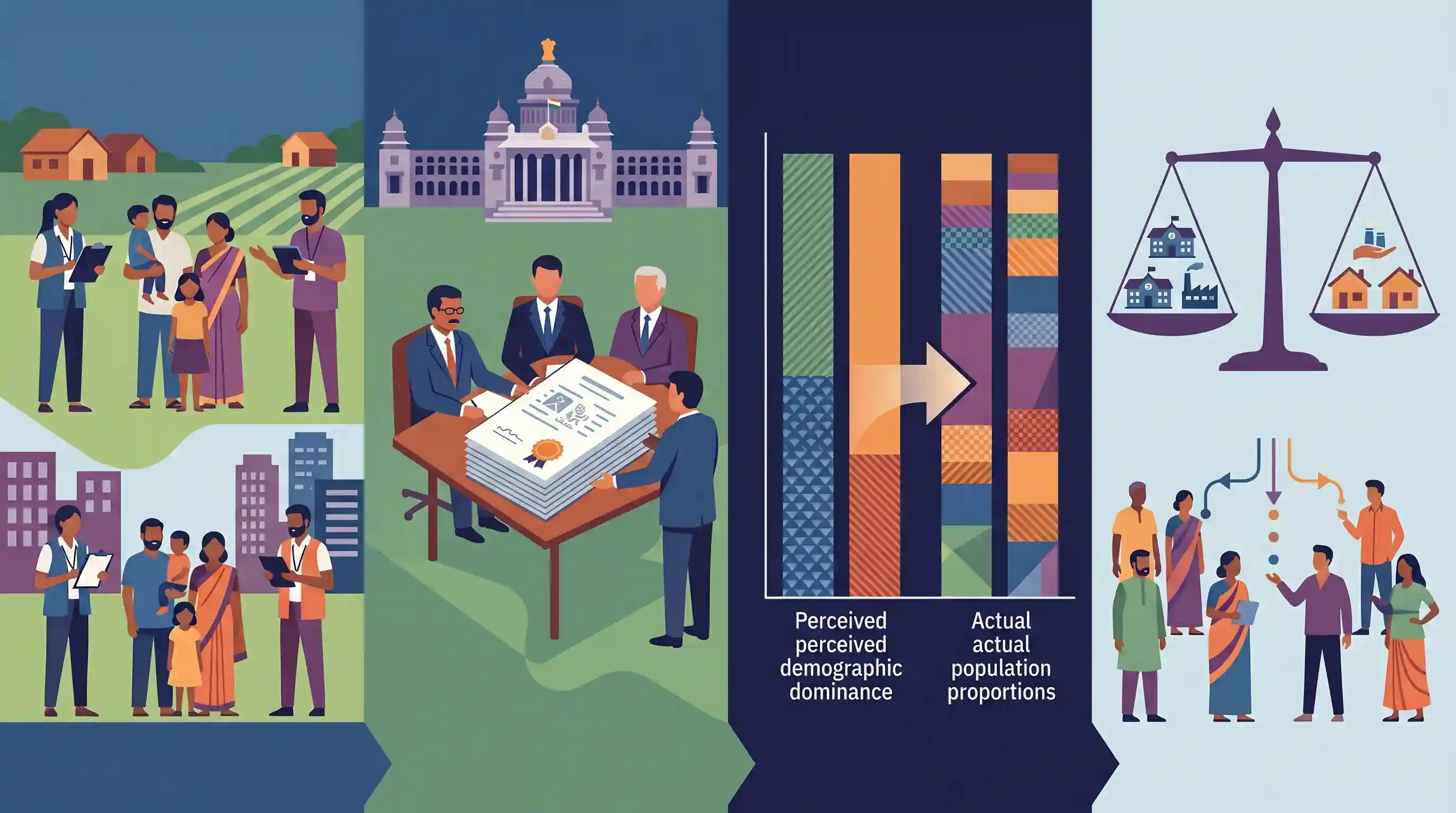
The Karnataka government is expected to receive the long-pending socio-economic and educational survey report, commonly known as the caste survey, by the end of April. According to Backward Classes Welfare Minister Shivaraj Tangadagi, the report, originally commissioned during Chief Minister Siddaramaiah's previous term in 2015, will soon be submitted by the state Backward Classes Commission. The findings are highly anticipated and politically sensitive, as they could reveal actual population proportions that challenge the perceived demographic dominance of major communities like Vokkaligas and Lingayats. This empirical data is poised to significantly impact ongoing debates regarding reservation policies and equitable distribution of state resources.
Key Points
- The Karnataka State Commission for Backward Classes is expected to submit the state's socio-economic and educational survey (caste survey) report by the end of April.
- Originally commissioned in 2015 during CM Siddaramaiah's earlier tenure, the survey aims to gather empirical data on the socio-economic and educational backwardness of various communities.
- The survey's release is politically sensitive, as the data might challenge the long-held demographic supremacy of dominant castes such as the Lingayats and Vokkaligas.
- The empirical findings are expected to fuel debates on proportional representation, reservation quotas, and the distribution of welfare benefits among marginalized classes.
Important Terms
Socio-Economic and Educational Survey (Caste Survey)

A comprehensive 2015 state-wide data collection exercise in Karnataka assessing demographic, economic, and educational status across castes to inform affirmative action and resource allocation.
UPSC context
GS II: Social Justice/Governance. Vital for understanding data-driven policy-making and the debate over empirical evidence for reservation quotas.
Karnataka State Commission for Backward Classes
A statutory body established under the 1995 Act to investigate the conditions of backward classes and recommend inclusions or exclusions in reservation lists.
UPSC context
GS II: Statutory and Regulatory Bodies. Tests knowledge of institutions responsible for safeguarding the interests of marginalized sections.
Article 340
Empowers the President to appoint a commission to investigate conditions of socially and educationally backward classes and recommend steps for their advancement.
UPSC context
GS II: Constitutional Provisions. Fundamental to the legal framework for identifying and uplifting Other Backward Classes (OBCs).
Indra Sawhney vs Union of India (1992)
Landmark 1992 Supreme Court judgment upholding 27% OBC reservation while mandating a 50% quota ceiling and the 'creamy layer' exclusion.
UPSC context
GS II: Judiciary/Social Justice. The cornerstone of Indian reservation jurisprudence, defining the legal limits of affirmative action.
Quantifiable Data
Empirical evidence regarding a community's backwardness and representation, legally required by courts to justify reservation policies or exceed the 50% cap.
UPSC context
GS II: Governance. Crucial for understanding the 'M. Nagaraj' and 'Jarnail Singh' criteria for maintaining administrative efficiency alongside social justice.
Prelims Trap
"The National Commission for Backward Classes notifies the list of backward classes for both the Central and State governments."
The 105th Constitutional Amendment (2021) explicitly restored the legislative competence of State Governments to identify, notify, and maintain their own state lists of SEBCs, independent of the NCBC.
Static Concepts Connected
What are the key constitutional provisions for Socially and Educationally Backward Classes (SEBCs)?
- Articles 15(4) & 16(4): Empower the State to make special provisions and reservations in educational institutions and public employment for SEBCs.
- Article 340: Authorizes the President to appoint a commission to investigate the conditions of socially and educationally backward classes (e.g., Mandal Commission).
- Articles 338B & 342A: Inserted by the 102nd CAA, this gave constitutional status to the NCBC and empowered the President to notify the Central SEBC list.
What is the judicial mandate regarding reservation limits and empirical data?
- Indra Sawhney (1992): Established a 50% ceiling on total reservations, allowing breaches only in extraordinary situations.
- Quantifiable Data: State policies altering quotas or breaching the 50% limit must be justified by robust empirical data proving backwardness and inadequate representation.
- Sub-classification: States can sub-classify backward classes (and SC/STs) to ensure equitable distribution of benefits, provided the sub-classification rests on empirical evidence.
Cross-Topic Patterns
Union Census vs. State Socio-Economic Surveys
Under the Census Act 1948, the Union enumerates only SCs/STs. States navigate around this by conducting "socio-economic surveys" to collect the quantifiable empirical data needed to legally defend SEBC quotas.
Dominant Castes & Agrarian Economy
M.N. Srinivas' sociological concept of 'Dominant Caste' explains why land-owning communities with numerical strength (e.g., Vokkaligas, Marathas, Patidars) heavily influence state-level political economy and drive modern reservation agitations.

The 105th CAA restoring state SEBC lists, combined with state caste surveys and SC rulings on quantifiable data, is prime for 2026 Prelims.
Linked PYQs · 4
Linked PYQs · 4
- 2022MainsGS2
Discuss the role of the National Commission for Backward Classes in the wake of its transformation from a statutory body to a constitutional body.
- 2018MainsGS1
Caste system is assuming new identities and associational forms. Hence, caste system cannot be eradicated in India." Comment.
- 2020MainsGS1
Has caste lost its relevance in understanding the multi-cultural Indian Society? Elaborate your answer with illustrations.
- 2023PrelimsGS1
Consider the following organizations/bodies in India: 1. The National Commission for Backward Classes 2. The National Human Rights Commission 3. The National Law Commission 4. The National Consumer Disputes Redressal Commission How many of the above are constitutional bodies?
