Karnataka Plans Engineering Seat Cap to Address Unemployment Fears
Source:Indian Express ↗
Why It Matters
It highlights the challenge of structural unemployment, skill mismatch, and the rapid commercialization of higher technical education. It points to a critical governance issue—the mandate of regulatory bodies like AICTE versus state jurisdiction in managing educational quality and matching market demand with demographic dividends.
Summary
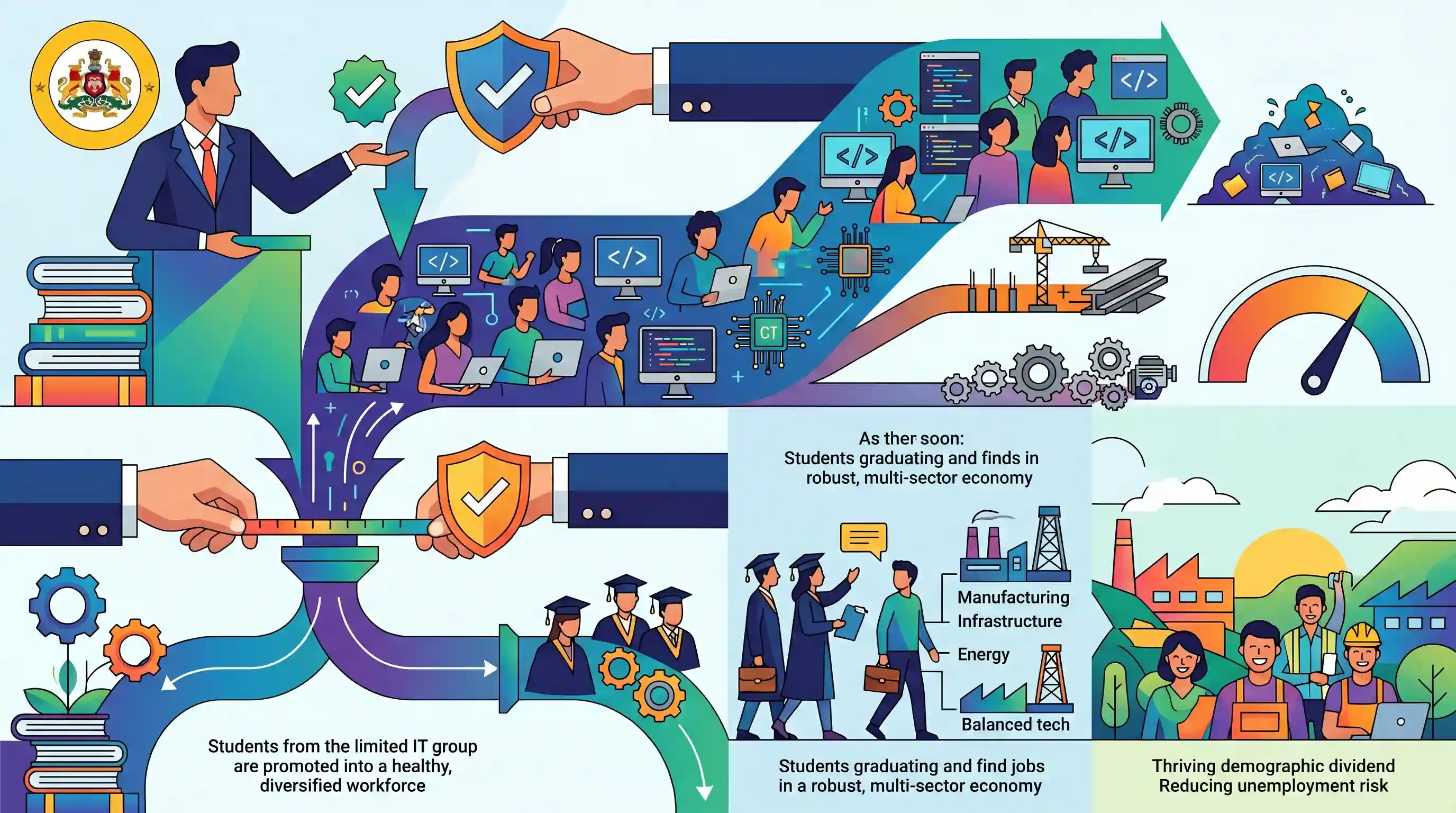
The Karnataka government has announced plans to cap engineering seat intakes for computer science and related fields, responding to concerns over structural imbalances in technical education and future unemployment. Currently, IT-related branches account for over 64% of the state's engineering seats, drawing focus and resources away from essential core engineering streams like civil and mechanical. Seeking to regulate this trend driven largely by private universities, the state approached the AICTE, which permitted local-level interventions. Similar regulations have been implemented in Telangana and upheld by the Supreme Court. The move aims to prevent skill over-saturation in a volatile tech job market and maintain educational quality.
Key Points
- The Karnataka government plans to cap seats for computer science and IT-related engineering courses to prevent an impending unemployment crisis caused by oversupply.
- Currently, over 64% of the 1.25 lakh engineering seats in Karnataka are dedicated to computer science and allied fields like AI, cyber security, and data science.
- Core engineering branches, including mechanical and civil engineering, are being marginalized or shut down by colleges to allocate more seats to high-demand IT courses.
- The All India Council for Technical Education (AICTE) clarified it does not have the mandate to regulate intake caps but has allowed states like Karnataka and Telangana to do so locally to ensure balanced educational growth.
- Private universities exploiting their autonomy to ramp up lucrative CS seats without sufficient infrastructure or faculty have prompted the state government to issue regulatory notices and enforce compliance.
Important Terms
All India Council for Technical Education (AICTE)

A national-level statutory body under the Ministry of Education responsible for planning, formulating standards, and maintaining quality in technical and management education across India.
UPSC context
GS Paper II: Statutory Bodies. Tests understanding of regulatory governance and standards in higher/technical education.
Supreme Court
The highest judicial forum in India; here, it serves as a final authority on the state's power to regulate educational intake to ensure market balance and prevent graduate unemployment.
UPSC context
GS Paper II: Judiciary/Governance. Tests knowledge of judicial review over executive policy decisions regarding education.
Structural Unemployment
A form of unemployment caused by a mismatch between the skills workers possess and the skills required by the current labor market, often due to technological shifts or over-saturation.
UPSC context
GS Paper III: Economy/Employment. Tests understanding of labor market dynamics and human capital development.
Concurrent List
A list in the Seventh Schedule of the Indian Constitution containing subjects where both Central and State governments have the power to legislate, including education.
UPSC context
GS Paper II: Federalism. Tests understanding of legislative power distribution between Union and States.
Statutory Body
A non-constitutional body established by an Act of Parliament or State Legislature to perform specific regulatory or administrative functions under the law.
UPSC context
GS Paper II: Governance. Differentiates between constitutional, statutory, and executive bodies.
Demographic Dividend
The economic growth potential resulting from shifts in a population's age structure, particularly when the working-age population is larger than the non-working-age population.
UPSC context
GS Paper III: Economy/Social Justice. Tests ability to link education policy with long-term economic stability.
Prelims Trap
AICTE has the exclusive statutory mandate to cap seat intakes for specific engineering branches across all states.
AICTE sets baseline infrastructure/faculty standards for approval but does not cap specific branch intakes nationally. States have the legal authority to impose local seat-intake caps.
Static Concepts Connected
What is the statutory mandate of AICTE in India?
- Statutory Status: Established in 1945 as an advisory body, it received statutory status in 1987 via an Act of Parliament.
- Core Functions: Responsible for planning, coordinated development, and maintaining norms and standards for the technical education system in India.
- Seat Cap Regulation: While it approves institutional capacity based on infrastructure, it allows state governments to assess regional employability to enforce local caps.
What is structural unemployment in the Indian context?
- Definition: A form of unemployment caused by a mismatch between the skills workers possess and the skills demanded by employers.
- Indian Example: Mass production of IT graduates exceeding market absorption capacity, while traditional manufacturing or core engineering sectors face talent shortages.
- Economic Impact: It diminishes India's demographic dividend by creating a pool of over-qualified but unemployable youth, leading to underemployment and credential inflation.
Cross-Topic Patterns
Education federalism and private autonomy
The balance between a private university's academic autonomy (UGC norms) and the state's power to intervene based on macroeconomic employability grounds (the 'Telangana model') highlights evolving education federalism.
Core engineering shortage vs PLI schemes
India's push for self-reliance via PLI schemes and the Semiconductor Mission requires core mechanical and electrical engineers. The systemic shift toward IT threatens the physical manufacturing talent pool.

AICTE's regulatory mandate vs State powers to cap private university seats is a high-probability Prelims polity trap for 2026.
Linked PYQs · 3
Linked PYQs · 3
- 2023MainsGS3
Most of the unemployment in India is structural in nature. Examine the methodology adopted to compute unemployment in the country and suggest improvements.
- 2014MainsGS3
While we flaunt India's demographic dividend, we ignore the dropping rates of employability. What are we missing while doing so? Where will the jobs that India desperately needs come from? Explain.
- 2015MainsGS2
The quality of higher education in India requires major improvements to make it internationally competitive. Do you think that the entry of foreign educational institutions would help improve the quality of higher and technical education in the country? Discuss.
