Karnataka guarantee schemes and fiscal sustainability analysis
Source:Indian Express ↗
Why It Matters
The debate over 'freebies' versus 'welfare' is a recurring theme in UPSC. These empirical evaluations provide concrete data on both the tangible benefits of Direct Benefit Transfers (DBT) (like women's empowerment and nutritional gains) and their macroeconomic downsides (fiscal burden, delayed workforce entry), offering perfect fodder for nuanced Mains answers in GS2 and GS3.
Summary
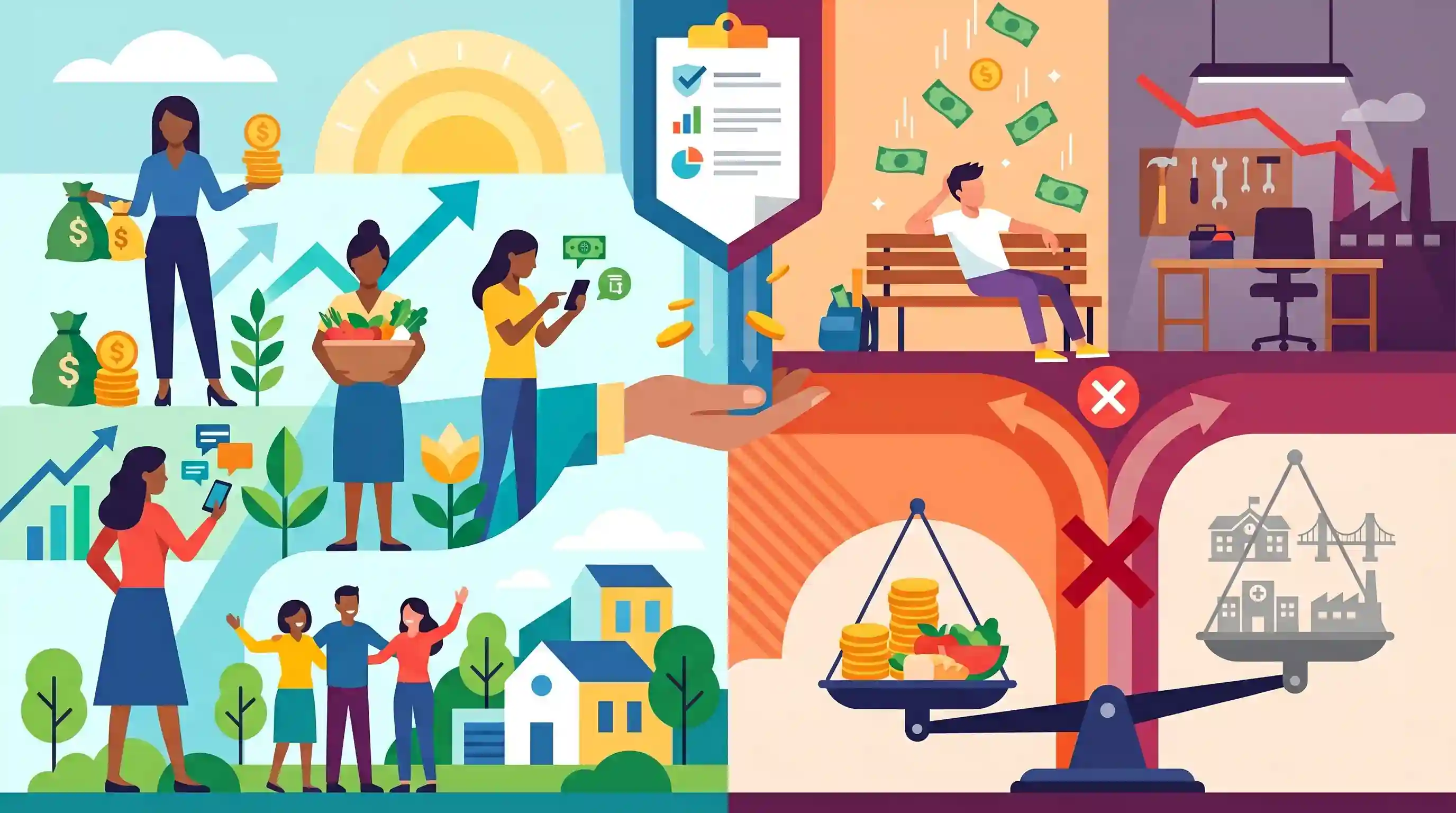
Multiple research studies assessing Karnataka's five guarantee schemes have lauded their positive social impacts, particularly regarding women's financial inclusion and consumption, while simultaneously flagging significant concerns about fiscal opportunity costs and potential disincentives to youth labour force participation.
Key Points
- Karnataka's five guarantee schemes have a total budgetary allocation of around Rs 51,000 crore for 2025-26.
- Researchers warn of the massive opportunity cost of these schemes, noting that welfare cash transfers are not a substitute for comprehensive economic growth and public goods investment.
- The Yuva Nidhi unemployment allowance scheme may have unintended negative effects on youth labour force participation by increasing graduates' reservation wages and delaying entry into the workforce.
- The Gruha Lakshmi scheme significantly improved women's financial inclusion, as 99% of female beneficiaries gained full control over the funds, using them for household necessities and strengthening their banking integration.
- Studies recommend shifting the narrative of these programs away from the pejorative 'freebies' label, instead viewing them as social security entitlements and a 'basic income for unpaid household labour'.
Important Terms
Gruha Lakshmi

A Direct Benefit Transfer (DBT) scheme providing ₹2,000 monthly to women heads of households in Karnataka to enhance financial autonomy and alleviate household poverty.
UPSC context
GS Paper II: Welfare schemes for vulnerable sections; GS Paper III: Inclusive growth and women's empowerment.
Gruha Jyothi
A welfare initiative providing free electricity up to 200 units per month to domestic consumers in Karnataka, aimed at reducing living costs for low-income families.
UPSC context
GS Paper II: Government policies and interventions; GS Paper III: Energy security and infrastructure.
Anna Bhagya
A food security scheme providing 10kg of free rice (5kg additional to the central allocation) to BPL and Priority Household (PHH) ration cardholders.
UPSC context
GS Paper II: Issues relating to poverty and hunger; GS Paper III: Public Distribution System (PDS).
Shakthi
A scheme providing free travel for women and transgender persons in non-premium state-run buses across Karnataka to promote mobility and workforce participation.
UPSC context
GS Paper II: Mechanisms, laws, institutions and bodies constituted for the protection and betterment of vulnerable sections.
Yuva Nidhi
An unemployment allowance scheme providing ₹3,000 monthly for graduates and ₹1,500 for diploma holders who remain unemployed for six months after completing their education.
UPSC context
GS Paper III: Indian Economy and issues relating to planning, mobilization of resources, growth, and employment.
Fiscal Opportunity Cost
The value of alternative developmental investments (e.g., infrastructure or healthcare) that are foregone when a government allocates limited budget resources toward welfare subsidies or "guarantees."
UPSC context
GS Paper III: Government Budgeting; fiscal consolidation vs. social spending.
Lokniti-CSDS
A premier Indian research institute specializing in election studies and political sociology, often partnering with global academic institutions to evaluate government policies.
UPSC context
GS Paper II: Important aspects of governance, transparency and accountability.
Prelims Trap
Karnataka's guarantee schemes represent the state's transition to a Universal Basic Income (UBI) model.
These schemes are targeted welfare transfers with specific eligibility criteria (e.g., female household heads, unemployed graduates). They are neither universal nor unconditional.
Static Concepts Connected
What is a 'reservation wage' and how do unemployment benefits affect it?
- Definition: The absolute lowest wage threshold at which an unemployed worker is willing to accept a specific job offer.
- Benefit impact: Unemployment allowances like Yuva Nidhi can artificially increase this wage, delaying workforce entry as graduates hold out for better-paying jobs.
- Voluntary unemployment: This dynamic exacerbates voluntary unemployment, as available market wages fail to meet the newly raised expectations of the youth.
What is the macroeconomic 'opportunity cost' of large-scale state welfare transfers?
- Revenue inflation: Such schemes drastically increase a state's committed revenue expenditure, crowding out available funds within the annual budget.
- Asset creation loss: The core opportunity cost is the foregone capital expenditure on public goods like infrastructure and schools, which drive long-term growth.
- Fiscal deficit risks: Heavy reliance on unbudgeted transfers threatens state compliance with FRBM Act targets, forcing higher market borrowings and debt.
Cross-Topic Patterns
Monetizing unpaid domestic labor
GS-1 Society meets GS-3 Economy: Cash transfers to female household heads act as an implicit basic income, recognizing and compensating women for the disproportionate burden of unpaid care work.
Freebies vs. Directive Principles
Connects Article 41 (Right to public assistance) with RBI's warnings on state finances. The Supreme Court frequently debates the line between electoral freebies and legitimate socio-economic welfare.

Expect a GS-3 Mains question contrasting the social safety net benefits of state 'guarantees' with their fiscal opportunity costs.
Linked PYQs · 4
Linked PYQs · 4
- 2022MainsGS2
Besides the welfare schemes, India needs deft management of inflation and unemployment to serve the poor and the underprivileged sections of the society. Discuss.
- 2019MainsGS2
Performance of welfare schemes that are implemented for vulnerable sections is not so effective due to absence of their awareness and active involvement at all stages of policy process. Discuss.
- 2024MainsGS1
Distinguish between gender equality, gender equity and women's empowerment. Why is it important to take gender concerns into account in programme design and implementation?
- 2014MainsGS3
While we flaunt India's demographic dividend, we ignore the dropping rates of employability. What are we missing while doing so? Where will the jobs that India desperately needs come from? Explain.
