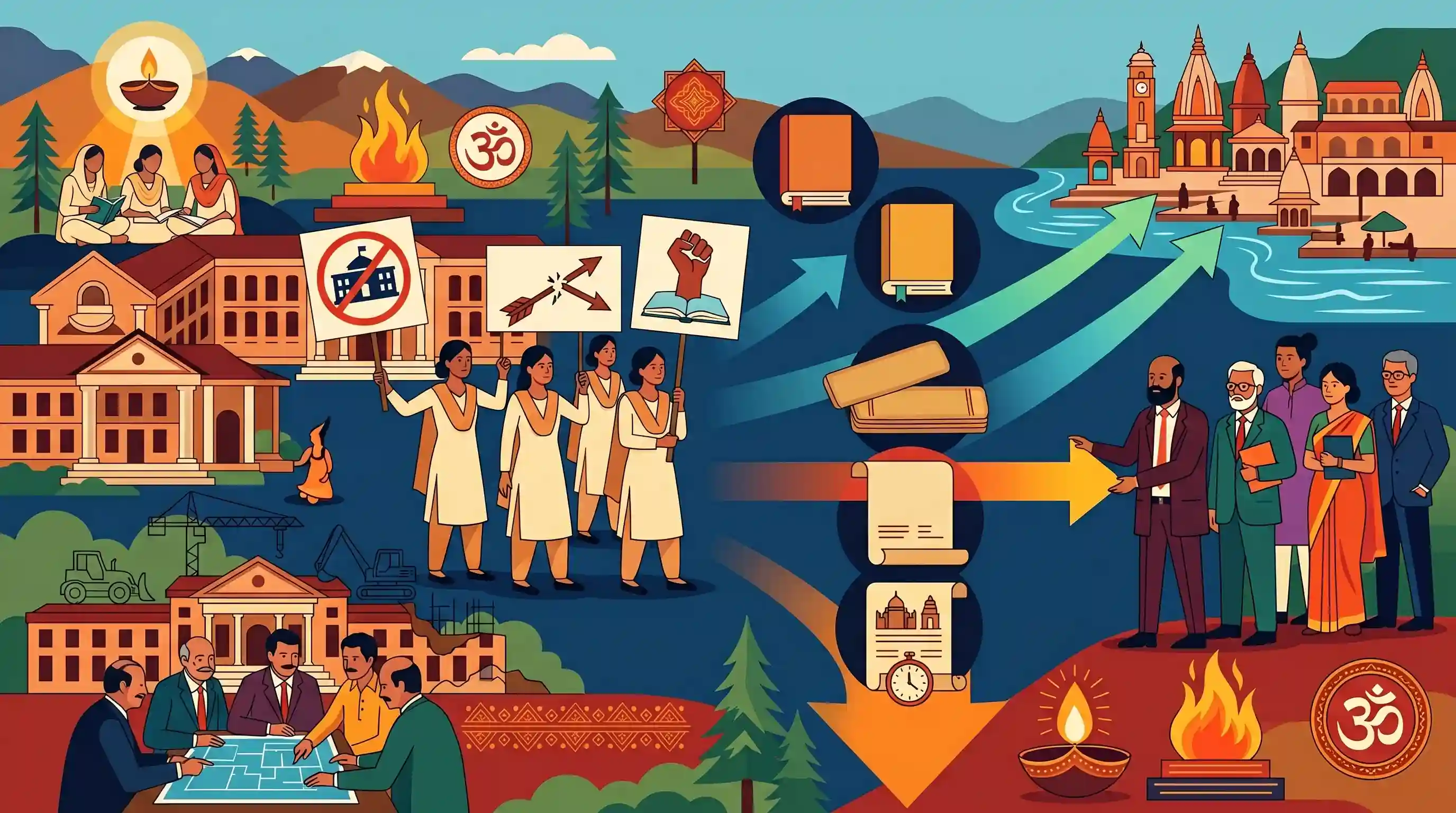
Kanya Gurukul students protest department relocation to Haridwar
Source:garhwalpost ↗
Why It Matters
The protest highlights the historic educational institutions of Uttarakhand (like Gurukul Kangri University and Kanya Gurukul) that were founded as part of the Arya Samaj movement to promote ancient Vedic and women's education. Understanding their history, founders (Swami Shraddhanand, Acharya Ramdev), and locations is highly relevant for UKPSC PCS Prelims history and culture questions.
Summary
Students of Kanya Gurukul, Dehradun, are actively protesting a decision by the Gurukul Kangri University management to relocate four major departments (Hindi, English, Sanskrit, and History) to the women's campus in Haridwar. The students claim that this relocation is a conspiracy to dismantle the century-old campus in Dehradun—traditionally dedicated to women's education—and use its land for private interests, compromising the institutional legacy and the reputation of the Arya Samaj.
Key Points
- Students of Kanya Gurukul in Dehradun launched protests against the decision of Gurukul Kangri University management to shift four key departments (Sanskrit, Hindi, English, and History) from the Dehradun campus to the Haridwar women's campus.
- The protesting students submitted a memorandum alleging that the relocation is part of a plan to shut down the historic Dehradun campus and use its highly valuable land for private gains, which would damage the legacy of Arya Samaj founders.
- The VC of Gurukul Kangri University, Prof. Dr. Pratibha Mehta Luthra, indicated the plans during her visit to Dehradun, triggering the protests.
- Kanya Gurukul Dehradun has a legacy spanning over a century (originally founded in 1923 by Acharya Ramdev, an associate of Swami Shraddhanand) dedicated specifically to women's higher education under the Vedic Gurukul guidelines.
Important Terms
Arya Samaj

A Hindu reform movement founded by Swami Dayananda Saraswati in 1875, promoting Vedic values, advocating women’s education and social equality, and rejecting idolatry and caste-based discrimination.
UPSC context
GS Paper I (Modern History), testing knowledge of 19th-century socio-religious reform movements and their impact on education and society.
Gurukul Kangri University
A government-funded deemed university in Haridwar, Uttarakhand, founded in 1902 by Swami Shraddhanand to revive the ancient Indian gurukula system as an indigenous alternative to British colonial education.
UPSC context
GS Paper I (Modern History), testing socio-religious reform initiatives, nationalist education models, and colonial-era institutional history.
Kanya Gurukul Dehradun
Established in 1922 by Acharya Ramdev under Arya Samaj principles, this institution was a pioneering center for women's education, later recognized as the second campus of Gurukul Kangri University in 1986.
UPSC context
GS Paper I (Modern Indian History / Education), testing indigenous efforts toward female literacy and social reform in the colonial era.
Prelims Trap
Swami Shraddhanand led the 'College Party' faction of Arya Samaj, which advocated for Western-style, English-medium education.
Aspirants often confuse the factions, assuming the 'Mahatma' faction led by Shraddhanand favored English-medium education to modernise, when in fact they championed traditional Gurukul Sanskrit education.
Static Concepts Connected
What caused the 1893 split in the Arya Samaj and what were its educational outcomes?
- The Core Dispute: Triggered by debates over the school curriculum (Sanskrit/Vedas vs. English/Western sciences) and dietary codes (vegetarianism vs. non-vegetarianism).
- College/DAV Faction: Led by Lala Hansraj and Lala Lajpat Rai; they established the Dayanand Anglo-Vedic (DAV) schools to synthesize Western science with Indian culture.
- Gurukul/Mahatma Faction: Led by Swami Shraddhanand; they advocated vegetarianism and traditional Sanskrit-based Vedic education, founding the Gurukul Kangri in 1902.
What was the significance of the Dola-Palki movement led by Jayanand Bharti?
- The Social Issue: A civil rights struggle in Garhwal against discriminatory customs that barred lower-caste (Shilpkar) brides and grooms from using palanquins.
- Leadership: Led by Jayanand Bharti, a prominent Arya Samajist and disciple of Swami Shraddhanand, during the 1920s and 1930s.
- Historical Impact: Successfully secured equal social rights for lower castes, linking regional hill reforms with the broader national anti-untouchability campaign.
Cross-Topic Patterns
Vedic revivalism vs. colonial modern education
Analyzes how the Gurukul movement constructed a nationalistic, non-Western curriculum while simultaneously promoting women's higher education through regional institutions.
Social hierarchy & Dalit assertion in hills
Connects Arya Samaj's reformist agenda in northern India to Uttarakhand's Dola Palki movement, showcasing the intersection of caste reforms and the national freedom struggle.

UPSC 2026 may test the 1893 Arya Samaj ideological split, mapping DAV versus Gurukul Kangri leadership and educational philosophies.
Linked PYQs · 3
Linked PYQs · 3
- 2025UKPSC_PRELIMSGS1
Who founded a branch of 'HOME-RULE League' at Dehradun in 1918 ?
- 2025UKPSC_PRELIMSGS1
Which of the following is incorrectly matched about Central Government Institutes located in Uttarakhand?
- 2024UKPSC_PRELIMSGS1
As per census 2011, which of the following district of Uttarakhand had lowest female literacy rate ?
