Western Uttar Pradesh Traffic Regulations for Kanwar Yatra
Source:The Hindu ↗
Why It Matters
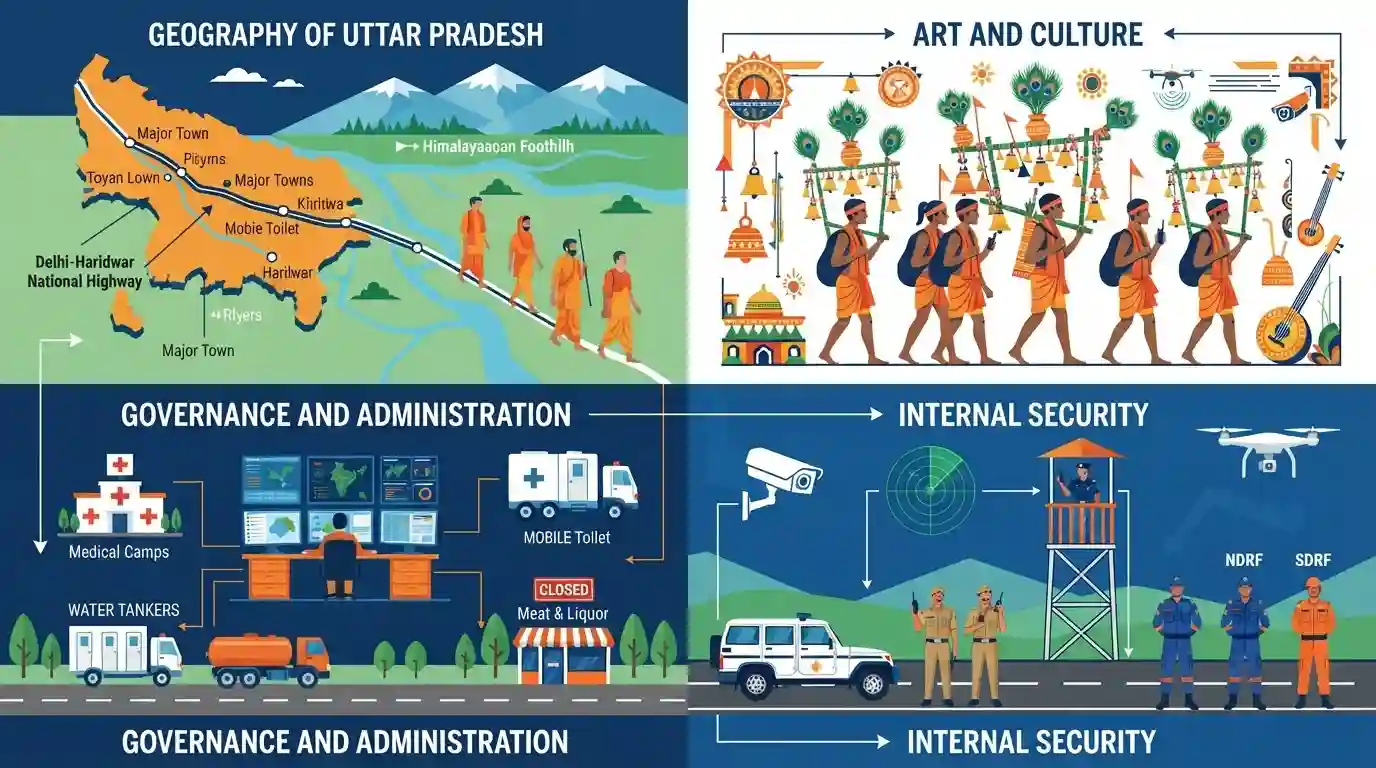
The Kanwar Yatra is one of the largest annual religious gatherings in India. Understanding its management highlights the intersection of cultural practices with state governance, internal security, disaster management, and infrastructure utilization (e.g., national highways, expressways, and canals) in Uttar Pradesh.
Summary
The Uttar Pradesh government has announced comprehensive traffic, security, and administrative arrangements for the upcoming Kanwar Yatra in Western Uttar Pradesh. Phased traffic restrictions will be enforced on major routes like the Delhi-Haridwar National Highway, with specific lanes dedicated to the pilgrims. Security will be tightly monitored using AI, CCTV cameras, and specialized forces including the NDRF and SDRF. Additionally, medical camps will be set up, and meat and liquor shops along the pilgrimage routes will be closed to ensure a smooth and peaceful event.
Key Points
- Phased traffic restrictions will be imposed on the Delhi-Haridwar National Highway from July 22 to August 2 to facilitate the annual Kanwar Yatra in Western Uttar Pradesh.
- Devotees fetching holy water from Haridwar will use the left lane of NH-58 and the Ganga canal road, while heavy vehicles will face complete bans or diversions.
- Advanced security protocols include 1,326 CCTV cameras, AI-enabled surveillance, and deployment of NDRF, SDRF, PAC, and Anti-Terrorist Squads along the route.
- Extensive administrative arrangements include over 2,600 medical camps, 400+ ambulances, temporary suspension of liquor and meat sales along the route, and anti-venom availability.
Important Terms
NDRF (National Disaster Response Force)

The National Disaster Response Force (NDRF) is India's specialized, multi-disciplinary paramilitary force, raised under the Disaster Management Act of 2005 to provide rapid, expert response to natural and man-made disasters.
UPSC context
GS-3 Disaster Management. Tests understanding of India's tiered disaster response architecture and the statutory backing of emergency forces.
SDRF (State Disaster Response Force)
The State Disaster Response Force (SDRF) acts as the state-level operational equivalent to the NDRF, providing specialized, rapid rescue and relief during natural or man-made emergencies within a state's jurisdiction.
UPSC context
GS-3 Disaster Management. Highlights decentralized governance and the role of state agencies as the first responders to crises.
Provincial Armed Constabulary (PAC)
The Provincial Armed Constabulary (PAC) is a specialized armed reserve police force in Uttar Pradesh and other states, deployed during emergencies to maintain public order, control riots, and support civil police.
UPSC context
GS-3 Internal Security. Tests knowledge of state police structures, law and order mechanisms, and crowd management strategies.
Anti-Terrorist Squad (ATS)
The Anti-Terrorist Squad (ATS) is a specialized state police intelligence and tactical unit tasked with surveillance, neutralizing terror modules, and dismantling organized crime syndicates in coordination with central agencies.
UPSC context
GS-3 Internal Security. Examines state-level counter-terrorism capabilities, intelligence gathering, and center-state law enforcement coordination.
Prelims Trap
The Ganga River officially originates and is named 'Ganga' directly from the Gangotri Glacier at Gaumukh.
The river is called Bhagirathi at its source (Gangotri Glacier/Gaumukh) and only acquires the name 'Ganga' downstream of Devprayag after merging with the Alaknanda.
Static Concepts Connected
What are the Panch Prayags of the Alaknanda River and their respective confluences?
- Vishnuprayag: Alaknanda meets Dhauliganga at Vishnuprayag.
- Nandaprayag: Alaknanda meets Nandakini at Nandaprayag.
- Karnaprayag: Alaknanda meets Pindar River at Karnaprayag.
- Rudraprayag: Alaknanda meets Mandakini River at Rudraprayag.
- Devprayag: Alaknanda meets Bhagirathi River to officially form the Ganga River.
How are trade restrictions balanced under Article 19 of the Indian Constitution?
- Article 19(1)(g): Guarantees all citizens the right to practice any profession, or to carry on any occupation, trade, or business.
- Article 19(6): Empowers the State to impose reasonable restrictions on this right in the interests of the general public.
- Judicial Test: Bans must satisfy the test of proportionality, serve a legitimate state interest (like public order/communal harmony), and be temporary in nature.
Cross-Topic Patterns
Crowd Management + NDMA Guidelines
Integrates seasonal religious congregations with GS-3 Disaster Management, focusing on NDMA protocols for crowd control, ICT-led density tracking, and stampede prevention.
Freedom of Trade + Public Order
Connects municipal meat bans along pilgrim routes to constitutional tests of secularism, public order, and Article 19(1)(g) economic liberties.

Panch Prayag confluences combined with Article 19(6) reasonable restrictions on trade during festivals likely for 2026.
Linked PYQs · 4
Linked PYQs · 4
- 2023UPPSC_PRELIMSGS1
Which one of the following place is the confluence of the river Alakhnanda and the Bhagirathi?
- 2023UPPSC_PRELIMSGS1
Which of the following statement is correct? (1) Ram Ganga river joins the Ganga at Kannauj. (2) River Betwa joins the Yamuna near Prayagraj. Select the correct answer using the code given below –
- 2023UPPSC_PRELIMSGS1
Which of the following Scheme/Programme is not the Central Government Programme and it is Uttar Pradesh Government's Programme?
- 2024UPPSC_PRELIMSGS1
Ramganga project's characteristics. Which of the following pairs is not correctly matched?
