Kanwar Yatra solid waste management crisis in Haridwar municipal area
Source:The Hindu ↗
Why It Matters
The article highlights the severe environmental impact of large, unregulated religious gatherings on local ecosystems and municipal infrastructure. It is highly relevant for UKPSC PCS Prelims concerning Uttarakhand-specific environmental challenges, solid waste management policies, and efforts to clean and maintain the River Ganga.
Summary
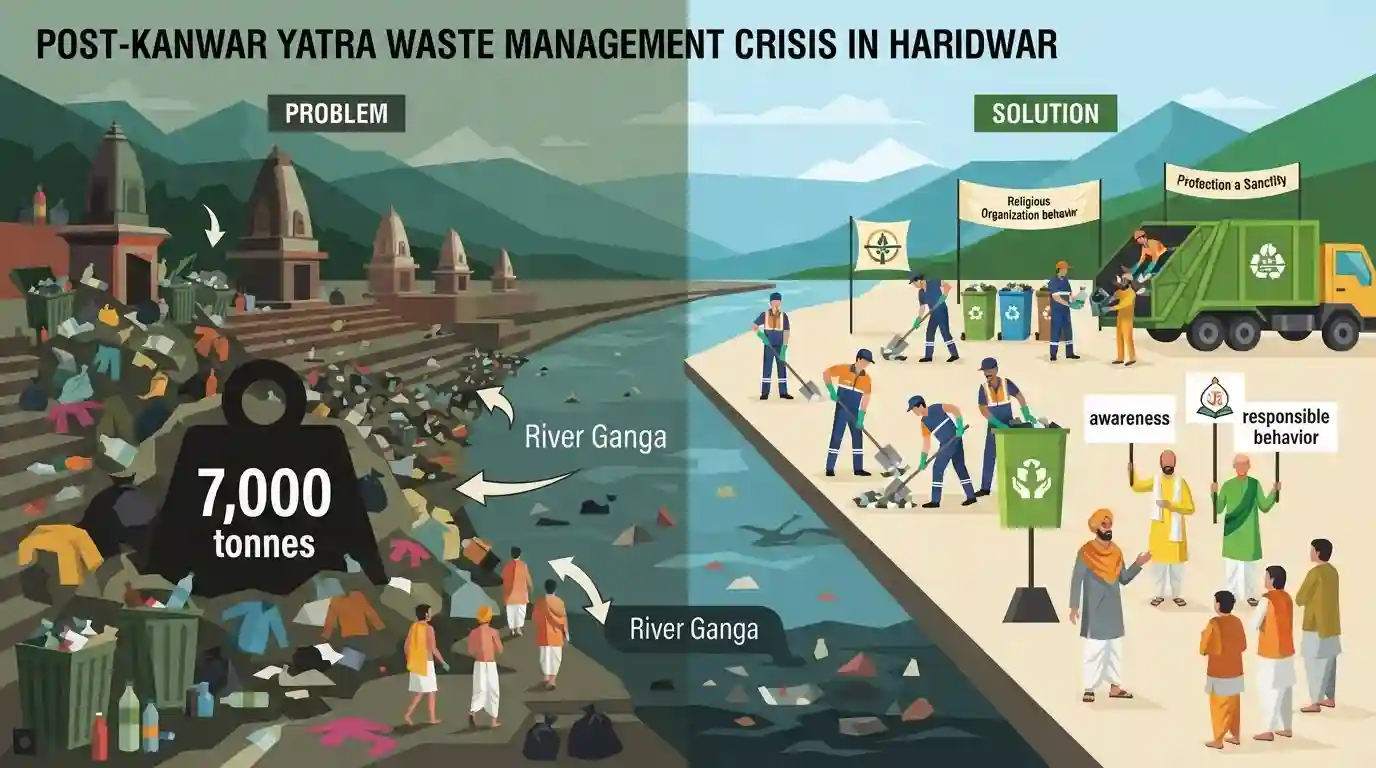
Following the conclusion of the Kanwar Yatra, Haridwar is grappling with an immense solid waste management crisis, with roughly 7,000 tonnes of garbage left behind by pilgrims. The waste includes plastics, discarded clothing, and even urine-filled bottles found at the revered Har Ki Pauri ghat, highlighting significant civic and environmental challenges during large-scale religious gatherings. The local municipal corporation has initiated a massive cleanup effort, while religious organizations plan to launch awareness campaigns to promote responsible pilgrim behavior and protect the sanctity of the River Ganga.
Key Points
- The recently concluded Kanwar Yatra resulted in the accumulation of approximately 7,000 tonnes of waste across Haridwar, severely straining local municipal resources.
- Cleanup operations revealed hazardous and unsanitary waste, including plastic, abandoned clothes, and urine-filled bottles, notably at the sacred Har Ki Pauri ghat.
- The Haridwar Municipal Corporation has deployed hundreds of sanitation workers and multiple vehicles in an extensive post-yatra cleanup drive.
- In response to the pollution and desecration, local religious bodies like the Ganga Sabha have announced plans for awareness campaigns to educate future pilgrims on maintaining the sanctity of the Ganga and religious sites.
Important Terms
Kanwar Yatra

An annual Hindu pilgrimage during the month of Shravan where devotees of Lord Shiva fetch sacred water from the Ganges and carry it over long distances to offer at Shiva temples.
UPSC context
Relevant to GS Paper 1 (Indian Culture) and GS Paper 2 (Governance), highlighting administrative and public order challenges during large-scale religious events.
Haridwar Municipal Corporation
The Urban Local Body governing Haridwar, Uttarakhand. It is responsible for providing essential civic services, including solid waste management, sanitation, and public health, especially challenged during large-scale pilgrim gatherings.
UPSC context
Tests GS Paper 2 (Local Governance) and GS Paper 3 (Solid Waste Management), showcasing the infrastructural strain of mass religious tourism on municipal bodies.
Ganga Sabha
A non-governmental religious organization established to manage rituals, such as the famous Ganga Aarti, and oversee the religious activities and sanctity of various ghats like Har Ki Pauri in Haridwar.
UPSC context
Important for GS Paper 1 (Culture) and GS Paper 2 (Role of Civil Society), highlighting community participation in heritage management and environmental awareness.
Prelims Trap
Under SWM Rules 2016, the local municipal body is solely responsible for managing waste generated during large public or religious gatherings.
SWM Rules 2016 explicitly mandate that event organizers (gatherings >100 persons) must segregate waste at source and ensure its handover to the local body.
Static Concepts Connected
What are the duties of event organizers under Solid Waste Management Rules, 2016?
- Prior Intimation: Must intimate the local authority at least three working days in advance about events gathering more than 100 persons.
- Source Segregation: Must segregate waste at source into dry, wet, and domestic hazardous categories.
- Safe Handover: Responsible for handing over the segregated waste to an authorized waste picker or local municipal body.
What are the core pillars of the Namami Gange Programme?
- Pollution Abatement: Creating sewage treatment capacity and regulating industrial effluent discharge into the river.
- Infrastructure & Cleaning: Improving ghats, ensuring river-surface cleaning (including solid waste removal), and rural sanitation.
- Conservation & Awareness: Promoting afforestation, biodiversity conservation, and public awareness campaigns to foster a people-river connection.
Cross-Topic Patterns
Carrying capacity in Himalayan eco-sensitive zones
The Haridwar waste crisis mirrors the broader debate on defining and enforcing the carrying capacity of ecologically fragile Himalayan regions, previously highlighted by the Joshimath subsidence and Char Dham pilgrim caps.
Namami Gange's 'Jan Ganga' community model
The Ganga Sabha's initiative reflects the 'Jan Ganga' (people-river connect) pillar of the Namami Gange programme, demonstrating that top-down infrastructural cleaning fails without bottom-up community stewardship.

GS3 Mains will likely test the conflict between mass religious tourism, Himalayan carrying capacity, and municipal solid waste management.
Linked PYQs · 1
Linked PYQs · 1
- 2025UKPSC_PRELIMSGS1
Match the items given in Column-I and II : | Column-I | Column-II | |---|---| | A. Biomagnification | 1. Synthesis of ozone | | B. Electrostatic precipitation | 2. Solid waste | | C. Landfills | 3. Concentration build up at successive trophic levels | | D. Stratosphere | 4. Particulate matter | Codes : A B C D
