Kanwar Yatra Safety and Administrative Preparedness Guidelines
Source:freepressjournal ↗
Why It Matters
Demonstrates state administrative strategies for managing massive public gatherings and religious events, involving multi-agency coordination (police, SDRF, health, power, food safety). These are essential aspects of governance and law enforcement relevant to UPPSC state-specific questions.
Summary
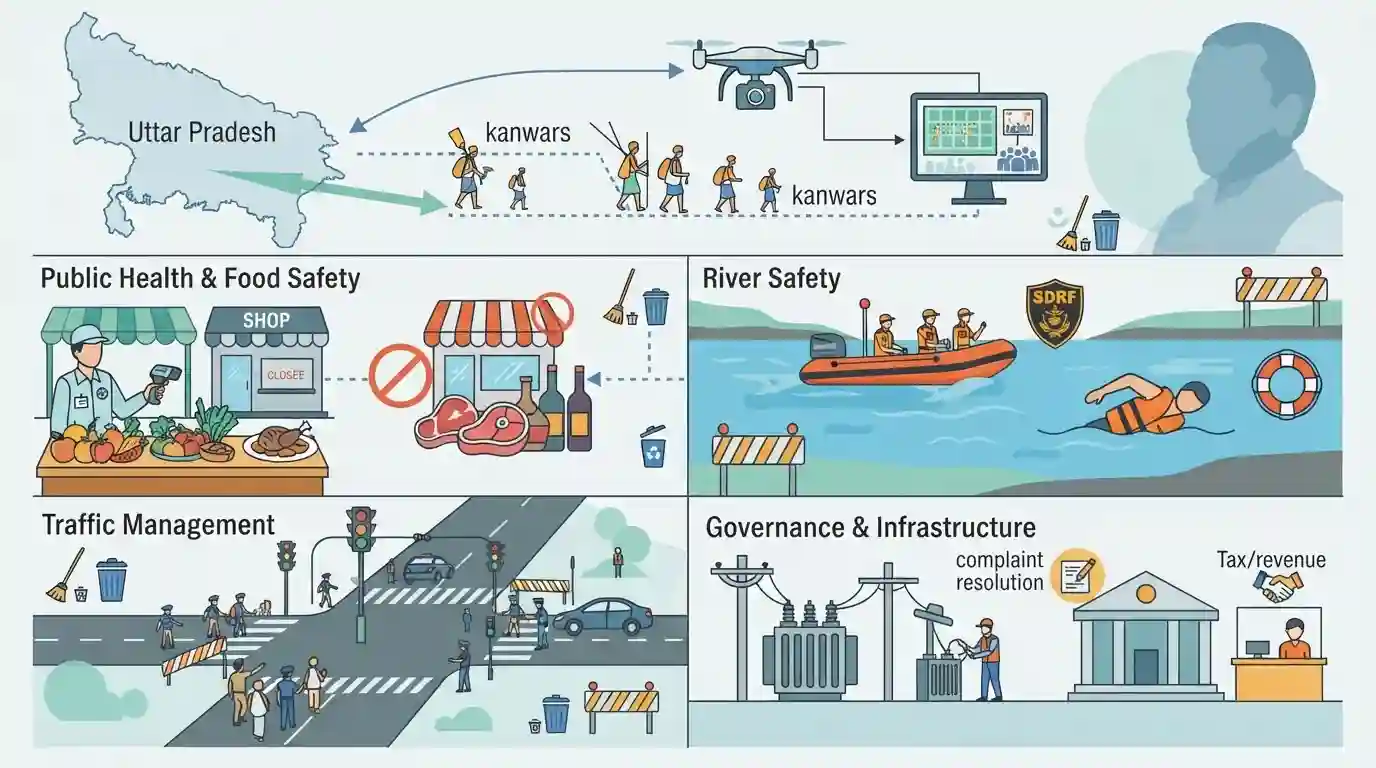
Uttar Pradesh Chief Minister Yogi Adityanath issued detailed guidelines to ensure safety, cleanliness, and order during the upcoming Kanwar Yatra and other Shravan month festivals. The administration has been directed to enforce strict security through drones, prevent food adulteration, close meat and liquor shops along yatra routes, manage traffic smoothly, and deploy the SDRF for river safety. Prompt resolution of power and revenue issues was also emphasized.
Key Points
- UP CM Yogi Adityanath directed officials to prepare comprehensively for the Kanwar Yatra 2026 and other upcoming Shravan month festivals.
- Meat and liquor shops along the Kanwar Yatra routes are to be closed, and DJ sound levels must adhere to prescribed limits.
- Extensive security measures include drone and CCTV surveillance, deployment of anti-Romeo squads, and monitoring of social media to curb rumors and incitement.
- The State Disaster Response Force (SDRF) and water police will patrol rivers to prevent drowning incidents at ghats, alongside establishing health camps along the route.
- Directives also include launching a campaign against food adulteration, preventing overcharging, and expediting the resolution of overbilling issues by power DISCOMs.
Important Terms
State Disaster Response Force (SDRF)

A specialized state-level emergency force in India, trained to carry out rapid search, rescue, and disaster relief operations during natural or man-made calamities, working in coordination with local administration and the NDRF.
UPSC context
GS Paper III (Disaster Management); tests understanding of emergency response mechanisms and state-level administrative preparedness for disaster mitigation.
DISCOMs
Distribution Companies in India’s power sector responsible for buying electricity from generation utilities and delivering it directly to end consumers, while managing billing, metering, and local grid infrastructure.
UPSC context
GS Paper III (Indian Economy & Infrastructure); tests knowledge of power sector reforms, financial viability, and last-mile infrastructure challenges.
Kanwar Yatra
An annual pilgrimage in Northern India during the Hindu calendar month of Shravan, where devotees (Kanwariyas) travel to the Ganges River to carry sacred water back to local Shiva temples.
UPSC context
GS Paper I (Indian Culture); tests awareness of pilgrimage traditions, mythological significance, and regional cultural festivals.
Food Adulteration
The deliberate or accidental contamination of food products with inferior, harmful, or prohibited substances to increase quantity or improve appearance, which compromises safety, public health, and nutritional value.
UPSC context
GS Paper III (Public Health & Food Security); tests understanding of regulatory frameworks, FSSAI standards, and consumer protection laws.
Prelims Trap
State Disaster Response Forces (SDRFs) are central forces directly controlled by the Union Ministry of Home Affairs.
SDRFs are raised, staffed, and governed by individual state governments, though they function under the national Disaster Management Act, 2005 framework.
Static Concepts Connected
How is authority over law, order, and disaster management divided under the Constitution?
- State List primacy: Public order and Police fall under Entries 1 and 2 of List II (State List), making states primarily responsible.
- Disaster Management Framework: Executed under the Disaster Management Act, 2005, invoking Concurrent List entries related to social security and welfare.
What is the legal framework regulating noise pollution in India?
- Statutory rules: Governed by the Noise Pollution (Regulation and Control) Rules, 2000, enacted under the Environment (Protection) Act, 1986.
- Constitutional link: The Supreme Court linked the right to a noise-free environment directly to Article 21 (Right to Life).
Cross-Topic Patterns
Secularism and state-led pilgrimage management
Analyzes how state facilitation of religious events balances Article 25-28 freedom of religion with public order, safety, and health mandates.
Smart policing and crowd disaster mitigation
Connects NDMA guidelines on crowd control to the integration of technology, such as drones and real-time social media monitoring, in state governance.

Mains 2026 may evaluate the constitutional limits of state-mandated route closures and trade restrictions during religious yatras under Article 19.
Linked PYQs · 2
Linked PYQs · 2
- 2021UPPSC_PRELIMSGS1
'Uttar Pradesh Swami Vivekanand Etihasik Paryatan Yatra Yojna 2021' was introduced by the U.P. Government for which of the following people for religious travel ?
- 2018UPPSC_PRELIMSGS1
Which of the following rivers of Uttar Pradesh has been declared a 'Biological Disaster' due to environmental pollution?
