All India Services Rules and Bureaucratic Resignation Procedures
Source:Indian Express ↗
Why It Matters
This case is highly relevant for GS Paper 2 (Role of Civil Services in a Democracy) and GS Paper 4 (Ethics in Public Administration). It provides a real-world case study on the administrative rules surrounding civil servant resignations, the boundaries of their freedom of expression, and the ethical dilemma of protesting state actions versus adhering to service conduct codes.
Summary
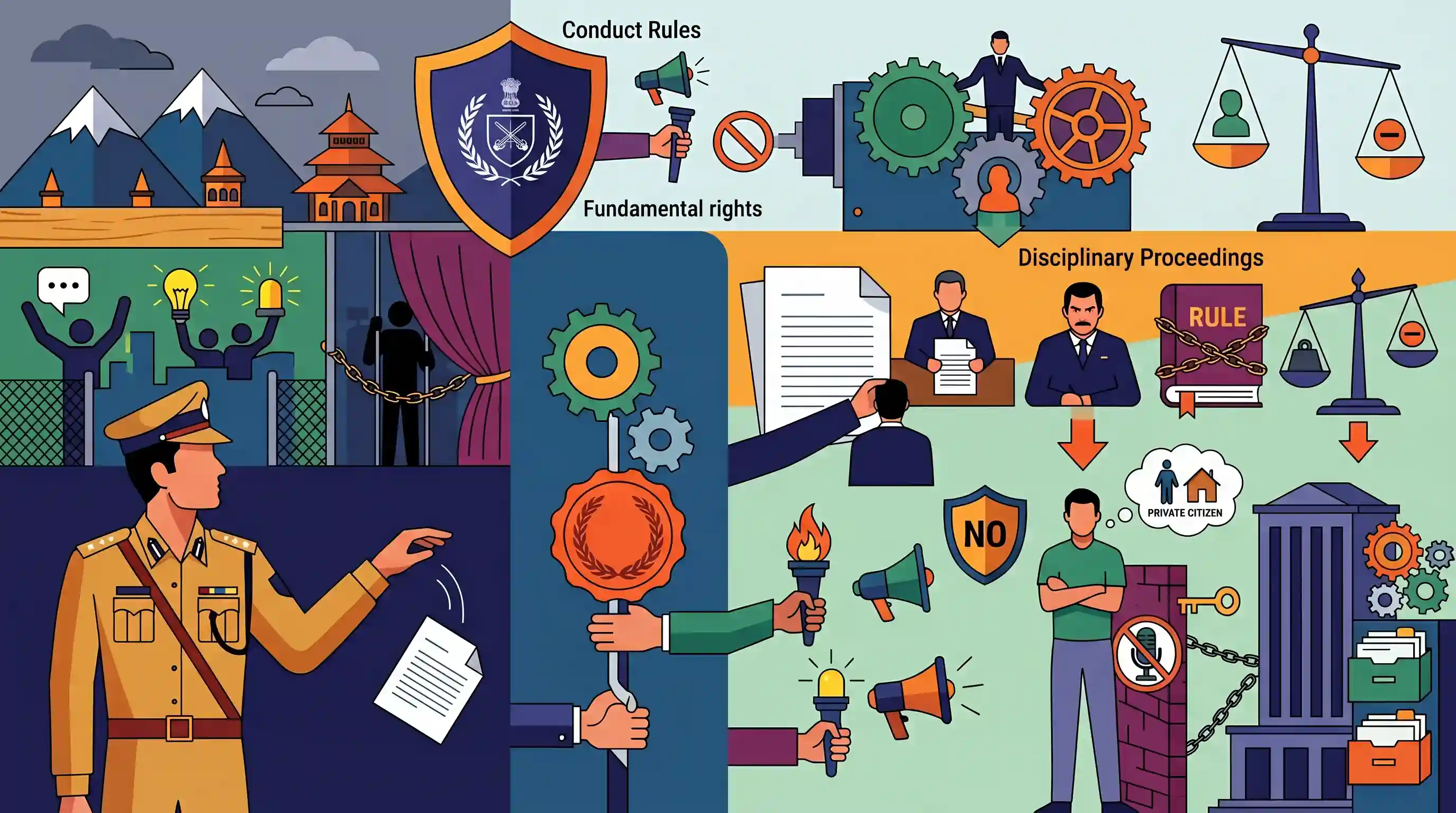
In 2019, Kannan Gopinathan, an AGMUT cadre IAS officer, submitted his resignation to express his protest against the restrictions placed on fundamental rights in Jammu & Kashmir after the abrogation of Article 370. However, the government has stalled his resignation, instead choosing to initiate disciplinary proceedings against him under the All India Services (Discipline and Appeal) Rules, 1969. The rules stipulate that an IAS officer's resignation is not a unilateral right; it requires formal acceptance from the competent authority and can be withheld if disciplinary action is pending or dues remain. Gopinathan has refused to participate in the inquiries, arguing that he is now a private citizen, thereby raising significant questions about civil service conduct rules, individual freedom of expression, and the bureaucratic constraints on resignation.
Key Points
- Kannan Gopinathan, a 2012-batch IAS officer, submitted his resignation in 2019 to protest the denial of fundamental rights in Jammu & Kashmir following the abrogation of Article 370.
- His resignation was not accepted; instead, the government initiated disciplinary proceedings against him for alleged insubordination, dereliction of duty, and unauthorized absence.
- Under the All India Services (Death-cum-Retirement Benefits) Rules, 1958, an officer's resignation is not automatic and must be formally accepted by the competent authority (Central Government/DoPT).
- Resignations can be rejected or stalled if the officer is under suspension, has pending disciplinary proceedings against them, or owes outstanding government dues.
- The situation highlights the complex tension between a civil servant's personal freedom of expression and the strict administrative conduct rules governing bureaucratic discipline.
Important Terms
All India Services (Death-cum-Retirement Benefits) Rules, 1958

Rules governing pension, gratuity, and resignation procedures for IAS, IPS, and IFoS. Rule 5 stipulates that resignation requires formal government acceptance and is not an absolute right of the officer.
UPSC context
GS Paper II (Governance). Tests knowledge of the statutory framework governing civil service resignations and terminal benefits.
All India Services (Discipline and Appeal) Rules, 1969
A statutory framework for disciplinary actions and appeals for All India Service members. It empowers the government to initiate or continue inquiries even after a resignation is submitted.
UPSC context
GS Paper II (Governance). Important for understanding the state’s power to enforce conduct rules and bureaucratic accountability.
AGMUT Cadre
A joint cadre for Arunachal Pradesh, Goa, Mizoram, and Union Territories. Unlike state cadres, its administrative control lies with the Ministry of Home Affairs (MHA) rather than a state government.
UPSC context
GS Paper II (Polity). Relevant for understanding federalism and the unique administrative setup of India’s Union Territories.
Department of Personnel and Training (DoPT)
The nodal agency for personnel management and the cadre-controlling authority for the IAS. It handles service matters including recruitment, training, and the final processing of resignations.
UPSC context
GS Paper II (Governance). Fundamental to understanding the executive structure and regulatory policies of the Indian bureaucracy.
Article 370
A constitutional provision (abrogated in 2019) that granted special autonomy to Jammu and Kashmir. Its removal led to the region's full integration and bifurcation into two Union Territories.
UPSC context
GS Paper II (Constitution). Essential for historical context of Indian federalism and the legal implications of major constitutional changes.
Indian Administrative Service (IAS)
The premier civil service of India, responsible for policy implementation and administration. It is one of the three All India Services established under Article 312 of the Constitution.
UPSC context
GS Paper II (Governance). The core administrative organ of the state; its conduct rules are frequently tested.
Prelims Trap
The State Government is the final competent authority to accept the resignation of an IAS officer serving in its cadre.
While submitted to the State's Chief Secretary, the resignation of an All India Service officer must be formally accepted by the Central Government (DoPT).
Static Concepts Connected
What restrictions apply to a civil servant's freedom of speech under Article 19?
- Conduct Rules: Strictly prohibit public criticism of government policies or actions to maintain bureaucratic anonymity, discipline, and political neutrality.
- Reasonable Restrictions: Subject to Article 19(2), the Supreme Court has upheld conduct rules as legally valid constraints tailored specifically for state employees.
How does resigning differ from taking Voluntary Retirement (VRS) in the civil services?
- Pension Forfeiture: Under the 1958 rules, resignation causes forfeiture of past service and pension benefits, whereas VRS entitles the officer to retain all post-retirement benefits.
- Acceptance Requirement: Neither is an absolute unilateral right; both require formal approval from the competent authority (Central Government) to take effect legally.
Cross-Topic Patterns
Doctrine of Pleasure & Article 311
The stalled resignation highlights the broader Polity theme of Article 310 (Doctrine of Pleasure) and the statutory rules governing the discipline, appeal, and removal of All India Service officers.
GS4: Neutrality vs. Moral Conscience
A classic Ethics syllabus theme: navigating the friction between bureaucratic rules (anonymity, obedience, neutrality) and a civil servant's personal moral conscience regarding constitutional values.

Expect a 2026 Prelims statement differentiating IAS resignation vs VRS rules, and DoPT's final authority over State Government recommendations.
Linked PYQs · 4
Linked PYQs · 4
- 2024MainsGS2
The Doctrine of Democratic Governance makes it necessary that the public perception of the integrity and commitment of civil servants becomes absolutely positive. Discuss.
- 2020MainsGS2
Institutional quality is a crucial driver of economic performance". In this context suggest reforms in Civil Service for strengthening democracy.
- 2022MainsGS4
Discuss the importance of 'Devotion to duty' in public service.
- 2021MainsGS4
Identify five ethical traits on which one can plot the performance of a civil servant. Justify their inclusion in the matrix.
