Himachal Pradesh fuel cess and E-20 impact debate
Source:theprint ↗
Why It Matters
This political dispute highlights two key governance issues relevant to HPAS Prelims: the real-world economic and technical impacts of the Centre's E20 fuel transition, and the fiscal challenges states face (using cesses) to fund welfare and rebuild infrastructure post-disaster.
Summary
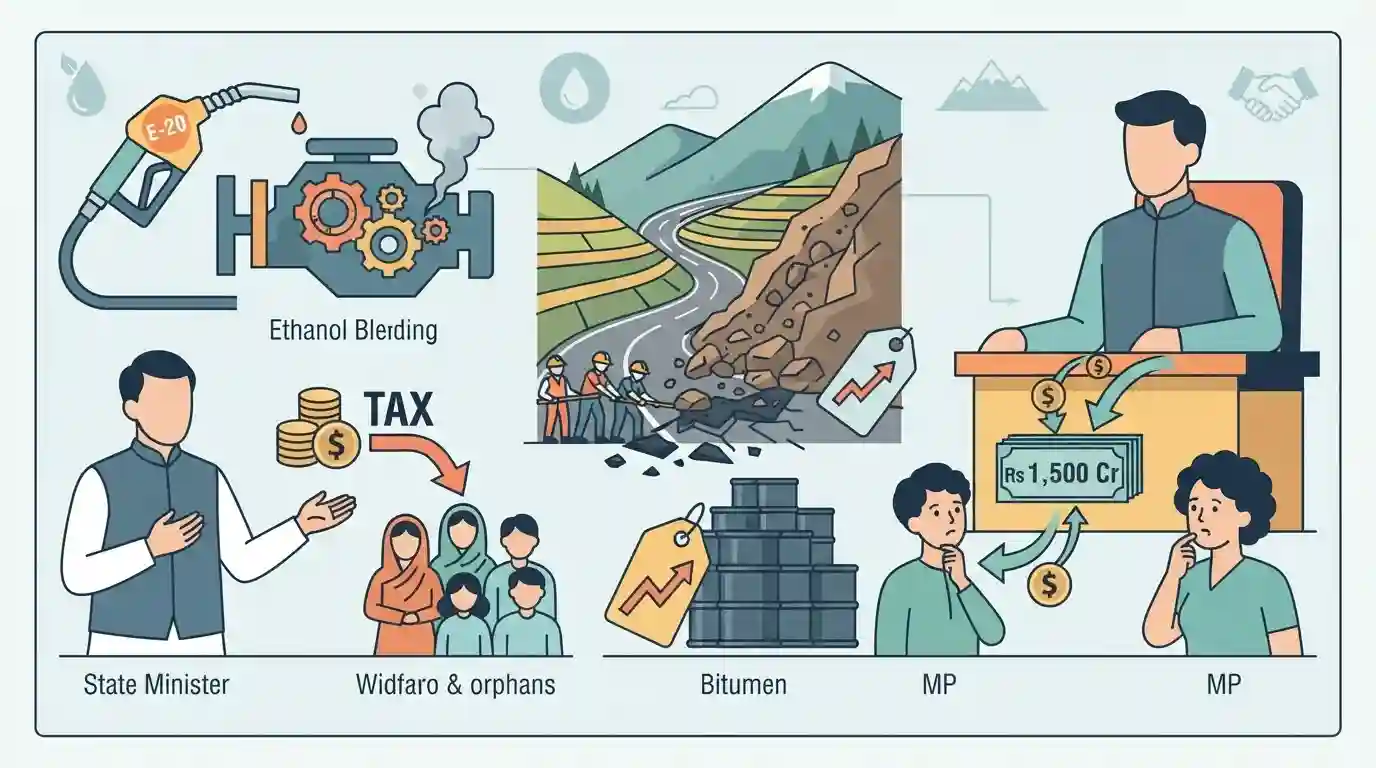
Himachal Pradesh PWD Minister Vikramaditya Singh defended the state's 60-paise fuel cess, aimed at funding welfare for widows and orphans, and challenged Mandi MP Kangana Ranaut to address the negative impacts of the Centre's E-20 ethanol-blended fuel on vehicle engines. Amid ongoing post-monsoon infrastructural challenges, he also urged the MP to help secure a promised Rs 1,500 crore central relief package for road reconstruction, noting that high bitumen prices have further complicated state efforts.
Key Points
- Himachal Pradesh imposed a 60-paise cess on petrol and diesel to fund welfare schemes for orphans and widows.
- PWD Minister Vikramaditya Singh criticized MP Kangana Ranaut for opposing the cess while remaining silent on engine damage allegedly caused by the Centre's E-20 ethanol-blended fuel.
- The minister urged Ranaut to secure the release of a promised Rs 1,500 crore central package to rebuild infrastructure damaged during the monsoon.
- Road repair and surfacing efforts in Himachal Pradesh have been hindered by high bitumen prices and significant natural disaster damage.
Important Terms
E-20 Fuel

A blended fuel comprising 20% plant-derived ethanol and 80% conventional petrol, introduced in India to reduce reliance on crude oil imports and mitigate greenhouse gas emissions.
UPSC context
GS Paper 3 (Energy; Environment). Tests understanding of India's renewable energy mix, biofuels, and climate action goals.
Cess
An additional tax levied by the government on top of the basic tax to collect revenue for a specific, earmarked developmental or welfare project.
UPSC context
GS Paper 3 (Economy) & GS Paper 2 (Polity). Tests public finance principles, tax structures, and impact on state finances.
Ethanol Blended Petrol (EBP) Programme
A national energy security initiative run by the Ministry of Petroleum and Natural Gas, promoting the mixing of ethanol with petrol to lower crude imports.
UPSC context
GS Paper 3 (Energy, Infrastructure, Agriculture). Tests sustainable technology, import substitution, and agricultural economy linkages.
National Disaster Response Fund (NDRF)
A specialized fund managed by the Central Government under the Disaster Management Act, 2005, to supplement State disaster funds during severe calamities.
UPSC context
GS Paper 3 (Disaster Management). Tests institutional financing for disaster response and centre-state cooperation during crises.
Prelims Trap
E-20 fuel can be seamlessly adopted by all existing petrol vehicles without any engine modifications.
Ethanol is hygroscopic and a polar solvent. Older engines lack material compatibility, leading to rubber/plastic degradation, moisture absorption, and internal corrosion.
Static Concepts Connected
What are the technical challenges of using E20 fuel in traditional ICE vehicles?
- Hygroscopic nature: Ethanol absorbs moisture from the air, which can cause phase separation and internal engine corrosion in older models.
- Solvent properties: Ethanol acts as a polar solvent, actively degrading older rubber seals, plastics, and fuel lines not designed for high ethanol blends.
- Lower energy density: Ethanol contains less energy per unit volume than pure petrol, which can marginally reduce a vehicle's overall fuel efficiency.
How is a 'cess' distinct from standard taxes in India's fiscal framework?
- Specific purpose: A cess is levied exclusively for a predefined objective (e.g., education, road repair). Unspent proceeds are generally kept in a non-lapsable dedicated fund.
- Divisible pool exclusion: Under Article 270 of the Constitution, Central cesses and surcharges are excluded from the divisible tax pool shared between the Centre and States.
- State levying power: State governments retain the power to levy cesses on subjects within their jurisdiction, such as additional levies on state VAT for petroleum products.
Cross-Topic Patterns
Biofuels & Crop Diversification
Achieving the advanced 2025-26 E20 target relies on diverting surplus rice and maize, intertwining India's energy security with MSP policies, food security, and groundwater depletion challenges.
Climate Disasters & Fiscal Federalism
Himalayan states face recurrent climate-induced infrastructural ruin, which strains local finances and heightens their reliance on discretionary central relief funds like the NDRF under the Disaster Management Act.

Expect a multi-statement Prelims question testing E20 fuel's chemical properties (hygroscopic/solvent) alongside feedstock crop viability.
Linked PYQs · 3
Linked PYQs · 3
- 2020HPAS_PRELIMSGS1
Which of the following statement is correct?
- 2023HPAS_PRELIMSGS1
Match List I with List II : | List-I (Scheme) | List-II (State) | |---|---| | (a) Vahan Mitra Scheme | (i) Rajasthan | | (b) Indira Rasoi Yojana | (ii) Madhya Pradesh | | (c) Emissions Trading Scheme | (iii) Andhra Pradesh | | (d) Gaushala Project | (iv) Gujrat | Choose the correct answer from the options given below : Code: (a) (b) (c) (d)
- 2025HPAS_PRELIMSGS1
When was the National Centre for Disaster Management established in India ?
