Cancellation of Kamil and Fazil Degrees by Uttar Pradesh Cabinet
Source:opindia ↗
Why It Matters
Highlights the regulatory limits of minority educational institutions and reinforces the statutory authority of the University Grants Commission (UGC) in standardizing higher education degrees across India.
Summary
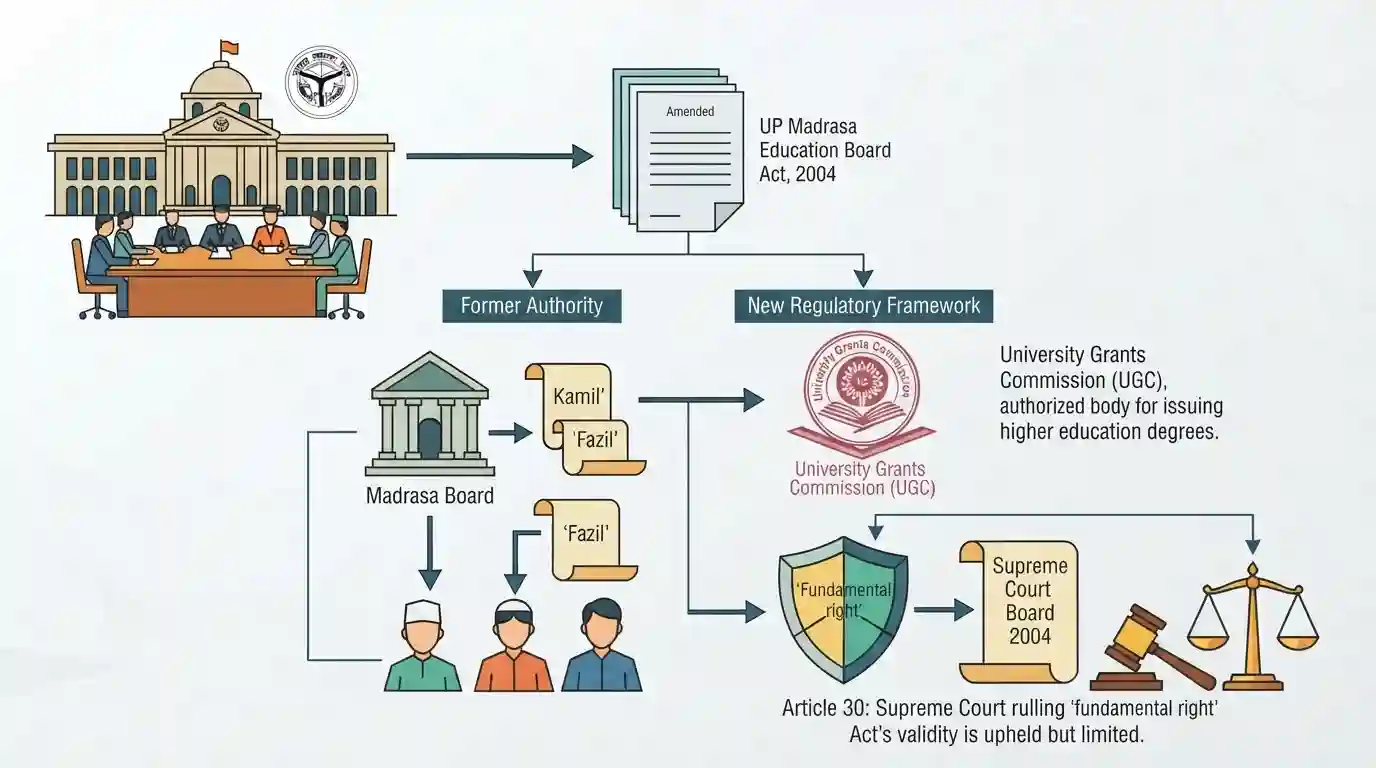
The Uttar Pradesh cabinet, chaired by CM Yogi Adityanath, is preparing to amend the Uttar Pradesh Madrasa Education Board Act, 2004, effectively canceling the Madrasa Board's authority to grant 'Kamil' (bachelor-equivalent) and 'Fazil' (master-equivalent) degrees. This legislative action directly implements a recent Supreme Court ruling, which upheld the constitutional validity of the 2004 Act but clarified that formal higher education degrees can only be awarded by institutions regulated under the University Grants Commission (UGC), thereby excluding madrasas from issuing higher academic qualifications.
Key Points
- The UP government proposes amending the Uttar Pradesh Madrasa Education Board Act, 2004, to discontinue 'Kamil' and 'Fazil' degrees.
- 'Kamil' is a three-year course equivalent to a Bachelor's degree, while 'Fazil' is a two-year course equivalent to a Master's degree.
- The move aligns with a Supreme Court directive affirming that madrasas cannot grant formal higher education degrees as they exist outside UGC regulations.
- The Supreme Court recently upheld the constitutional validity of the UP Madarsa Education Act 2004 while striking down its higher education provisions.
Important Terms
Uttar Pradesh Madrasa Education Board Act, 2004

A state legislation regulating madrasa education standards in UP. The Supreme Court recently upheld its overall constitutionality but struck down its provisions for awarding higher education degrees, asserting that such powers conflict with UGC regulations.
UPSC context
Relevant for GS Paper 2 (Government Policies). Tests the balance between minority rights to administer educational institutions and state regulatory authority.
University Grants Commission (UGC)
A statutory body established under the UGC Act of 1956, responsible for coordinating, determining, and maintaining higher education standards in India. It is the sole apex authority mandated to regulate, fund, and recognize university-level degrees.
UPSC context
Crucial for GS Paper 2 (Statutory Bodies, Education). Topics focus on its mandate, regulatory authority, and recent higher education reforms.
Kamil and Fazil Degrees
Traditional madrasa degrees equivalent to bachelor's and master's qualifications. The Supreme Court recently invalidated the UP Madrasa Board's authority to grant them, affirming that higher academic degrees must be awarded exclusively by UGC-regulated institutions.
UPSC context
Highlights statutory conflicts between state boards and central agencies. Relevant to GS Paper 2 (Education, Federalism, and Union List jurisdiction).
Article 30 of the Indian Constitution
A Fundamental Right guaranteeing religious and linguistic minorities the autonomy to establish and administer educational institutions. While protecting cultural identity, courts have ruled this autonomy is not absolute and allows reasonable state regulation.
UPSC context
Core GS Paper 2 topic (Fundamental Rights). Frequently tests the limits of minority autonomy versus the state's duty to ensure educational standards.
Prelims Trap
State governments can authorize Madrasa Boards to issue Bachelor's and Master's degrees under the Concurrent List.
While general education is in the Concurrent List, regulating higher education standards (Entry 66, Union List) is an exclusive parliamentary domain managed by UGC.
Static Concepts Connected
How is legislative power over education divided in the 7th Schedule?
- Concurrent List (Entry 25): Covers general education, including technical education, medical education, and universities, but remains subject to the provisions of the Union List.
- Union List (Entry 66): Grants Parliament exclusive power over the coordination and determination of standards in higher education and research institutions.
What are the limits of state regulation on Minority Educational Institutions (MEIs)?
- Not absolute: Article 30 guarantees minorities the right to establish and administer educational institutions, but the Supreme Court has clarified this right is not absolute.
- Permissible regulation: The state can enforce regulations concerning academic standards, syllabus, teacher qualifications, and student health to ensure excellence without violating minority rights.
Cross-Topic Patterns
RTE Act exemptions for religious schools
The RTE Act specifically exempts Madrasas and Vedic Pathshalas to protect minority autonomy, but they must still comply with statutory higher-ed standards if granting formal degrees.
UGC mandate vs State education autonomy
Similar to NEET mandates under the NMC Act, UGC's exclusive authority under Entry 66 limits states from creating parallel degree-granting frameworks.

Expect a multi-statement question testing Article 30 regulatory limits vs UGC's exclusive mandate under Entry 66 of the Union List.
Linked PYQs · 3
Linked PYQs · 3
- 2022UPPSC_PRELIMSGS1
What is the name of the test for undergraduate admission in Central Universities Single Window Admission for 2022 – 23?
- 2022UPPSC_PRELIMSGS1
Right to Education has been included into the Fundamental Rights by the
- 2024UPPSC_PRELIMSGS1
The UPSC derives its functions from which of the following sources? 1. The Constitution 2. Parliamentary Laws 3. Executive Rules and Orders 4. Conventions Select the correct answer from the codes given below:
