Industrial Safety Failures and Enforcement Gaps in Andhra Pradesh
Source:The Hindu ↗
Why It Matters
The article is a classic case study of governance failure and poor disaster preparedness in the hazardous industrial sector. It is relevant for GS Paper 2 (Accountability & E-governance) and GS Paper 3 (Disaster Management & Industrial Safety), emphasizing the need for robust institutional frameworks and technological interventions in safety enforcement.
Summary
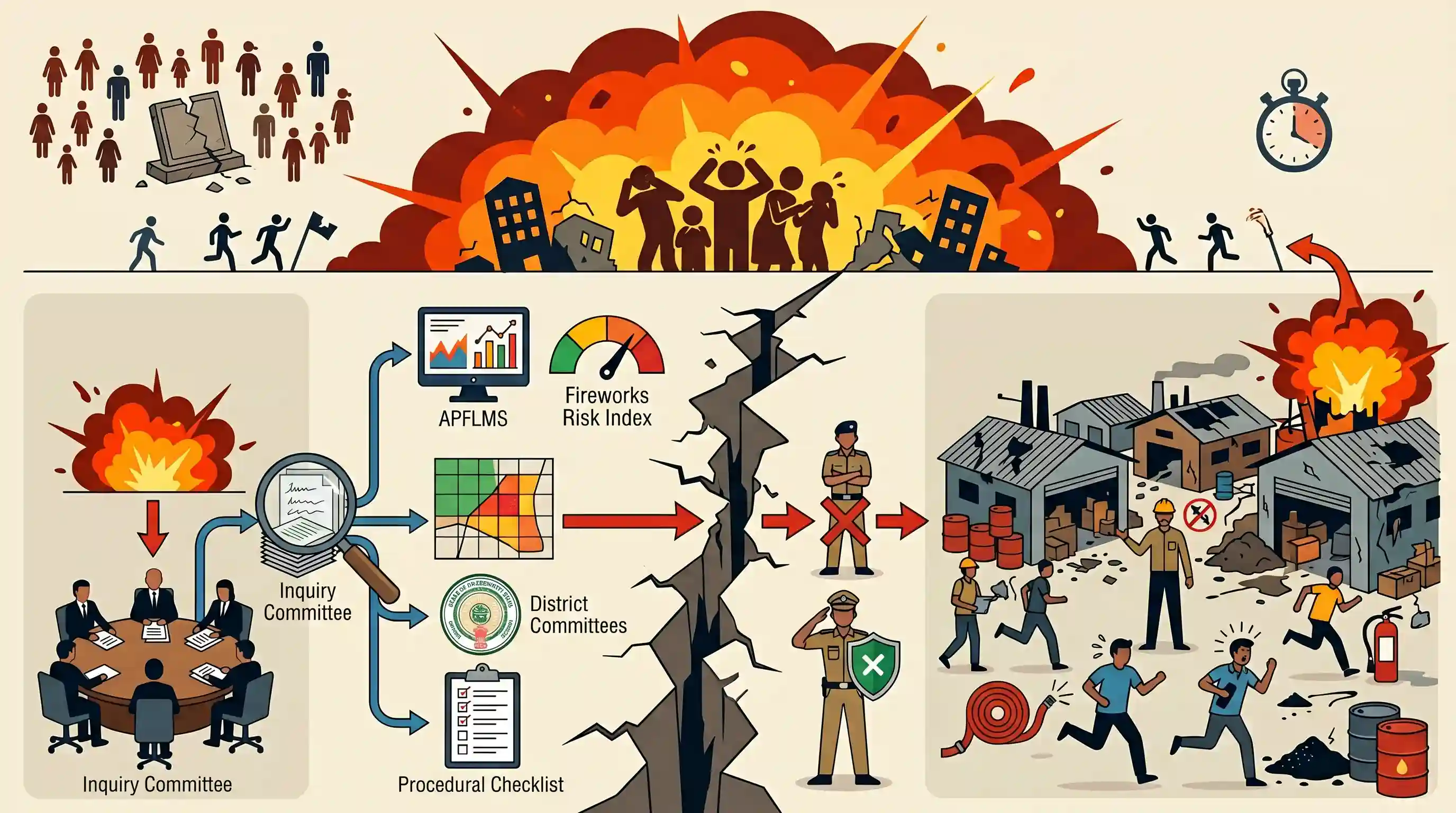
A devastating firecracker blast in Kakinada, Andhra Pradesh, claiming 20 lives, has exposed systemic apathy towards industrial safety and occupational hazards. The incident is a tragic repeat of the October 2025 Konaseema explosion. Despite a detailed inquiry committee report recommending a robust regulatory framework—including a digital monitoring system (APFLMS), a Fireworks Risk Index, strict zoning laws, and District Fireworks Safety Committees—enforcement agencies failed to implement these Standard Operating Procedures. Operational negligence by manufacturers, such as bypassing the employment of PESO-approved foremen, lack of segregated manufacturing sheds, and absence of safety drills, further compounded the disaster. This highlights a critical gap between policy recommendations and grass-roots implementation in hazardous unorganized sectors.
Key Points
- A firecracker unit blast in Kakinada, Andhra Pradesh, resulted in 20 fatalities, marking the second major accident of its kind in the state within six months.
- The tragedy underscores severe regulatory and enforcement failures, as Standard Operating Procedures (SOPs) recommended after a prior blast in Konaseema were entirely ignored.
- Key unimplemented recommendations included the creation of a unified digital portal (APFLMS), risk-based categorization (FRI), strict 500-metre buffer zoning, and mandatory joint inspections.
- Operational safety mandates, such as deploying PESO-approved foremen, maintaining segregated sheds, installing CCTV surveillance, and using non-sparking tools, were routinely flouted by manufacturers.
Important Terms
Petroleum and Explosives Safety Organisation (PESO)

Nodal regulatory authority under the Ministry of Commerce and Industry (DPIIT) responsible for safety of explosives, petroleum, and compressed gases. It enforces the Explosives Rules, 2008, and issues licenses to manufacturers.
UPSC context
GS Paper III: Disaster Management and Industrial Safety; GS Paper II: Regulatory Bodies.
Andhra Pradesh Fireworks Licensing and Monitoring System (APFLMS)
A proposed digital portal in Andhra Pradesh designed to unify firecracker licensing and monitoring. It integrates multiple departments to track compliance, inspections, and safety standards in real-time.
UPSC context
GS Paper II: Governance and e-Governance; testing policy implementation at the grassroots.
Fireworks Risk Index (FRI)
A data-driven metric used to categorize firecracker units based on hazard levels. It allows enforcement agencies to prioritize inspections and regulatory oversight for high-risk manufacturing facilities.
UPSC context
GS Paper III: Disaster Management; tests risk assessment and hazard mitigation strategies.
District Fireworks Safety Committee (DFSC)
A local administrative body chaired by the District Collector to oversee firecracker safety. It performs quarterly inspections, maintains risk registers, and has the power to suspend licenses for safety violations.
UPSC context
GS Paper II: Local Governance and Statutory Bodies; Paper III: Industrial Disaster Management.
Prelims Trap
"PESO is an autonomous statutory body functioning under the Ministry of Home Affairs."
PESO actually functions under DPIIT, Ministry of Commerce and Industry, despite dealing with explosives, security, and public safety.
Static Concepts Connected
What is the Petroleum and Explosives Safety Organisation (PESO)?
- Statutory Authority: Administers the Explosives Act, 1884, and Petroleum Act, 1934 to regulate hazardous substances.
- Nodal Ministry: Operates under the Department for Promotion of Industry and Internal Trade (DPIIT), Ministry of Commerce.
- Core Mandate: Regulates manufacture, storage, transport, and handling of explosives, fireworks, and compressed gases across India.
How does the OSH Code address industrial safety?
- Law Consolidation: Subsumes 13 legacy labor laws to regulate occupational safety, health, and working conditions across sectors.
- Hazardous Sectors: Mandates strict safety standards and regular health exams for workers employed in hazardous factories.
- Implementation Gap: Micro-units in the unorganized sector often escape stringent compliance due to high threshold applicability limits.
Cross-Topic Patterns
Sivakasi model & Child Labour
The unorganized firework sector's safety deficits deeply intersect with child labor violations (Article 24) and informal MSME governance challenges, echoing historical issues in Sivakasi.
NDMA & Micro-zonation
Industrial blast zoning failures directly connect to NDMA guidelines on chemical and industrial disasters, highlighting poor local land-use planning and ignored safety buffers.

PESO's nodal ministry (Commerce, not Home Affairs) and the OSH Code's enforcement gaps in unorganized hazardous units are prime for 2026.
Linked PYQs · 4
Linked PYQs · 4
- 2024MainsGS3
Discuss the merits and demerits of the four 'Labour Codes' in the context of labour market reforms in India. What has been the progress so far in this regard?
- 2019MainsGS3
Disaster preparedness is the first step in any disaster management process. Explain how hazard zonation mapping will help disaster mitigation in the case of landslides.
- 2023MainsGS2
e-governance, as a critical tool of governance, has ushered in effectiveness, transparency and accountability in governments. What inadequacies hamper the enhancement of these features ?
- 2025MainsGS2
"In contemporary development models, decision-making and problem-solving responsibilities are not located close to the source of information and execution defeating the objectives of development." Critically evaluate.
