Kailadevi Sanctuary Ecological Profile and Buffer Zone Status
Source:vajiramandravi ↗
Why It Matters
Important for RPSC RAS questions involving geographical mapping of wildlife sanctuaries, districts, rivers, and tiger reserves in Rajasthan.
Summary
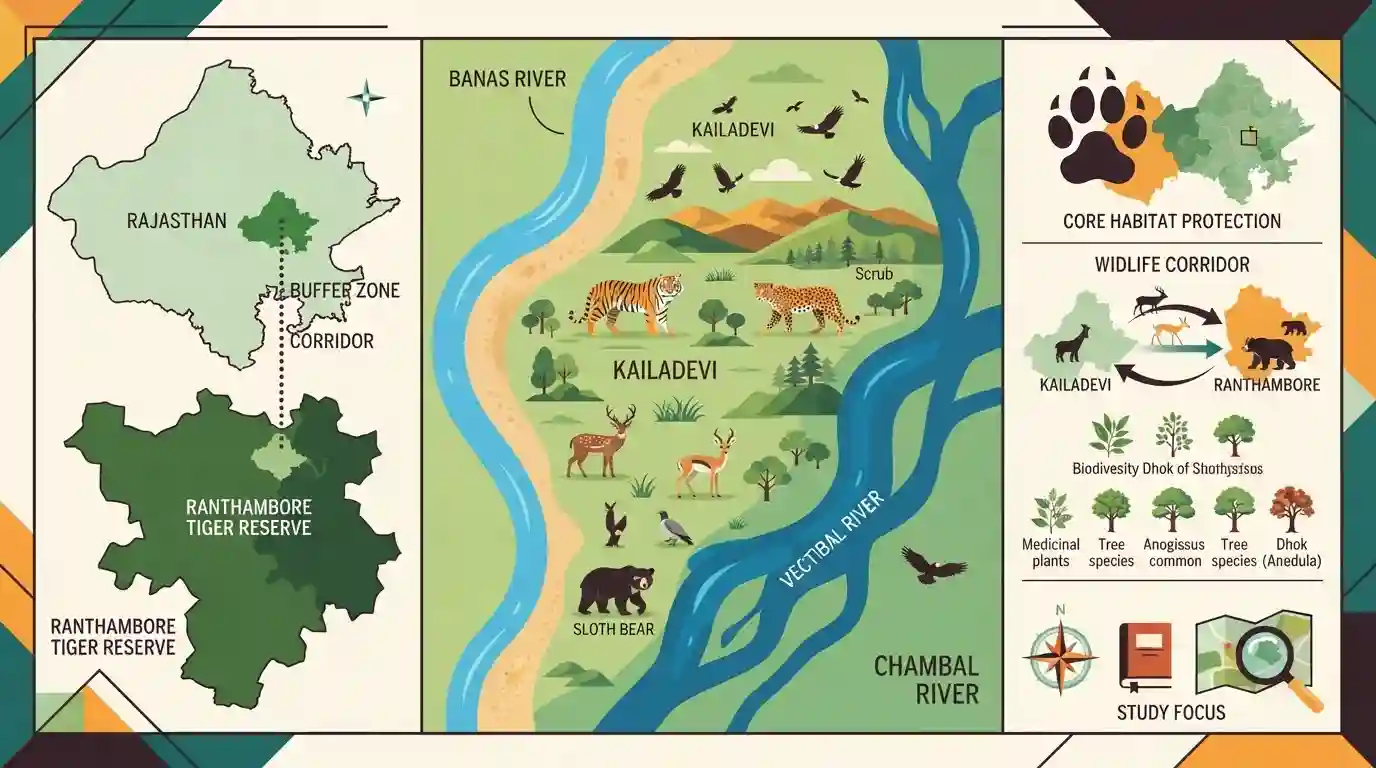
An overview of the Kailadevi Wildlife Sanctuary in Rajasthan, highlighting its geographical boundaries (Banas and Chambal rivers), its role as a northern-western extension and buffer zone of the Ranthambore Tiger Reserve, and its ecological and conservation significance for RPSC RAS aspirants.
Key Points
- Kailadevi Wildlife Sanctuary is located in the Karauli and Sawai Madhopur districts of Rajasthan and forms the northern-western buffer zone of the Ranthambore Tiger Reserve.
- The sanctuary is bounded by the Banas River on the west and the Chambal River on the south-east, showcasing rich biodiversity including dhok forests and dry deciduous vegetation.
- It acts as a crucial wildlife corridor connecting Ranthambore with other forested patches, supporting tigers, leopards, chinkaras, and wolves.
- Recent administrative and conservation discussions emphasize protecting its ecological integrity against mining and developmental pressures.
Prelims Trap
Kailadevi Wildlife Sanctuary is located exclusively in Karauli district and has no administrative or ecological linkage to Ranthambore Tiger Reserve.
Aspirants often assume Kailadevi is a separate standalone sanctuary without tiger presence, missing its official status as a northern-western buffer zone of Ranthambore Tiger Reserve.
Static Concepts Connected
What are the geographical boundaries and key river systems associated with Kailadevi Wildlife Sanctuary?
- Location: District Location: Spans across Karauli and Sawai Madhopur districts of Rajasthan.
- Tiger Reserve: Buffer Role: Serves as the northern-western extension and critical buffer zone of Ranthambore Tiger Reserve.
- River Basins: River Boundaries: Bounded by the Banas River on the west and the Chambal River on the south-east.
- Ecology: Flora & Fauna: Dominated by dhok (Anogeissus pendula) forests, supporting leopards, chinkaras, and wolves.
Cross-Topic Patterns
Wildlife Corridors and Interstate River Basins
Sanctuary corridors intersecting with Chambal ravines and interstate boundaries (Madhya Pradesh) form vital zones for gharial and tiger dispersal studied in regional environment papers.
Eco-Sensitive Zones vs Mineral Economics
Mining pressures in buffer zones of Aravalli and Vindhyan extensions test the balance between eco-sensitive zones (ESZ) and mineral extraction revenue.

RPSC frequently pairs sanctuary boundaries with river catchments or tiger reserve buffer roles in matching/statement questions.
Linked PYQs · 2
Linked PYQs · 2
- 2023RPSC_PRELIMSGS1
The National Tiger Conservation Authority has conferred the status of the fifth tiger sanctuary in Rajasthan, to which of the following sanctuaries?
- 2023RPSC_PRELIMSGS1
Which of the following pairings is incorrect? Wildlife Sanctuary – District
