Kailadevi Sanctuary integrated into tiger reserve for conservation
Source:vajiramandravi ↗
Why It Matters
Directly relevant for Rajasthan-specific geography, environment, and wildlife conservation questions in RPSC RAS Prelims.
Summary
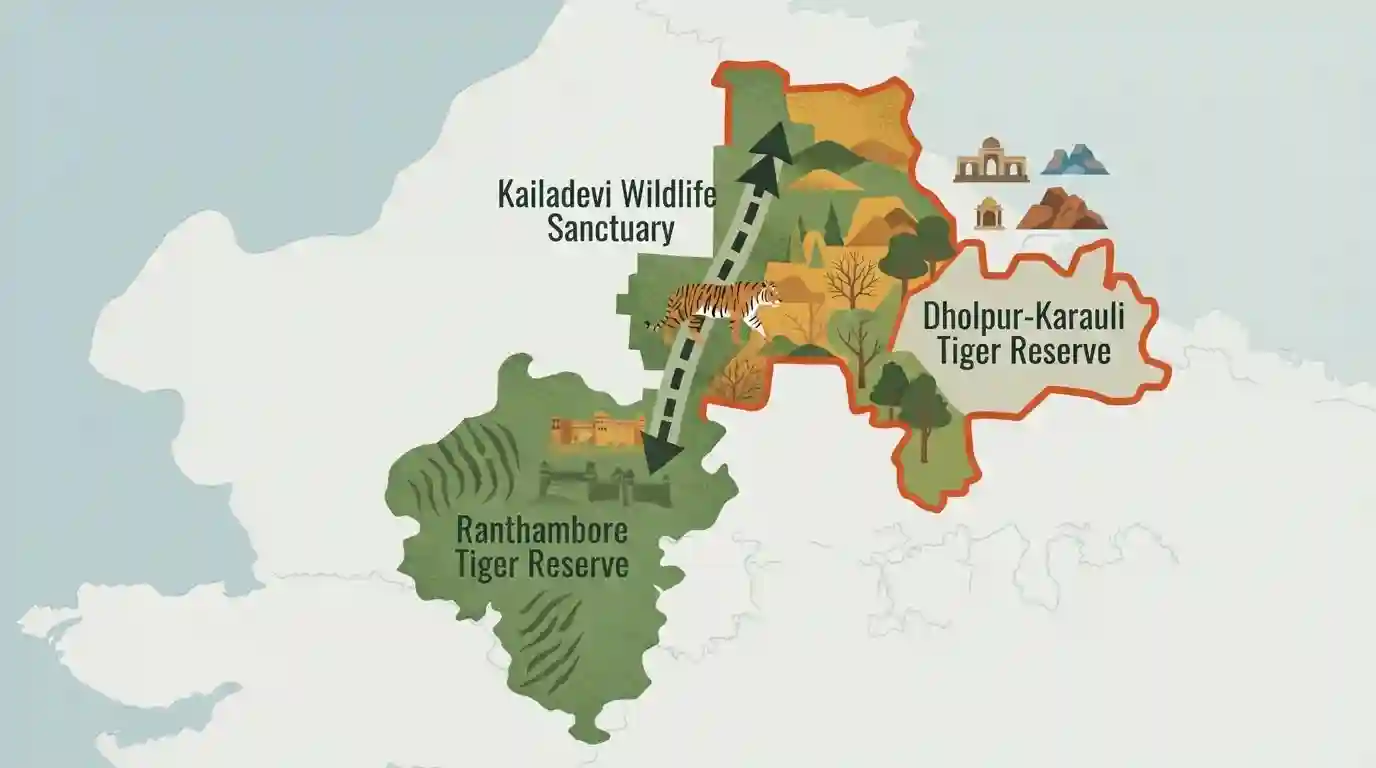
The Kailadevi Wildlife Sanctuary, situated in Rajasthan's Karauli and Dholpur districts, serves as an essential northern extension and wildlife corridor for the Ranthambore Tiger Reserve. Recently, it has been integrated into the newly established Dholpur-Karauli Tiger Reserve, making it crucial for tiger conservation and regional biodiversity in Rajasthan.
Key Points
- Kailadevi Wildlife Sanctuary is located in the Karauli and partly in the Dholpur districts of Rajasthan.
- It acts as an important northern buffer zone and ecological corridor for the Ranthambore Tiger Reserve.
- The sanctuary is now part of the Dholpur-Karauli Tiger Reserve, which is Rajasthan's fifth tiger reserve.
- Geographically characterized by dry deciduous forests, ravines of the Banas and Chambal rivers, and rich biodiversity including leopards, hyenas, and wolves.
Important Terms
Wildlife Protection Act 1972

A landmark central legislation enacted in 1972 that provides the legal framework for the protection of wild animals, birds, and plants, and establishes protected areas like sanctuaries and national parks.
UPSC context
RPSC Paper / Environment & Biodiversity: Tests legal mechanisms, schedules, and conservation governance structures in India and Rajasthan.
National Tiger Conservation Authority
A statutory body under the Ministry of Environment, Forest and Climate Change established under the Wildlife Protection Act, 1972, tasked with managing Project Tiger across India.
UPSC context
RPSC Paper / Wildlife Conservation: Frequently tested for institutional frameworks governing tiger reserves and national wildlife policies.
Rajasthan Forest Department
The state government body responsible for the administration, protection, and management of forests, wildlife sanctuaries, and tiger reserves across Rajasthan.
UPSC context
RPSC Rajasthan Geography & Administration: Tests implementation of state-level conservation initiatives, protected areas, and wildlife corridor management.
Prelims Trap
Kailadevi Wildlife Sanctuary is completely independent of the Ranthambore Tiger Reserve ecosystem.
Aspirants often confuse Kailadevi as a standalone sanctuary independent of Ranthambore, overlooking its critical role as its northern buffer/corridor.
Static Concepts Connected
What are the statutory provisions governing Tiger Reserves and Wildlife Sanctuaries in India?
- NTCA Notification: Tiger reserves are notified by state governments upon recommendations of the National Tiger Conservation Authority (NTCA) under the Wildlife Protection Act, 1972.
- Legal Status: Sanctuaries are established under Section 26A or 35 of the WPA 1972, with varying degrees of human activity permitted compared to National Parks.
- Core-Buffer Zoning: Core and buffer zones are demarcated to balance wildlife conservation with sustainable local community resource use.
Cross-Topic Patterns
Tiger Reserves + Wildlife Protection Act 1972
The inclusion of Kailadevi into a tiger reserve directly links sanctuary restructuring with Project Tiger and NTCA statutory notifications under WPA 1972.
Chambal Ravines + Eastern Rajasthan Geography
Ravine topography along the Chambal and Banas rivers connects protected areas with geographical badland formation and dry deciduous ecology in eastern Rajasthan.

Expect a matching or multi-statement question on Rajasthan's tiger reserves, specifically linking Kailadevi to Dholpur-Karauli.
Linked PYQs · 1
Linked PYQs · 1
- 2023RPSC_PRELIMSGS1
The National Tiger Conservation Authority has conferred the status of the fifth tiger sanctuary in Rajasthan, to which of the following sanctuaries?
