KSPCB inspects polluting units along Kadambrayar river
Source:The Hindu ↗
Why It Matters
This article exemplifies the practical enforcement of environmental jurisprudence, notably the 'polluter pays' principle, and the active role of the National Green Tribunal (NGT) in holding state machinery accountable. It is highly relevant for GS-3 (Environmental Pollution) questions concerning river cleaning initiatives and GS-2 questions on the effectiveness of statutory bodies like the SPCBs and the NGT in governance.
Summary
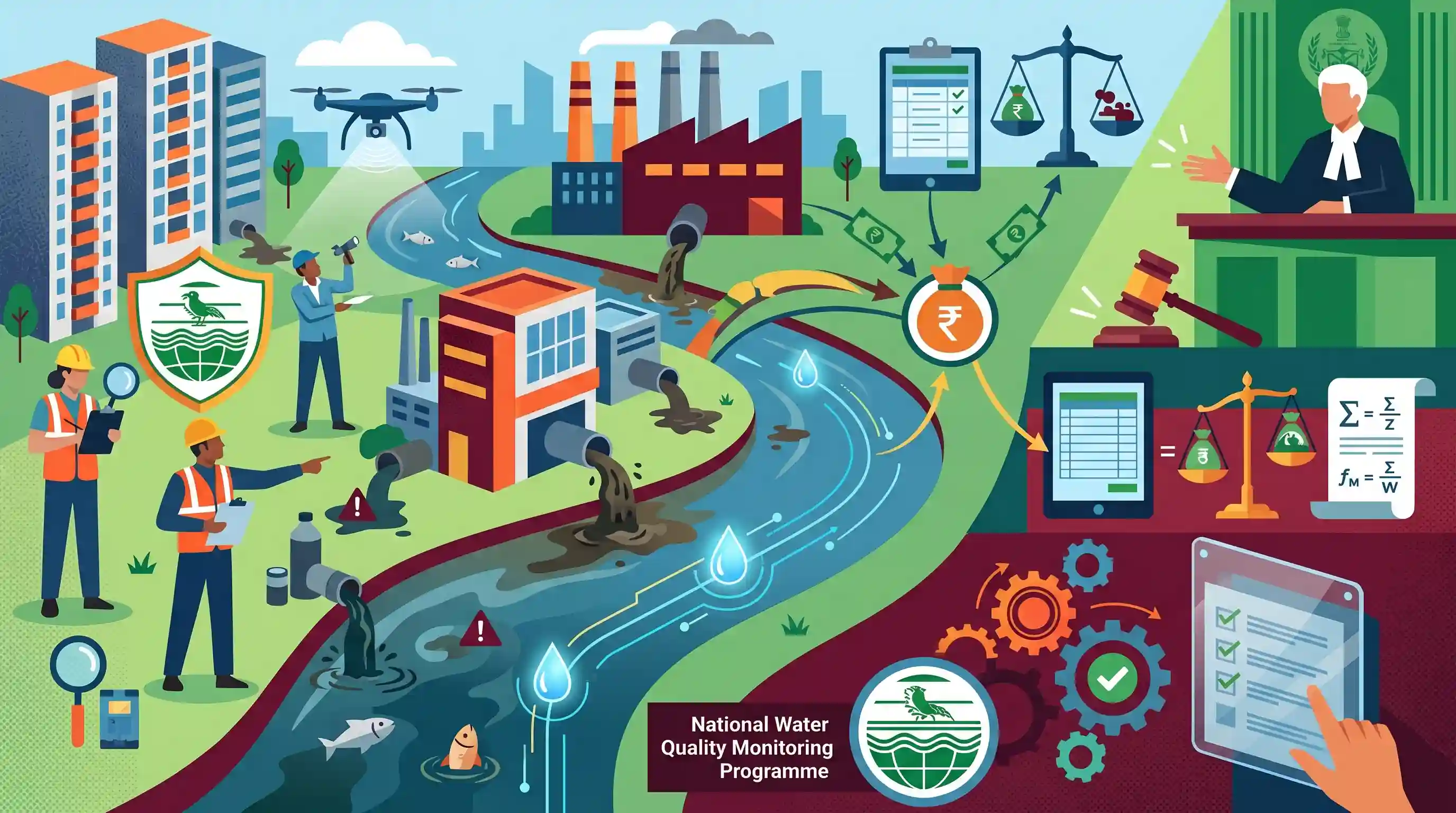
The Kerala State Pollution Control Board (KSPCB) has commenced physical inspections of establishments along the Kadambrayar river in Ernakulam district to curb the illegal discharge of untreated wastewater. Prompted by the National Green Tribunal's suo motu intervention over escalating pollution levels, authorities are identifying violators—including industries, commercial units, and apartments—to levy environmental compensation. This compensation will be calculated using Central Pollution Control Board guidelines based on the 'polluter pays' principle. The initiative underscores the role of statutory bodies in enforcing environmental compliance and highlights water tracking efforts under the National Water Quality Monitoring Programme.
Key Points
- KSPCB has initiated physical verification of commercial and industrial units, as well as residential complexes, to identify entities illegally discharging untreated wastewater into the Kadambrayar river.
- This enforcement action follows suo motu cognisance taken by the National Green Tribunal (Southern Bench) concerning the severe deterioration of the river's water quality.
- Violators will be subjected to environmental compensation calculated according to Central Pollution Control Board (CPCB) guidelines, strictly applying the 'polluter pays' principle.
- The river's status is tracked through monthly monitoring at locations such as Brahmapuram and Manakkakadavu under the National Water Quality Monitoring Programme.
- The NGT previously criticised local civic bodies and the KSPCB for lax enforcement, highlighting governance gaps in tackling urban and industrial river pollution.
Important Terms
National Green Tribunal (NGT)

A specialized statutory body established under the NGT Act, 2010 for the effective and expeditious disposal of cases relating to environmental protection, forest conservation, and natural resource management.
UPSC context
GS Paper II (Statutory Bodies) and Paper III (Environment); tests specialized judicial mechanisms and environmental justice.
Central Pollution Control Board (CPCB)
The apex statutory body for pollution control in India, constituted under the Water (Prevention and Control of Pollution) Act, 1974, to manage air and water quality.
UPSC context
GS Paper III (Environmental Pollution); tests the regulatory framework and institutional role in maintaining national environmental standards.
Polluter Pays Principle
An environmental law concept where those responsible for producing pollution must bear the costs of its management, cleanup, and mitigation to prevent harm to society.
UPSC context
GS Paper III (Environment and Ethics); tests understanding of sustainable development principles and environmental accountability.
National Water Quality Monitoring Programme (NWMP)
A nationwide network managed by the CPCB in collaboration with state boards to monitor the status of water quality in rivers, lakes, and groundwater across India.
UPSC context
GS Paper III (Conservation); tests knowledge of technical schemes and government monitoring systems for water resource management.
Kerala State Pollution Control Board (KSPCB)
The statutory body responsible for enforcing environmental laws, issuing permits, and monitoring industrial and commercial pollution within the state of Kerala.
UPSC context
GS Paper II (Regulatory Bodies); tests the role of state institutions in India's federal environmental governance structure.
Prelims Trap
"The NGT cannot take suo motu cognisance of environmental issues as it is purely a statutory tribunal."
The Supreme Court (2021) explicitly upheld the NGT's power to take suo motu cognisance, ruling it essential for its environmental protection mandate despite being a statutory body.
Static Concepts Connected
What principles legally bind the National Green Tribunal's decisions?
- Statutory Mandate: Under Section 20 of the NGT Act, 2010, the Tribunal must apply sustainable development, the precautionary principle, and the polluter pays principle.
- Natural Justice: The NGT is not bound by the procedure laid down under the Code of Civil Procedure, 1908, but is guided by the principles of natural justice.
How is surface water quality monitored under the NWMP?
- Execution Mechanism: Executed nationwide by the Central Pollution Control Board (CPCB) in collaboration with State Pollution Control Boards (SPCBs).
- Key Indicators: It tracks Biochemical Oxygen Demand (BOD) and Dissolved Oxygen (DO). A BOD level exceeding 3 mg/L is the standard criterion for classifying a polluted river stretch.
Cross-Topic Patterns
NGT Suo Motu vs. Local Governance
NGT frequently pulls up municipal bodies for solid and liquid waste mismanagement, creating a direct overlap between GS2 (local self-government failures) and GS3 (environmental degradation).
Water Act 1974 as the foundation
Both CPCB and SPCBs derive their core enforcement powers, including inspections and compensation levies, originally from the Water Act of 1974, not just the Environment Protection Act of 1986.

Expect a prelims question testing the statutory backing of the 'polluter pays' principle and NGT's suo motu powers affirmed by SC in 2021.
Linked PYQs · 4
Linked PYQs · 4
- 2024MainsGS3
Industrial pollution of river water is a significant environmental issue in India. Discuss the various mitigation measures to deal with this problem and also the government's initiatives in this regard.
- 2013MainsGS3
Enumerate the National Water Policy of India. Taking river Ganges as an example, discuss the strategies which may be adopted for river water pollution control and management. What are the legal provisions of management and handling of hazardous wastes in India?
- 2022MainsGS2
“The most significant achievement of modern law in India is the constitutionalization of environmental problems by the Supreme Court.” Discuss this statement with the help of relevant case laws.
- 2017PrelimsGS1
Biological Oxygen Demand (BOD) is a standard criterion for
