Dynastic Succession Crises Strain Regional Political Parties
Source:Indian Express ↗
Why It Matters
The dynamics of regional political parties, including their internal democracy and succession, are vital for understanding Indian state politics and electoral representation. It highlights the challenges of family-run political organizations and their impact on democratic governance.
Summary
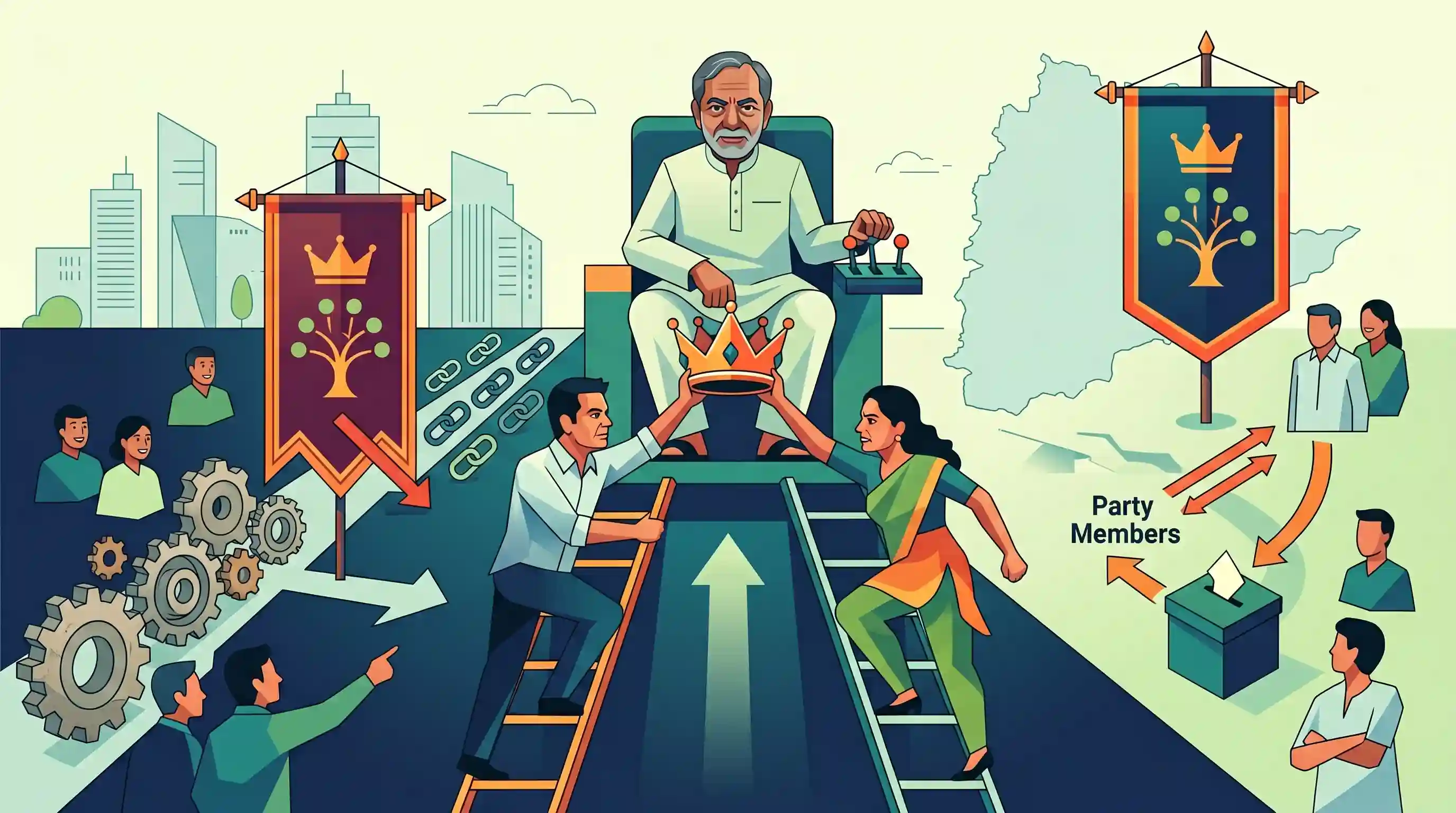
An analysis of the internal politics within Telangana's Bharat Rashtra Samithi (BRS) reveals a brewing sibling saga involving K. Kavitha and K. T. Rama Rao (KTR). With party founder K. Chandrashekar Rao (KCR) at the helm, the public airing of grievances reflects underlying tensions over succession and power distribution within the regional party. This dynamic illustrates the broader issues of dynastic politics and the lack of internal democracy often seen in regional political outfits in India, particularly when transitioning leadership or facing electoral challenges.
Key Points
- The article highlights the internal political dynamics within the Bharat Rashtra Samithi (BRS) in Telangana.
- It focuses on the sibling rivalry and succession struggles between K. Kavitha and K. T. Rama Rao (KTR), children of party founder K. Chandrashekar Rao (KCR).
- The public airing of internal grievances underscores the broader challenge of internal democracy and succession planning in family-dominated regional political parties in India.
- Following electoral setbacks, the party's future trajectory and internal cohesion are under intense public and political scrutiny.
Important Terms
Bharat Rashtra Samithi (BRS)

A regional political party in Telangana, formerly known as Telangana Rashtra Samithi (TRS), founded by K. Chandrashekar Rao (KCR) to spearhead the movement for a separate state.
UPSC context
GS Paper 2: Role of regional parties in Indian federalism and their evolution into national entities.
Internal Party Democracy
The practice of adhering to democratic principles within a party's internal structure, including regular elections for leadership, transparent decision-making, and active member participation.
UPSC context
GS Paper 2: Electoral reforms, functioning of political parties, and challenges like 'high-command' culture.
Dynastic Politics
A political system where power and leadership positions are largely inherited within families across generations, often prioritizing lineage over individual merit or competence.
UPSC context
GS Paper 2: Salient features of the Representation of People's Act and challenges to representative democracy.
Regional Parties
Political organizations whose base of support and agenda are primarily confined to a specific state or geographic region, often representing ethnic, linguistic, or cultural identities.
UPSC context
GS Paper 2: Impact on federalism, coalition politics, and the 'One-Party Dominant System'.
Representation of the People Act, 1951
The legal framework governing the registration of political parties, conduct of elections, and qualifications of representatives in India, particularly Section 29A regarding party constitutions.
UPSC context
GS Paper 2: Core statutory provision for electoral and party regulation in India.
Succession Politics
The process and competition involving the transfer of power or leadership within a political entity, which can be democratic or hereditary in nature.
UPSC context
GS Paper 2: Internal stability and leadership transitions in regional political outfits.
Prelims Trap
"The Election Commission can deregister a political party if it fails to conduct periodic internal elections."
The Supreme Court ruled the ECI lacks statutory power to deregister parties for this. RPA 1951 requires a democratic pledge but has no penal provisions for skipping internal elections.
Static Concepts Connected
How does the RPA 1951 govern the internal democracy of political parties?
- Section 29A: Requires parties to pledge allegiance to the Constitution and democratic principles for registration, but lacks explicit rules or penal provisions mandating internal elections.
- ECI Limitations: The Election Commission cannot deregister a party solely for failing to hold organizational elections, as established by the Supreme Court in the 2002 INC v. Institute of Social Welfare case.
What key panels have recommended reforms for inner-party democracy?
- 170th Law Commission: Recommended a dedicated regulatory framework to govern internal structures, inner-party democracy, and financial accountability to prevent internal dictatorships.
- NCRWC: Proposed enacting a comprehensive law making transparent internal elections mandatory to explicitly check the rise of dynasticism and nepotism in Indian politics.
Cross-Topic Patterns
Federal demands vs. Centralized parties
A persistent paradox in Indian polity where regional parties fiercely advocate for State autonomy and decentralization, yet function internally as highly centralized, dynastic fiefdoms.
Internal democracy and anti-defection
The lack of inner-party democracy often leaves dissenters with no internal grievance mechanisms, forcing them to defect and triggering Tenth Schedule (Anti-Defection Law) controversies.

Expect a Prelims question testing the ECI's exact deregistration powers under RPA 1951, specifically regarding internal party elections.
Linked PYQs · 1
Linked PYQs · 1
- 2022MainsGS2
“While the national political parties in India favour centralisation, the regional parties are in favour of State autonomy.” Comment.
