Rajasthan Decentralized Battery Energy Storage Pilot Tender Details
Source:solarquarter ↗
Why It Matters
Decentralized Battery Energy Storage Systems (BESS) are critical for integrating intermittent renewable energy sources, like solar and wind, into the state grid. This pilot project marks a significant step for Rajasthan's distribution companies (DISCOMs) in modernizing grid infrastructure, reducing distribution losses, and improving power quality and reliability at the grassroots (DTR) level.
Summary
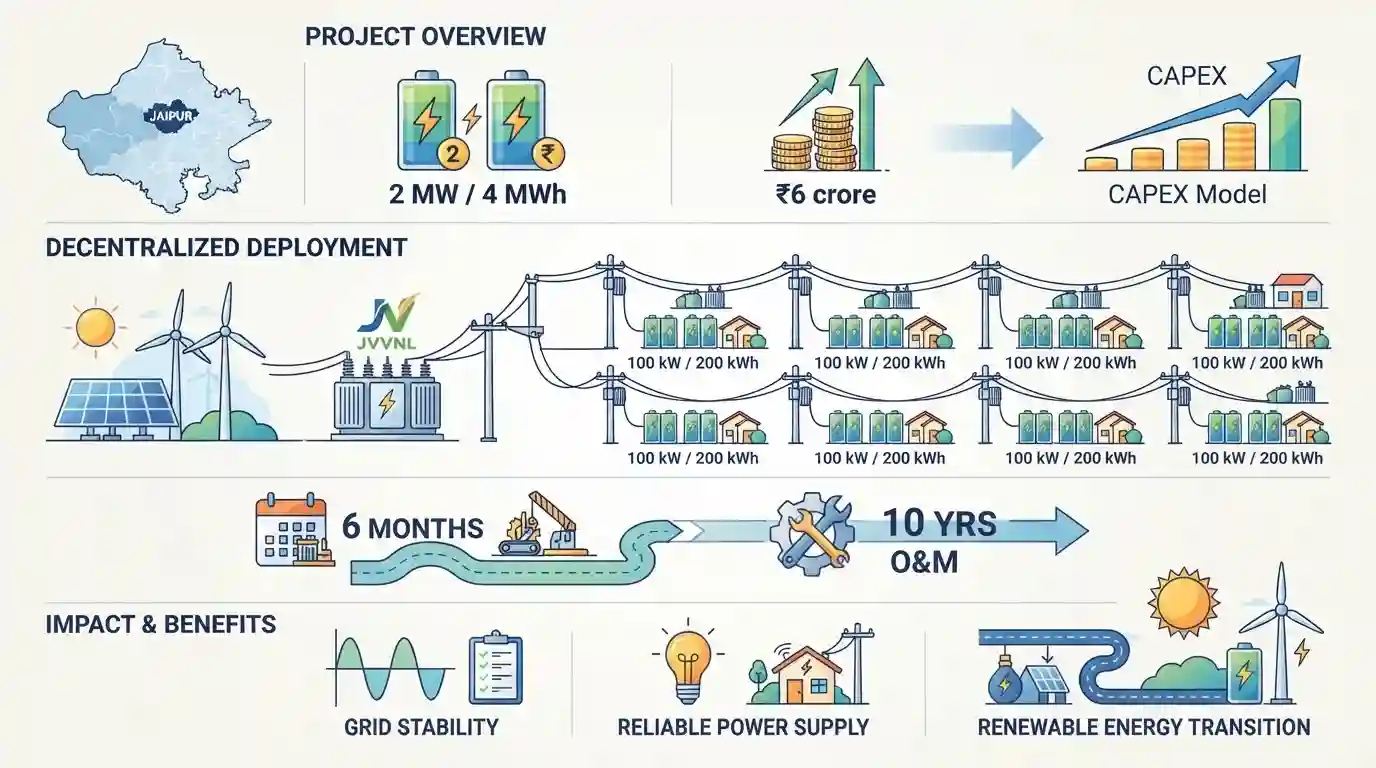
Jaipur Vidyut Vitran Nigam Limited (JVVNL) has floated a tender for a 2 MW/4 MWh Decentralized Battery Energy Storage System (BESS) Pilot Project in Rajasthan. Valued at approximately ₹6 crore, the project operates under a CAPEX model and involves installing twenty individual 100 kW/200 kWh battery storage units at the Distribution Transformer (DTR) level. The selected bidder will be tasked with project completion within six months, followed by ten years of comprehensive operation and maintenance. This decentralized pilot aims to bolster grid stability, ensuring reliable power supply distribution and facilitating Rajasthan's transition toward enhanced renewable energy storage capabilities.
Key Points
- Jaipur Vidyut Vitran Nigam Limited (JVVNL) has invited tenders for a 2 MW/4 MWh Decentralized Battery Energy Storage System (BESS) Pilot Project in Rajasthan.
- The initiative entails deploying 2,000 kW/4,000 kWh of storage capacity via twenty 100 kW/200 kWh individual battery storage units at the Distribution Transformer (DTR) level.
- The project will operate under a Capital Expenditure (CAPEX) model and carries an estimated cost of ₹6 crore.
- The selected bidder will be responsible for a six-month completion period and ten years of Comprehensive Operation and Maintenance (O&M).
- To qualify, bidders must possess prior experience in supplying, commissioning, or developing Battery Energy Storage Systems.
Important Terms
Jaipur Vidyut Vitran Nigam Limited (JVVNL)

A state-owned public enterprise incorporated in 2000, responsible for power distribution and supply across 12 eastern and south-eastern districts of Rajasthan.
UPSC context
Crucial for Rajasthan State Economy and administrative structure questions regarding the state's energy and power sector.
Decentralized Battery Energy Storage System (BESS)
Small-scale, localized energy storage units placed close to consumption points to store renewable energy, enhance local grid stability, and manage peak power demands efficiently.
UPSC context
Relevant for GS-III (Science & Technology / Environment) regarding renewable energy integration and grid modernization.
CAPEX (Capital Expenditure) Model
A financial framework where the buyer pays the entire upfront cost to install an asset, thereby gaining full ownership and capturing all long-term financial savings and benefits.
UPSC context
Important for Economic Development topics, testing knowledge of infrastructure financing models compared to OPEX or RESCO.
Distribution Transformer (DTR)
An electrical device in the power grid that steps down high voltage to lower utility voltages for consumers, now increasingly serving as nodes for decentralized energy storage.
UPSC context
Relevant for Energy Infrastructure and Science & Tech questions on smart grids and power distribution modernization.
Prelims Trap
The JVVNL BESS project is a centralized grid-scale storage facility.
It is a decentralized pilot deploying small (100 kW) units at local Distribution Transformers, not a massive centralized grid-scale plant.
Static Concepts Connected
Why is BESS critical for Rajasthan's renewable energy sector?
- Grid Stability: Balances power fluctuations caused by intermittent solar and wind generation, maintaining voltage and frequency.
- Peak Shaving: Stores excess energy generated during peak daytime solar hours for dispatch during peak evening demand.
- Decentralized Edge: Deploying storage directly at the Distribution Transformer (DTR) reduces transmission losses and improves local power quality.
What is the institutional structure of power distribution in Rajasthan?
- Three Discoms: Rajasthan's distribution is managed territorially by three Discoms: JVVNL (Jaipur), AVVNL (Ajmer), and JdVVNL (Jodhpur).
- RSEB Unbundling: These entities were formed in 2000 following the unbundling of the Rajasthan State Electricity Board (RSEB) to improve operational efficiency.
Cross-Topic Patterns
Solar Intermittency + Grid Modernization
Rajasthan's massive solar capacity necessitates grid upgrades. Decentralized BESS at the DTR level specifically addresses local grid stress caused by distributed renewable generation like rooftop solar and agricultural PM-KUSUM pumps.
CAPEX Model in Energy Storage
Unlike typical Power Purchase Agreements (OPEX), this JVVNL pilot uses a CAPEX model where the Discom owns the asset, but the contractor assumes long-term (10-year) O&M responsibilities.

Expect multi-statement questions linking Rajasthan's solar dominance with grid stability solutions like decentralized DTR-level BESS.
Linked PYQs · 3
Linked PYQs · 3
- 2023RPSC_PRELIMSGS1
Which agency has been given the responsibility of implementing the PM-KUSUM scheme (Component A) in Rajasthan, which involves the establishment of solar power plants with a capacity of 0.5 MW to 2 MW?
- 2018RPSC_PRELIMSGS1
What is the target set by the Government of India to achieve by 2022 in terms of solar energy capacity?
- 2025RPSC_PRELIMSGS1
Which of the following statements are correct with respect to the PM Surya Ghar Free Electricity Scheme? (i) Under this scheme, solar plants will be installed on one crore houses to provide free electricity up to 300 units per month. (ii) Provision of 30% subsidy for installing rooftop solar plants (iii) 100% online system for registration, application, approval and grant (iv) Provision of lending to each applicant at a bank interest rate of 4%
