Supreme Court Inhouse Inquiry and Judicial Impeachment Process
Source:The Hindu ↗
Why It Matters
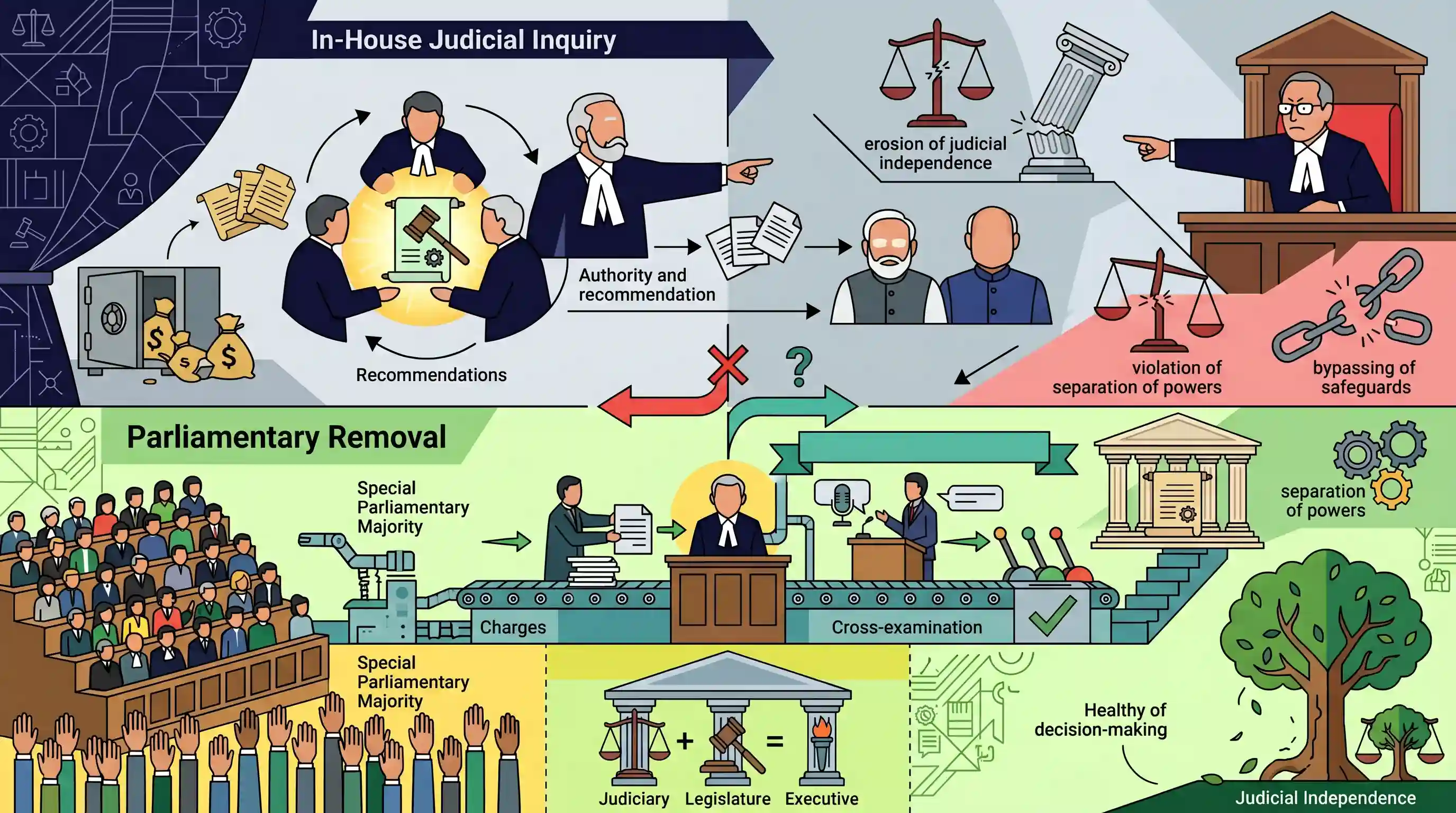
This case highlights a critical constitutional friction point between internal judicial accountability mechanisms (the Supreme Court's in-house procedure) and the separation of powers mandating parliamentary oversight (the Judges Inquiry Act, 1968). It is highly relevant for GS Paper 2 topics concerning the functioning, accountability, and independence of the higher judiciary in India.
Summary
Allahabad High Court judge Justice Yashwant Varma has petitioned the Supreme Court to challenge the report of a three-judge in-house inquiry committee that recommended his removal over the discovery of unaccounted cash at his official residence. Former Chief Justice of India Sanjiv Khanna had forwarded the committee's report to the Prime Minister and President after Justice Varma refused to resign. In his petition, Varma asserts that the Supreme Court's in-house procedure is a "parallel, extra-constitutional mechanism" that usurps Parliament's exclusive authority to remove judges under Articles 124 and 218. He argues that the in-house mechanism bypasses the Judges (Inquiry) Act, 1968, stripping him of crucial safeguards like formal charges, cross-examination, and the requirement of a special parliamentary majority for removal. Varma claims that concentrating such disciplinary power within the judiciary, without legislative sanction, violates the separation of powers, erodes judicial independence, and contravenes the basic structure of the Constitution.
Key Points
- Allahabad High Court judge Justice Yashwant Varma has moved the Supreme Court to challenge an in-house inquiry committee report recommending his removal after unaccounted cash was found at his residence.
- Varma argues that the Supreme Court's in-house inquiry is a parallel, extra-constitutional mechanism that usurps Parliament's exclusive authority to remove judges under Articles 124 and 218.
- He contends that the in-house procedure bypasses the stringent procedural safeguards established under the Judges (Inquiry) Act, 1968, which mandates formal charges, cross-examination, and an address by Parliament with a special majority.
- The petition argues that enabling punitive outcomes against sitting judges without legislative sanction violates the separation of powers and threatens judicial independence, which is a part of the Constitution's basic structure.
- Varma also claims a lack of due process, alleging the committee relied on presumptions, unverified photos/videos, and denied him a personal hearing or a chance to cross-examine witnesses.
Important Terms
Judges (Inquiry) Act, 1968

A statutory framework regulating the investigation of misbehaviour or incapacity of Supreme Court and High Court judges. It requires a three-member inquiry committee to report findings before Parliament votes on removal.
UPSC context
GS Paper II (Polity) — Tests knowledge of judicial accountability mechanisms and the statutory process for removing higher judiciary members.
Article 124 of the Constitution
The constitutional provision establishing the Supreme Court and detailing the removal of its judges through a special majority in Parliament on grounds of 'proved misbehaviour or incapacity.'
UPSC context
GS Paper II (Judiciary) — Fundamental for understanding the constitutional safeguards and removal process of Supreme Court judges.
Article 218 of the Constitution
A provision that extends the removal procedure of Supreme Court judges (under Article 124) to High Court judges, ensuring uniform disciplinary standards across the higher judiciary.
UPSC context
GS Paper II (Polity) — Tests the application of Supreme Court removal procedures to High Courts, highlighting federal judicial consistency.
In-house Procedure (Supreme Court)
An internal mechanism adopted by the Supreme Court in 1999 to investigate complaints against judges. It serves as a peer-review fact-finding process for misconduct that may not reach the impeachment threshold.
UPSC context
GS Paper II (Judiciary) — Important for discussing internal judicial accountability versus the constitutional removal process.
Judicial Independence
A Basic Structure principle ensuring the judiciary is free from external influence or pressure from the executive and legislature to maintain impartial adjudication and the rule of law.
UPSC context
GS Paper II (Basic Structure) — Central to questions on balancing judicial accountability and protection from political interference.
Separation of Powers
The constitutional division of state functions among the legislature, executive, and judiciary to prevent the concentration of power and ensure checks and balances.
UPSC context
GS Paper II (Polity) — Tests understanding of constitutional boundaries between the judiciary and Parliament in disciplinary matters.
Prelims Trap
"The Supreme Court's In-House Procedure for investigating judges is governed by the provisions of the Judges (Inquiry) Act, 1968."
The In-House Procedure is a judicially evolved, non-statutory mechanism (1999). It is entirely separate from the statutory procedures of the Judges (Inquiry) Act.
Static Concepts Connected
What is the Constitutional procedure for removing higher judiciary judges?
- Grounds: Can only be initiated for "proved misbehaviour" or "incapacity" under Articles 124(4) and 218.
- Special Majority: Requires an address supported by a special majority in both Houses of Parliament in the same session.
- Presidential Order: The judge is formally removed only by an order passed by the President of India following the parliamentary address.
How does the Judges (Inquiry) Act, 1968 structure the investigation?
- Initiation: Requires a motion signed by 100 Lok Sabha members or 50 Rajya Sabha members submitted to the respective presiding officer.
- Committee Composition: The Speaker/Chairman forms a 3-member committee: a Supreme Court judge, a High Court Chief Justice, and a "distinguished jurist."
- Outcome: Only if this statutory committee proves the misbehaviour does Parliament take up the motion for a formal vote.
Cross-Topic Patterns
NJAC parallel on judicial autonomy
Similar to striking down the NJAC to protect judicial appointments, the judiciary uses the in-house mechanism to shield disciplinary matters from the legislature, sparking debates over accountability versus judicial independence.
Constitutional silences and Basic Structure
This highlights how the Supreme Court fills 'constitutional silences' (handling misconduct that falls short of impeachment) using self-devised resolutions, which critics argue disrupts the Separation of Powers doctrine.

Expect a 2026 Prelims question contrasting the non-statutory In-House Procedure with the statutory Judges (Inquiry) Act 1968.
Linked PYQs · 3
Linked PYQs · 3
- 2019PrelimsGS1
Consider the following statements: 1. The motion to impeach a Judge of the Supreme Court of India cannot be rejected by the Speaker of the Lok Sabha as per the Judges (Inquiry) Act, 1968. 2. The Constitution of India defines and gives details of what constitutes 'incapacity and proved misbehaviour' of the Judges of the Supreme Court of India. 3. The details of the process of impeachment of the Judges of the Supreme Court of India are given in the Judges (Inquiry) Act, 1968. 4. If the motion for the impeachment of a Judge is taken up for voting, the law requires the motion to be backed by each House of the Parliament and supported by a majority of total membership of that House and by not less than two-thirds of total members of that House present and voting. Which of the statements given above is/are correct?
- 2012PrelimsGS1
What is the provision to safeguard the autonomy of the Supreme Court of India? 1. While appointing the Supreme Court Judges, the President of India has to consult the Chief Justice of India. 2. The Supreme Court Judges can be removed by the Chief Justice of India only. 3. The salaries of the Judges are charged on the Consolidated Fund of India to which the legislature does not have to vote. 4. All appointments of officers and staffs of the Supreme Court of India are made by the Government only after consulting the Chief Justice of India. Which of the statements given above is/are correct?
- 2023MainsGS2
“Constitutionally guaranteed judicial independence is a prerequisite of democracy.” Comment.
