High Court Judge Resigns Amid Cash at Home Inquiry Proceedings
Source:The Hindu ↗
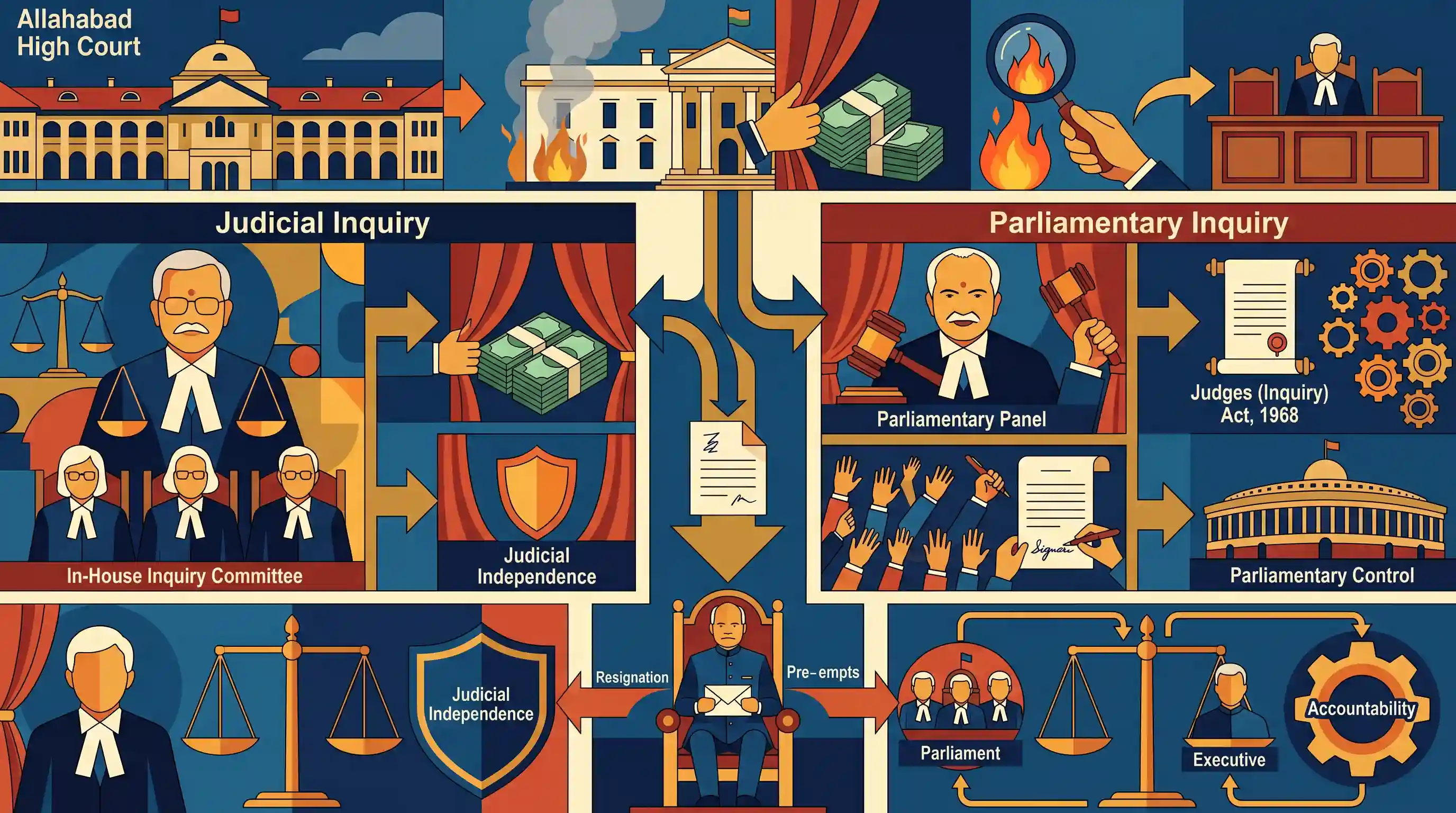
Why It Matters
The event is a rare, real-world application of the procedures laid out in the Judges (Inquiry) Act, 1968, and Article 124(4)/217 of the Constitution. It provides practical context to theoretical GS-II polity questions regarding judicial independence, internal accountability (in-house procedures), and the role of the Parliament in holding the higher judiciary accountable.
Summary
Justice Yashwant Varma of the Allahabad High Court has resigned amidst an ongoing inquiry into unaccounted cash found at his official residence. The incident triggered a rare invocation of the Judges (Inquiry) Act, 1968, with Lok Sabha Speaker Om Birla forming a parliamentary panel to investigate the misconduct. Concurrently, Chief Justice of India Sanjiv Khanna established an in-house inquiry committee. Justice Varma's resignation preempts potential impeachment proceedings and highlights the intricate balance between judicial independence and accountability mechanisms in India.
Key Points
- Allahabad High Court Judge Yashwant Varma resigned ahead of a parliamentary inquiry into his alleged involvement in a cash-at-home scam.
- The inquiry was prompted by the discovery of unaccounted cash in the outhouse of his official residence following a fire.
- Lok Sabha Speaker Om Birla admitted a motion and constituted a panel under the Judges (Inquiry) Act, 1968 to investigate the allegations.
- Chief Justice of India Sanjiv Khanna additionally constituted an in-house inquiry committee to probe the matter, reinforcing internal judicial accountability mechanisms.
- The Supreme Court dismissed Justice Varma's challenge to the Speaker's formation of the inquiry panel.
Important Terms
Judges (Inquiry) Act, 1968

Statutory framework (operationalizing Article 124(5)) regulating investigation of misbehaviour or incapacity of SC/HC judges. It requires a three-member committee (SC judge, HC Chief Justice, eminent jurist) to prove charges before Parliamentary voting.
UPSC context
GS Paper II (Polity). Essential for understanding the legal procedure for judicial oversight and the separation of powers.
Article 124(4) and 217
Constitutional mandates for judge removal. Article 124(4) details the Parliamentary procedure (special majority) for SC judges, which Article 217 extends to High Court judges to safeguard tenure and independence.
UPSC context
GS Paper II. High-frequency topic for Prelims (procedural steps) and Mains (judicial independence vs legislative check).
In-house Procedure (Judiciary)
An internal judicial mechanism (adopted 1999) to investigate misconduct falling below the threshold of impeachment. It allows a peer committee to recommend resignation or withdrawal of work to maintain institutional integrity.
UPSC context
GS Paper II. Crucial for discussing self-regulation, judicial reforms, and the 'Restatement of Values of Judicial Life.'
Judicial Accountability
The principle that the judiciary must remain answerable for ethical conduct and performance. It balances Article 50 (Independence) with the need for transparency, using mechanisms like the 1968 Act and internal inquiries.
UPSC context
GS Paper II (Governance). A recurring Mains theme focusing on the 'Who guards the guardians?' debate in Indian democracy.
Removal of Judges (Impeachment)
The formal removal of a judge for 'proved misbehaviour' or 'incapacity.' Initiated by 100 Lok Sabha or 50 Rajya Sabha members, it requires a special majority in both Houses and a Presidential order.
UPSC context
GS Paper II. Key for understanding the rigorous checks and balances that prevent arbitrary executive or legislative interference in the judiciary.
Prelims Trap
"The procedure for the removal of a High Court judge is detailed in the Constitution of India."
The Constitution only specifies the grounds for removal (proved misbehaviour or incapacity). The step-by-step procedure is actually detailed in a separate statute: the Judges (Inquiry) Act, 1968.
Static Concepts Connected
What is the procedure to remove a High Court or Supreme Court Judge?
- Initiation Phase: A removal motion needs 100 Lok Sabha or 50 Rajya Sabha MPs. The Speaker or Chairman has the discretionary power to admit or reject it.
- Investigation Panel: Upon admission, a three-member statutory committee (Supreme Court Judge, High Court Chief Justice, distinguished jurist) probes the charges.
- Parliamentary Voting: If found guilty, the motion must pass both Houses by a special majority (majority of total membership and 2/3rds present and voting).
- Presidential Order: The President issues the formal removal order under Article 124(4)/217. A judge can preempt this by resigning.
What is the Supreme Court's In-House Procedure?
- Origin & Purpose: Adopted in 1999, it is an internal, self-regulatory mechanism to investigate complaints against judges that fall below the threshold of formal parliamentary impeachment.
- Mechanism: The Chief Justice of India can constitute a fact-finding committee of peer judges to investigate the allegations.
- Corrective Action: Lacking statutory removal power, the CJI can only advise resignation, voluntary retirement, or withdraw judicial work from the tainted judge.
Cross-Topic Patterns
Judicial Independence vs Accountability
The tension between insulating judges from executive pressure and penalizing misconduct is a recurring GS2/GS4 theme, often contrasting self-regulation (In-House mechanism) with external oversight (Judges Inquiry Act, failed NJAC).
The Preemptive Resignation Loophole
Resigning before parliamentary voting causes impeachment motions to lapse. This legal loophole, seen with Justices Varma, Dinakaran, and Sen, allows tainted judges to bypass formal removal and retain post-retirement benefits.

Expect a 2026 Prelims multi-statement question contrasting the statutory Judges (Inquiry) Act procedure with the SC's In-House mechanism.
Linked PYQs · 3
Linked PYQs · 3
- 2019PrelimsGS1
Consider the following statements: 1. The motion to impeach a Judge of the Supreme Court of India cannot be rejected by the Speaker of the Lok Sabha as per the Judges (Inquiry) Act, 1968. 2. The Constitution of India defines and gives details of what constitutes 'incapacity and proved misbehaviour' of the Judges of the Supreme Court of India. 3. The details of the process of impeachment of the Judges of the Supreme Court of India are given in the Judges (Inquiry) Act, 1968. 4. If the motion for the impeachment of a Judge is taken up for voting, the law requires the motion to be backed by each House of the Parliament and supported by a majority of total membership of that House and by not less than two-thirds of total members of that House present and voting. Which of the statements given above is/are correct?
- 2012PrelimsGS1
What is the provision to safeguard the autonomy of the Supreme Court of India? 1. While appointing the Supreme Court Judges, the President of India has to consult the Chief Justice of India. 2. The Supreme Court Judges can be removed by the Chief Justice of India only. 3. The salaries of the Judges are charged on the Consolidated Fund of India to which the legislature does not have to vote. 4. All appointments of officers and staffs of the Supreme Court of India are made by the Government only after consulting the Chief Justice of India. Which of the statements given above is/are correct?
- 2023MainsGS2
“Constitutionally guaranteed judicial independence is a prerequisite of democracy.” Comment.
