Madhya Pradesh High Court Acting Chief Justice Appointment
Source:etvbharat ↗
Why It Matters
The elevation of High Court Chief Justices to the Supreme Court and the appointment of Acting Chief Justices under Article 223 are vital topics for the MPPSC Prelims (Polity and Madhya Pradesh Administration). Additionally, the expansion of the Supreme Court's sanctioned strength via Ordinance-making powers is of significant constitutional importance.
Summary
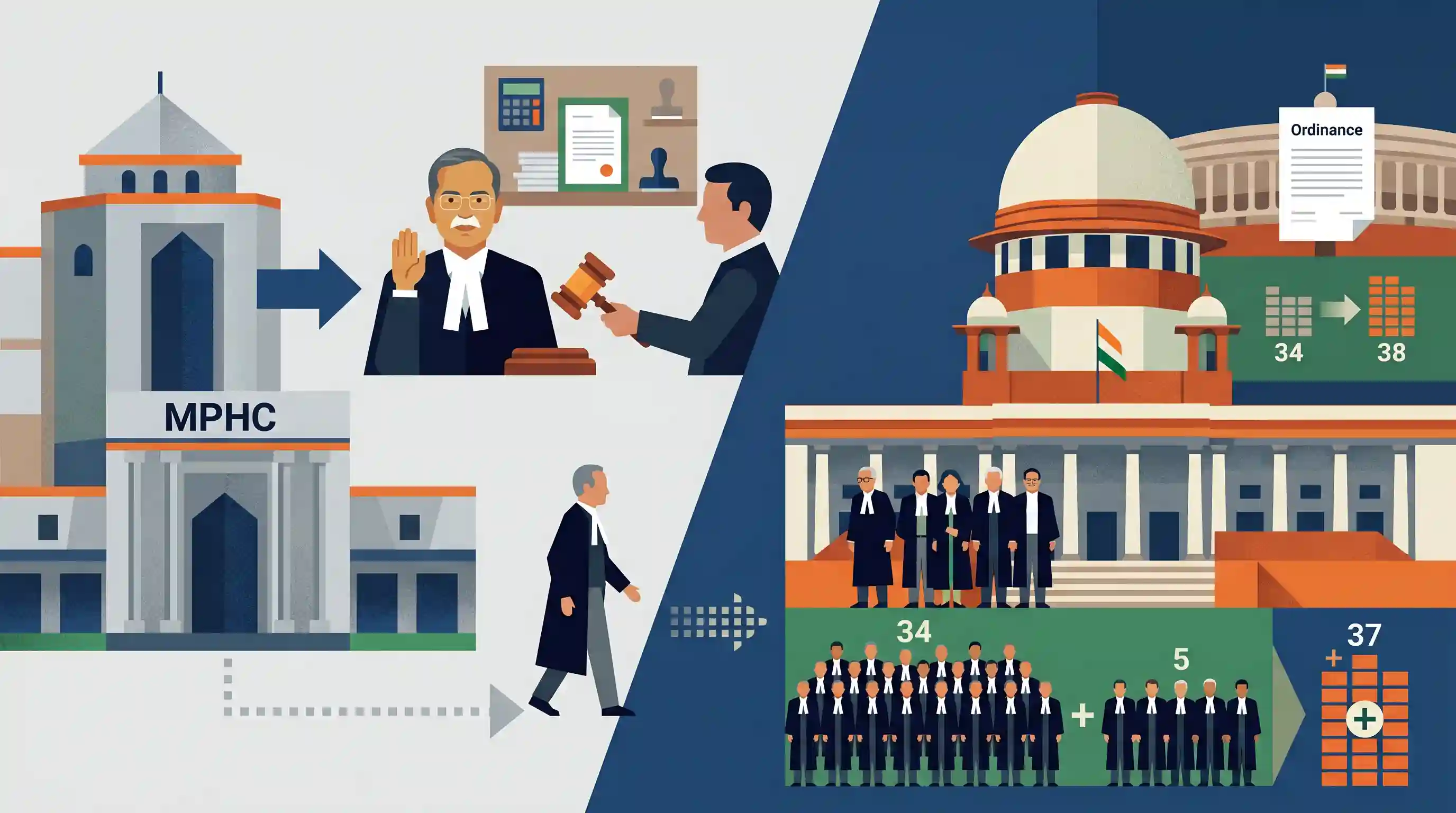
Justice Vivek Rusia has been appointed as the Acting Chief Justice of the Madhya Pradesh High Court following the elevation of Chief Justice Sanjiv Sachdeva to the Supreme Court of India. Along with Justice Sachdeva, four other judges were appointed to the Supreme Court, raising its active strength to 37. This follows an ordinance by the central government that increased the sanctioned strength of Supreme Court judges from 34 to 38. Justice Rusia, who previously served as an administrative judge, was appointed as a permanent judge of the MP High Court in 2018.
Key Points
- Justice Vivek Rusia has been appointed as the Acting Chief Justice of the Madhya Pradesh High Court by the Union Ministry of Law and Justice.
- The vacancy was created following the elevation of Chief Justice Sanjiv Sachdeva of the MP High Court to the Supreme Court of India.
- The central government approved five new appointments to the Supreme Court, raising its active strength to 37 judges, leaving only one vacancy out of the newly expanded strength of 38.
- The sanctioned strength of Supreme Court judges was increased from 34 to 38 via a recent government ordinance.
- Justice Vivek Rusia, born in Jabalpur, completed his BSc and LLB before enrolling in the MP State Bar Council in 1992. He was appointed as a permanent judge of the MP High Court in March 2018.
- Constitutional provisions: Article 223 governs the appointment of an Acting Chief Justice of a High Court, while Article 124 outlines the establishment and constitution of the Supreme Court of India.
Important Terms
Article 223 of the Constitution of India

A constitutional provision that empowers the President of India to appoint a judge of a High Court as an Acting Chief Justice when the office is vacant or unavailable.
UPSC context
GS Paper II: Polity & Governance; tests knowledge of state-level judicial administration, appointments, and constitutional continuity.
Article 124 of the Constitution of India
A constitutional provision establishing the Supreme Court of India, governing the appointment, qualifications, tenure, and removal of its judges, including the Chief Justice.
UPSC context
GS Paper II: Constitutional Provisions & Judiciary; tests understanding of apex court appointments, Collegium system, and judicial independence.
Article 123 of the Constitution of India
A constitutional provision empowering the President of India to promulgate temporary ordinances during parliamentary recess to address urgent matters with the force of law.
UPSC context
GS Paper II: Executive Powers; tests understanding of the executive’s legislative powers, its limitations, and parliamentary oversight.
Madhya Pradesh High Court
The premier judicial organ of Madhya Pradesh, established in 1956, with its principal seat in Jabalpur and permanent benches in Gwalior and Indore.
UPSC context
GS Paper II: State Judiciary; tests state-specific judicial structure, history, and benches (important for MPPSC and UPSC state-focused questions).
States Reorganisation Act, 1956
A landmark 1956 legislative act that redrew India's state boundaries on linguistic lines and led to the reconstitution of regional High Courts.
UPSC context
GS Paper I & II: Post-Independence Consolidation; tests historical federal reorganization, evolution of state boundaries, and administrative consolidation.
Article 224 of the Constitution of India
A constitutional provision enabling the temporary appointment of additional and acting High Court judges by the President to manage caseload backlogs or temporary vacancies.
UPSC context
GS Paper II: High Court Functioning; tests mechanisms to address judicial pendency, temporary appointments, and administrative flexibility.
Prelims Trap
The Governor of the respective State appoints the Acting Chief Justice of a High Court during a vacancy.
Under Article 223, the power to appoint an Acting Chief Justice of a High Court rests solely with the President of India, not the Governor of the State.
Static Concepts Connected
How is the strength of the Supreme Court of India increased?
- Parliamentary Authority: Article 124(1) vests the power to increase the number of Supreme Court judges solely in Parliament through legislative acts.
- Statutory Mechanism: It is amended periodically via the Supreme Court (Number of Judges) Act, 1956.
- Ordinance Route: The executive can temporarily increase strength via a Presidential Ordinance under Article 123 when Parliament is recessing, which must later be approved by Parliament.
What is the constitutional distinction between Additional and Ad-hoc Judges?
- Additional Judges: Appointed under Article 224(1) exclusively in High Courts for up to two years to clear backlogs; no such provision exists for the Supreme Court.
- Ad-hoc Judges: Appointed under Article 127 exclusively in the Supreme Court by the CJI (with President's consent) when a quorum of permanent judges is lacking.
- Age Limits: High Court judges retire at 62 (including acting/additional), whereas Supreme Court judges (including ad-hoc/retired) have an upper limit of 65.
Cross-Topic Patterns
Ordinance power & judicial expansion
Using Article 123 to expand judicial strength under Article 124 highlights the executive's intervention in managing judicial backlogs, linking legislative delegation with judicial administration.
Integrated judiciary & federal dynamics
Though High Courts operate at the state level, the President’s sole authority to appoint permanent and Acting CJs (Article 223) underscores India's integrated, non-federal judicial architecture.

Statement-based questions on the distinct provisions of Additional Judges (HCs only) versus Ad-hoc Judges (SC only) highly probable in 2026.
Linked PYQs · 2
Linked PYQs · 2
- 2020MPPSC_PRELIMSGS1
Who among the following Chief Justice of Madhya Pradesh High Court has not been the Judge at Supreme Court of India?
- 2020MPPSC_PRELIMSGS1
Which of the following type of Judge/Judges can be appointed in the Supreme Court of India? (i) ad hoc Judge (ii) Additional Judge ## Codes:
