Legal experts express concern over RTI Act dilution and transparency
Source:The Hindu ↗
Why It Matters
This article bridges several core GS2 syllabus areas: transparency in governance (the weakening of the RTI Act), the evolving role of the judiciary (live-streaming courts and its consequences), and fundamental rights (the tension between the Right to be Forgotten and public records). These themes are frequent topics in UPSC Mains, providing candidates with recent expert arguments on the balance between privacy, transparency, and regulation.
Summary
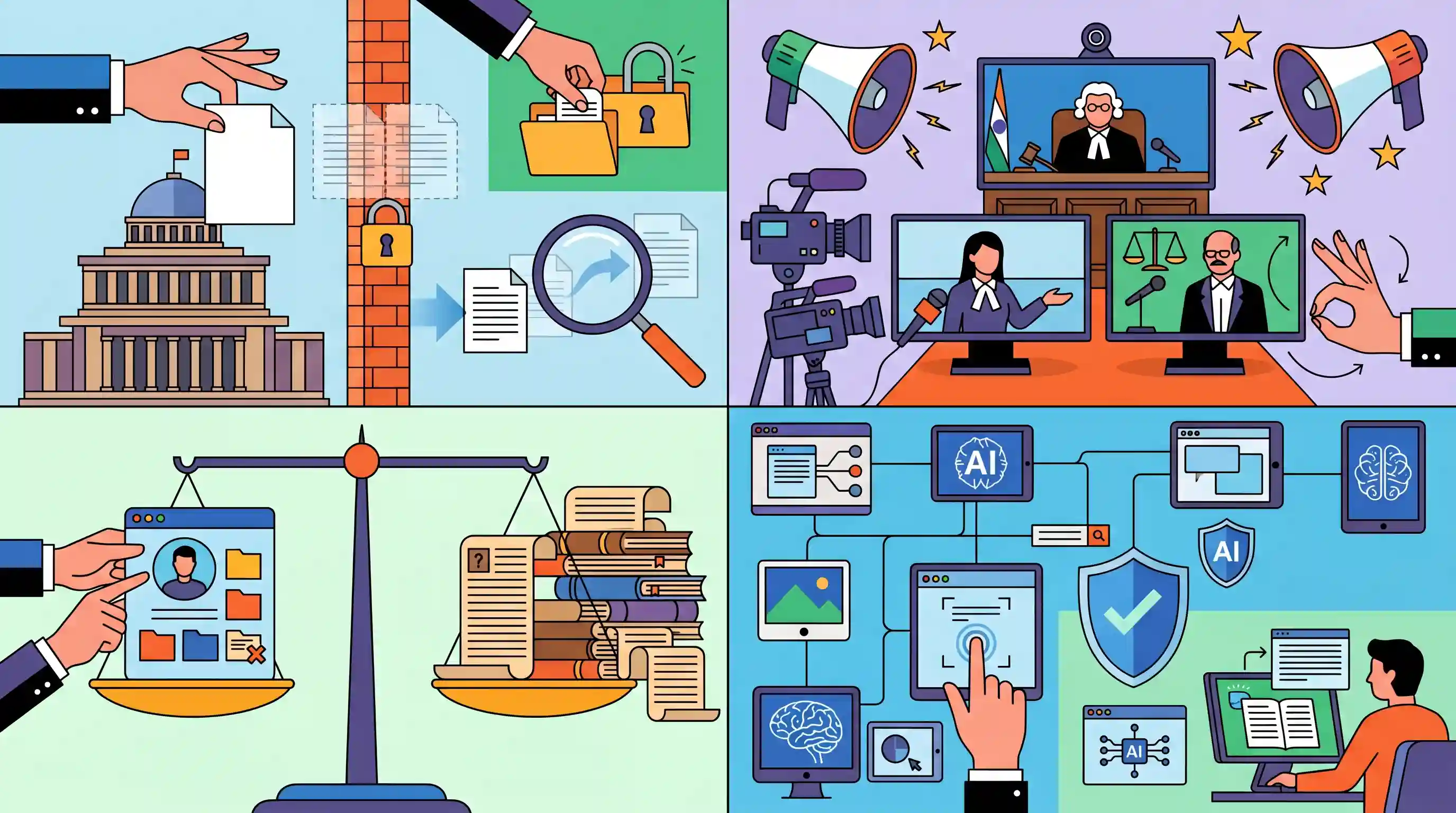
At the 'Justice Unplugged' legal conclave, experts raised concerns over the dilution of the Right to Information (RTI) Act, arguing that the difficulty in obtaining information from Central agencies is undermining democratic accountability. The panel highlighted the challenges of live-streaming court proceedings, urging the Bench and Bar to exercise restraint to prevent media sensationalization of judicial remarks. Additionally, they debated the 'Right to be Forgotten' against the necessity of preserving public records, and concluded that current frameworks like the IT Act are adequate for regulating online obscenity, provided citizens receive digital literacy to navigate AI and emerging digital structures.
Key Points
- Legal experts note that the RTI Act is experiencing a 'dead phase,' with Central agencies frequently denying information requests, which weakens democratic accountability.
- The live-streaming of court proceedings requires judicial restraint, as sensational or off-the-cuff remarks made by the Bench or Bar are quickly amplified by the media, potentially affecting the integrity of the judicial process.
- The 'Right to be Forgotten' was debated, with arguments that legal charges and acquittals are matters of public record; completely erasing an individual's digital past risks sanitizing history.
- Experts argued that existing laws, such as the IT Act, 2000 and current criminal laws, are sufficient to regulate obscenity and abusive content on digital platforms without the need for new legislation.
- There is a critical need for widespread digital literacy to enable citizens to critically engage with Artificial Intelligence and modern digital power structures.
Important Terms
Right to Information (RTI) Act

A 2005 law ensuring transparency by allowing citizens to access government-held records. Recent amendments via the DPDP Act have restricted disclosure of personal information.
UPSC context
GS Paper 2: Governance, Transparency & Accountability. Tests understanding of citizen empowerment and legislative challenges.
Right to be Forgotten
A framework allowing individuals to request the removal of personal data from the internet if it is outdated, irrelevant, or violates privacy.
UPSC context
GS Paper 2: Fundamental Rights (Article 21). Tests the balance between individual privacy and public records.
Digital Personal Data Protection (DPDP) Act, 2023
Legislation governing data processing in India. It introduces the Right to Erasure but is criticized for amending Section 8(1)(j) of the RTI Act, limiting public transparency.
UPSC context
GS Paper 2 & 3: Governance and Cybersecurity. Focuses on data sovereignty and privacy-transparency trade-offs.
Information Technology (IT) Act, 2000
India's primary law for electronic governance and cybercrimes. It serves as the baseline for regulating online content, digital literacy, and emerging AI structures.
UPSC context
GS Paper 3: IT & Computers. Essential for understanding the legal evolution of India's digital ecosystem.
Constitutional Morality
The principle that judicial and state actions must adhere to constitutional values (equality, liberty) rather than majoritarian or social morality.
UPSC context
GS Paper 2: Indian Constitution and Judiciary. Tests the philosophical underpinnings of judicial review and restraint.
Prelims Trap
The 'Right to be Forgotten' guarantees the absolute removal of an individual's past legal and criminal records from all platforms.
RTBF is not absolute. Derived from the Puttaswamy judgment (Article 21), it is consistently weighed against the public's right to information, historical accuracy, and the necessity of maintaining legal records.
Static Concepts Connected
How did the RTI (Amendment) Act, 2019 alter the Information Commission's autonomy?
- Tenure Control: Replaced the fixed 5-year statutory term with a tenure prescribed directly by the Central Government.
- Salary Determination: Removed structural parity with Election Commissioners; salaries, allowances, and service conditions are now dictated by the Centre.
What is the constitutional and statutory basis for the Right to be Forgotten?
- Puttaswamy Judgment: The Supreme Court recognized it as an essential subset of informational privacy under Article 21 (Right to Life and Personal Liberty).
- DPDP Act 2023: Provides statutory backing via the 'Right to Erasure', allowing individuals to request deletion of personal data once its purpose is served.
- Reasonable Restrictions: It is not absolute and cannot override the necessity of preserving public records, freedom of expression, or larger public interest.
Cross-Topic Patterns
Open Courts vs. Media Trials
The tension between Article 21 access to justice via live-streaming and media sensationalism connects directly to broader syllabus themes of judicial accountability and contempt of court.
RTBF in the era of Generative AI
The Right to be Forgotten intersects heavily with AI regulation. LLMs scraping public legal records make true data erasure technically unfeasible, challenging enforcement of the new DPDP Act.

Expect a 2026 prelims question pairing the RTI Amendment Act of 2019 with the DPDP Act of 2023 to test the transparency-privacy balance.
Linked PYQs · 4
Linked PYQs · 4
- 2020MainsGS2
Recent amendments to the Right to Information Act will have profound impact on the autonomy and independence of the Information Commission". Discuss.
- 2024MainsGS2
Right to privacy is intrinsic to life and personal liberty and is inherently protected under Article 21 of the constitution. Explain. In this reference discuss the law relating to D.N.A. testing of child in the womb to establish its paternity.
- 2017MainsGS2
Examine the scope of Fundamental Rights in the light of the latest judgement of the Supreme Court on Right to Privacy.
- 2024MainsGS3
Social media and encrypting messaging services pose a serious security challenge. What measures have been adopted at various levels to address the security implications of social media? Also suggest any other remedies to address the problem.
