Justice Surya Kant assumes office as 53rd Chief Justice of India
Source:The Hindu ↗
Why It Matters
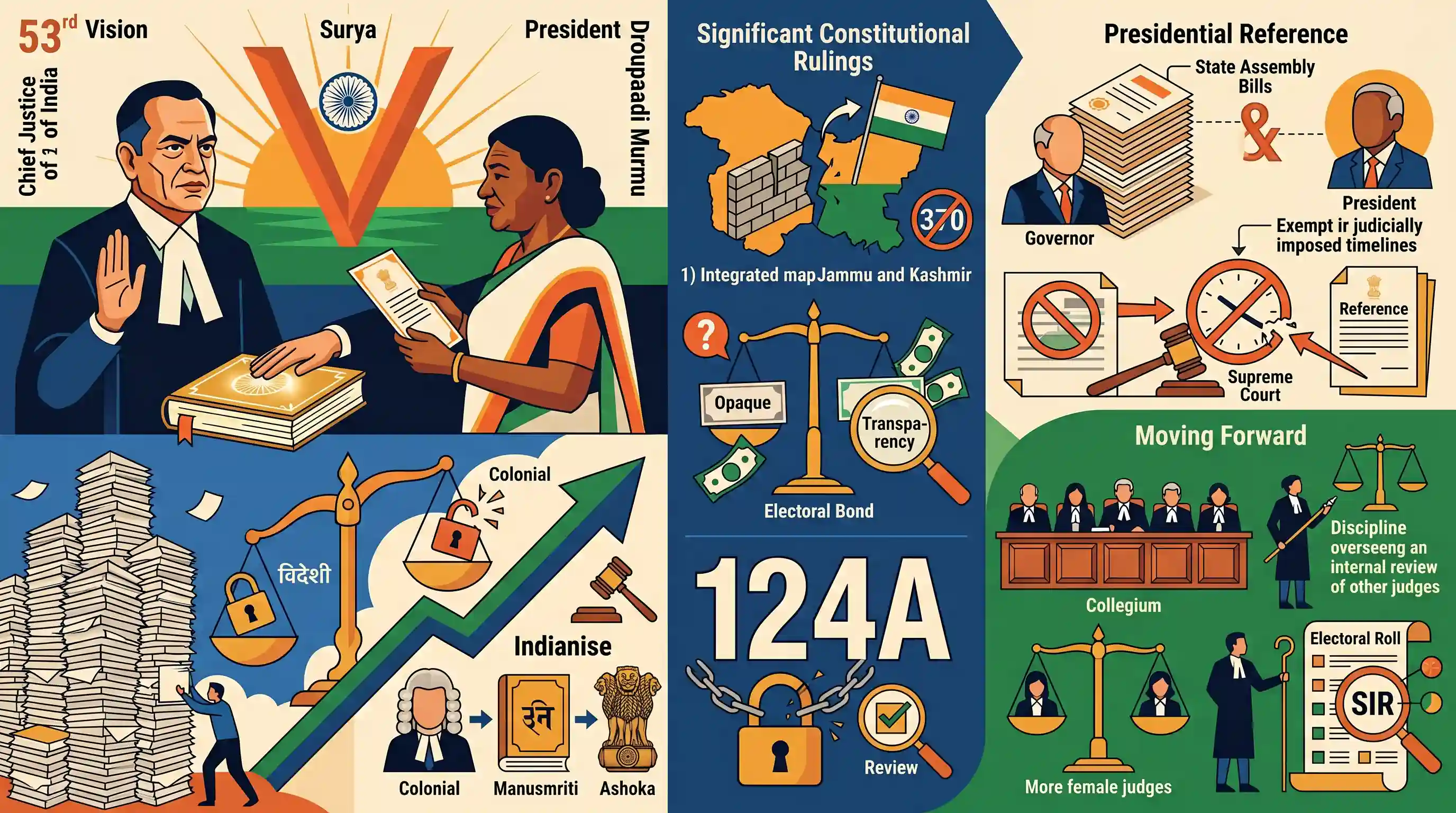
The appointment of a new Chief Justice is a major constitutional event. His stated priorities—reducing judicial pendency and 'Indianising' jurisprudence—highlight ongoing structural reforms in the justice delivery system. Furthermore, his past rulings on the Governor's powers over State Bills and Article 370 directly intersect with core GS-2 syllabus themes covering federalism, the separation of powers, and the functioning of the higher judiciary.
Summary
Justice Surya Kant has been sworn in as the 53rd Chief Justice of India by President Droupadi Murmu, embarking on a tenure that will last until February 2027. Outlining his vision, he prioritized tackling the Supreme Court's backlog of over 90,000 cases and emphasized 'Indianising' the judiciary by pivoting away from foreign and colonial precedents. A veteran of historic Constitution Benches dealing with the abrogation of Article 370, Electoral Bonds, and the Sedition Law, he is also known for authoring a crucial Presidential Reference opinion affirming that constitutional heads (President and Governors) are exempt from judicially imposed timelines on State Bills. Moving forward, he must navigate Collegium dynamics to elevate more women to the higher judiciary and handle internal judicial discipline.
Key Points
- Justice Surya Kant was sworn in as the 53rd Chief Justice of India by President Droupadi Murmu, with a tenure lasting until February 2, 2027.
- He prioritized clearing the Supreme Court's massive pendency of over 90,000 cases.
- He emphasized the need to incorporate 'Indianness' into the justice system by relying on domestic precedents and ancient Indian texts rather than colonial or foreign jurisprudence.
- Justice Kant previously authored the 16th Presidential Reference opinion, stating that the President and Governors are not bound by judicially imposed timelines when considering State Bills.
- He was a key member of Constitution Benches that ruled on major issues like the abrogation of Article 370, the unconstitutionality of Electoral Bonds, and the Pegasus spyware case.
- As CJI, he faces challenges including resolving Collegium deadlocks to appoint more women judges and addressing internal disciplinary matters regarding High Court judges.
Important Terms
Article 370

A constitutional provision (now abrogated) that granted special autonomous status to Jammu and Kashmir. The Supreme Court upheld its 2019 repeal, affirming India's indivisible sovereignty and Parliament's power.
UPSC context
GS Paper II: Federalism and Constitutional Amendments. Tests understanding of Centre-State relations and judicial review of executive actions.
Electoral Bonds Scheme
A now-defunct political funding system struck down by the Supreme Court for violating the "Right to Know" under Article 19(1)(a). It allowed anonymous donations to political parties via bank instruments.
UPSC context
GS Paper II: Transparency & Accountability, Elections. Tests knowledge of electoral reforms and fundamental rights.
Sedition Law
Section 124A of the IPC, a colonial-era provision criminalizing speech that incites "disaffection" against the government. The Supreme Court kept it in abeyance pending legislative review to protect free speech.
UPSC context
GS Paper II: Fundamental Rights (Freedom of Speech). Tests awareness of colonial-era laws versus modern constitutional morality.
Collegium
A system where the CJI and senior-most SC judges recommend appointments and transfers of judges. It evolved through the "Three Judges Cases" to ensure judicial independence from executive interference.
UPSC context
GS Paper II: Judiciary, Appointment of Judges. Tests knowledge of judicial independence and the balance of power.
Presidential Reference
The President's power under Article 143 to seek the Supreme Court's opinion on questions of law. A recent reference clarified that constitutional heads cannot be bound by judicially-imposed timelines.
UPSC context
GS Paper II: Powers of President and Supreme Court. Tests understanding of advisory jurisdiction and constitutional checks.
Judicial Pendency
The massive backlog of undecided cases in courts. Addressing this is a primary goal for the CJI, focusing on mediation and systemic efficiency to ensure "timely justice."
UPSC context
GS Paper II: Structure & Functioning of Judiciary. Tests understanding of barriers to justice and administrative reforms.
Prelims Trap
"A State Bill receives 'deemed assent' if the Governor fails to act on it within a judicially mandated timeframe."
The Supreme Court explicitly rejected 'deemed assent' and ruled that courts cannot impose fixed timelines on constitutional heads under Articles 200/201, citing separation of powers.
Static Concepts Connected
What are the key features of the Supreme Court's Advisory Jurisdiction (Article 143)?
- Presidential Reference: The President can seek the Supreme Court's opinion on any question of law or fact of public importance.
- Not Binding: The opinion tendered by the Supreme Court is purely advisory and is not binding on the President.
- Mandatory vs Discretionary: For disputes arising from pre-Constitution treaties or agreements, the Supreme Court is obligated to tender its opinion.
What options does a Governor have under Article 200 regarding State Bills?
- Assent Options: The Governor may give assent, withhold assent, or return the Bill (if not a Money Bill) for reconsideration.
- Presidential Reservation: The Governor can reserve the Bill for the President's consideration (mandatory if it derogates the powers of the High Court).
- No Time Limit: The Constitution deliberately avoids specifying a time limit for the Governor to act, a gap often leading to State-Centre litigation.
Cross-Topic Patterns
Governor's Assent & Separation of Powers
The 16th Presidential Reference links federal tensions over delayed State Bills directly to the Separation of Powers doctrine, preventing judicial overreach into executive/legislative domains.
Decolonization of laws and BNS transition
The CJI's push for 'Indianness' conceptually mirrors the recent transition from colonial-era IPC/CrPC to the Bharatiya Nyaya Sanhita (BNS), reflecting a broader systemic shift toward indigenous jurisprudence.

A combined Prelims 2026 question testing Article 143 (Advisory Jurisdiction), Article 200 (Governor's assent), and 'deemed assent' is highly likely.
Linked PYQs · 4
Linked PYQs · 4
- 2025MainsGS2
Discuss the evolution of collegium system in India. Critically examine the advantages and disadvantages of the system of appointment of the Judges of the Supreme Court of India and that of the USA.
- 2017MainsGS2
Critically examine the Supreme Court's judgement on 'National Judicial Appointments Commission Act, 2014' with reference to appointment of judges of higher judiciary in India.
- 2025PrelimsGS1
Consider the following statements : I. The Constitution of India explicitly mentions that in certain spheres the Governor of a State acts in his/her own discretion. II. The President of India can, of his/her own, reserve a bill passed by a State Legislature for his/her consideration without it being forwarded by the Governor of the State concerned. Which of the statements given above is/are correct?
- 2016MainsGS2
To what extent is Article 370 of the Indian Constitution, bearing marginal note "Temporary provision with respect to the State of Jammu and Kashmir", temporary? Discuss the future prospects of this provision in the context of Indian polity.
