Appointment of Justice Surya Kant as Chief Justice of India
Source:Indian Express ↗
Why It Matters
The appointment of the Chief Justice of India is a core constitutional process (Article 124). Justice Surya Kant's impending tenure highlights ongoing debates about the Collegium system, judicial independence, pendency, and the affordability of legal recourse—recurring topics in GS2 Polity.
Summary
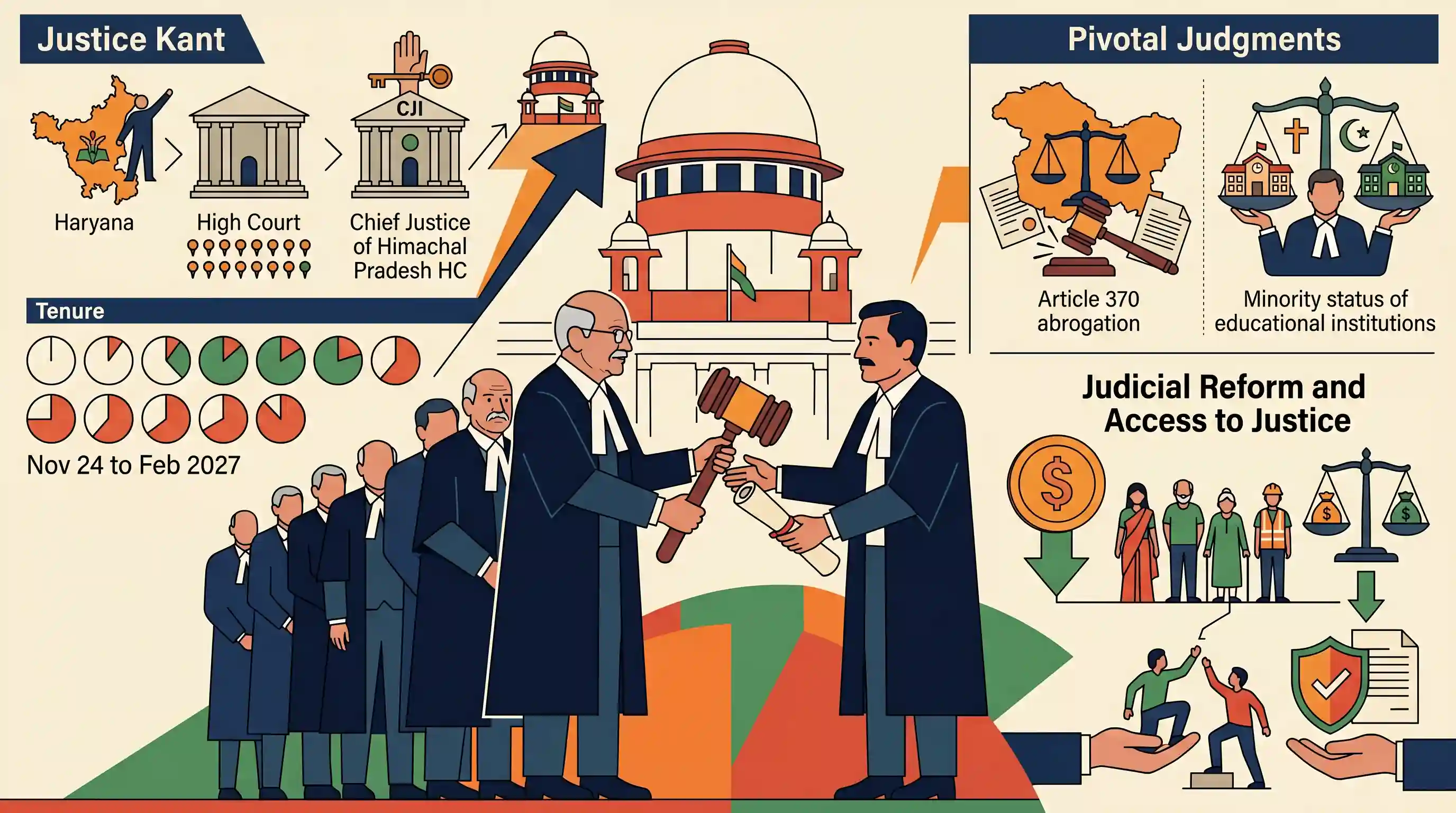
Justice Surya Kant has been officially appointed as the 53rd Chief Justice of India (CJI). Taking over from CJI B R Gavai, he will assume office on November 24 for a 15-month tenure ending in February 2027. Making history as the first CJI from Haryana, Justice Kant brings substantial legal and judicial experience, including serving as a High Court judge for 14 years and Chief Justice of the Himachal Pradesh High Court. During his tenure at the Supreme Court, he has authored and contributed to pivotal judgments, including the uphold of Article 370's abrogation and cases regarding the minority status of educational institutions. He is also known for advocating structural reforms to reduce legal costs and improve free legal aid for marginalized sections.
Key Points
- Justice Surya Kant has been appointed as the 53rd Chief Justice of India, succeeding CJI B R Gavai, with his term beginning on November 24 and lasting 15 months.
- He is the first judge from Haryana to become the Chief Justice of India, having previously served as the state's youngest Advocate General and Chief Justice of the Himachal Pradesh High Court.
- Justice Kant has been a vocal advocate for accessible justice, recently highlighting the necessity of legal aid by noting that steep legal fees often "eclipse monthly incomes."
- He has been part of critical Supreme Court Constitution benches, including those delivering verdicts on the abrogation of Article 370 and examining the minority status of Aligarh Muslim University.
Important Terms
Chief Justice of India (CJI)

The highest-ranking officer of the Indian judiciary and head of the Supreme Court, responsible for administrative tasks like case allocation (Master of the Roster) and leading the Collegium.
UPSC context
GS Paper II: Appointments to various Constitutional posts, powers, functions, and responsibilities of various Constitutional Bodies.
Supreme Court Collegium
A system for the appointment and transfer of judges in the Supreme Court and High Courts, comprising the CJI and four senior-most SC judges, evolved through the 'Three Judges Cases'.
UPSC context
GS Paper II: Structure, organization, and functioning of the Judiciary; tests the concept of judicial independence and executive-judicial balance.
Article 370
A temporary constitutional provision that granted special autonomous status to Jammu and Kashmir; its abrogation in 2019 was upheld by a Constitution Bench including Justice Surya Kant.
UPSC context
GS Paper II: Indian Constitution—historical underpinnings, evolution, features, and significant provisions; Federalism and Special Provisions.
Article 30
A fundamental right under the Indian Constitution that grants religious and linguistic minorities the right to establish and administer educational institutions of their choice.
UPSC context
GS Paper II: Fundamental Rights and protection of interests of minority groups; relevant to the Aligarh Muslim University (AMU) case.
National Legal Services Authority (NALSA)
A statutory body established under the Legal Services Authorities Act, 1987, to provide free legal services to the weaker sections and organize Lok Adalats for amicable settlement.
UPSC context
GS Paper II: Welfare schemes for vulnerable sections; Access to justice and the role of free legal aid.
Prelims Trap
The Constitution prescribes a fixed minimum tenure for the Chief Justice of India to ensure judicial independence.
The Constitution does not fix a tenure in years. Under Article 124(2), a Supreme Court judge simply holds office until attaining the retirement age of 65.
Static Concepts Connected
How is the Chief Justice of India appointed?
- Constitutional mandate: Under Article 124(2), the President appoints SC judges, but the Collegium system effectively dictates the choice.
- Seniority convention: The outgoing CJI recommends the senior-most judge of the Supreme Court as their successor, barring exceptional circumstances.
- MoP Role: The Memorandum of Procedure (MoP) is the guiding document framing the executive-judiciary interaction for final appointments.
What are the constitutional provisions for free legal aid?
- Article 39A (DPSP): Added by the 42nd Amendment, it directs the State to provide free legal aid to ensure justice is not denied due to economic disabilities.
- Statutory framework: The Legal Services Authorities Act, 1987 established NALSA to monitor, implement, and fund legal aid programs across India.
Cross-Topic Patterns
Free Legal Aid + Article 39A
Justice Kant's focus on legal costs connects to Article 39A (DPSP) and NALSA's statutory role, a theme frequently tested alongside fundamental rights to fair trial.
Article 30(1) + AMU minority status
His involvement in the AMU case links to the broader constitutional debate on the degree of state regulation allowed over minority educational institutions.

Expect a 2026 prelims question mixing CJI appointment conventions (MoP) with constitutional provisions like Article 124(2) and age limits.
Linked PYQs · 5
Linked PYQs · 5
- 2025MainsGS2
Discuss the evolution of collegium system in India. Critically examine the advantages and disadvantages of the system of appointment of the Judges of the Supreme Court of India and that of the USA.
- 2017MainsGS2
Critically examine the Supreme Court's judgement on 'National Judicial Appointments Commission Act, 2014' with reference to appointment of judges of higher judiciary in India.
- 2023MainsGS2
“Constitutionally guaranteed judicial independence is a prerequisite of democracy.” Comment.
- 2014PrelimsGS1
The power to increase the number of judges in the Supreme Court of India is vested in
- 2012PrelimsGS1
What is the provision to safeguard the autonomy of the Supreme Court of India? 1. While appointing the Supreme Court Judges, the President of India has to consult the Chief Justice of India. 2. The Supreme Court Judges can be removed by the Chief Justice of India only. 3. The salaries of the Judges are charged on the Consolidated Fund of India to which the legislature does not have to vote. 4. All appointments of officers and staffs of the Supreme Court of India are made by the Government only after consulting the Chief Justice of India. Which of the statements given above is/are correct?
