Judicial Appointments and Executive Influence on Collegium System
Source:The Hindu ↗
Why It Matters
This article addresses core issues of judicial independence, separation of powers, and the friction between the executive and judiciary regarding the Collegium system of appointment, making it vital for GS Paper II.
Summary
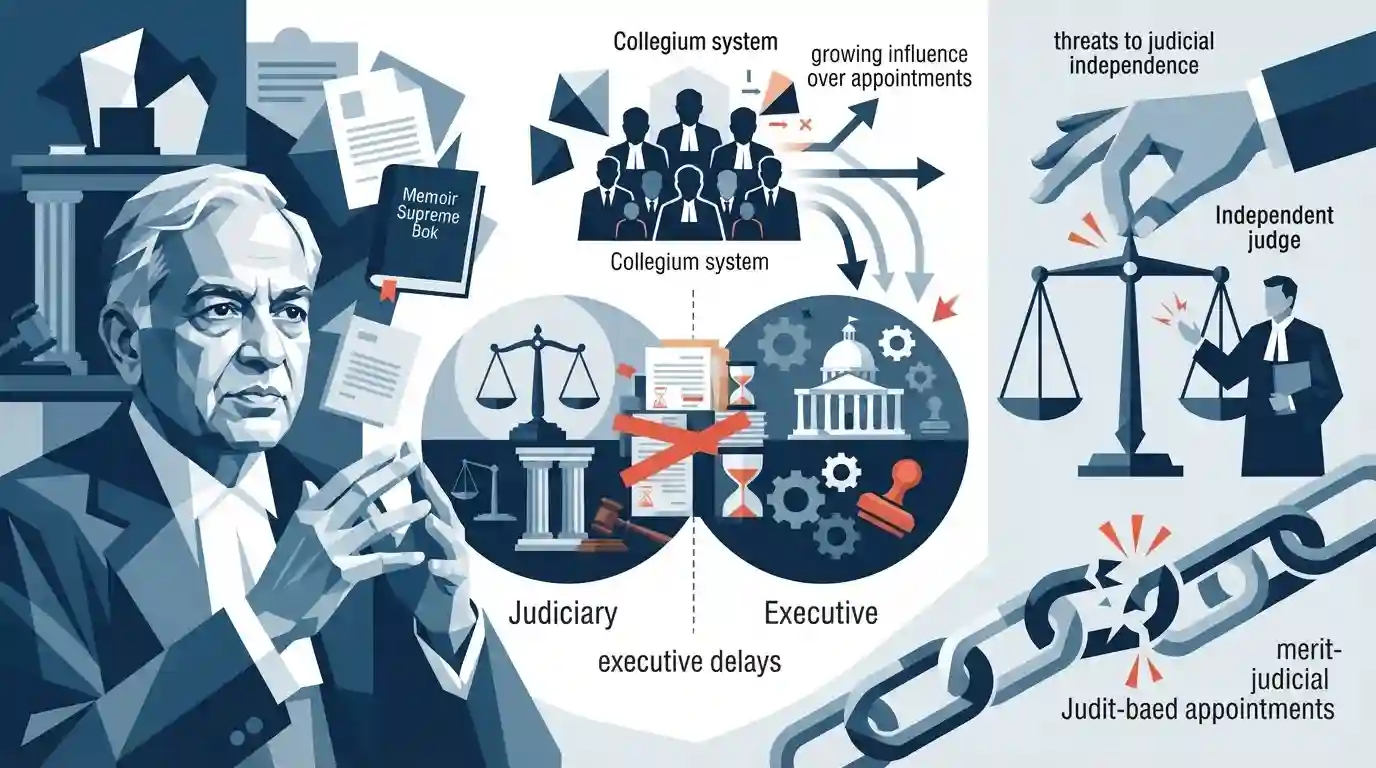
In an interview regarding his memoir, former Supreme Court judge Justice Sanjay Kishan Kaul addresses structural challenges facing the Indian judiciary, particularly executive delays and growing influence over the Collegium system for judicial appointments, underscoring threats to judicial independence.
Key Points
- Former Supreme Court judge Justice Sanjay Kishan Kaul discusses his memoir 'Without Fear or Favour', highlighting judicial independence.
- Raises concerns regarding the executive's growing influence and delays in clearing recommendations made by the Collegium system.
- Emphasizes the tension between the judiciary and executive over judicial appointments and institutional checks and balances.
Important Terms
Collegium System

A judicial mechanism evolved through Supreme Court judgments for appointing and transferring judges to higher courts, ensuring judicial primacy and independence from executive influence.
UPSC context
UPSC Mains GS Paper II: Structure, organization, and functioning of the Judiciary and executive-judicial relations.
Supreme Court of India
The highest constitutional court of India, serving as the ultimate guardian of the Constitution, court of appeal, and guarantor of fundamental rights.
UPSC context
UPSC Mains GS Paper II: Organs of the State, judicial review, and separation of powers.
National Judicial Appointments Commission Act
A statutory body proposed via the 99th Constitutional Amendment to replace the collegium system with a mixed-member panel, struck down for violating judicial independence.
UPSC context
UPSC Mains GS Paper II: Constitutional amendments, basic structure doctrine, and separation of powers.
Prelims Trap
binding reiterations must be cleared within a fixed constitutional deadline
Aspirants often assume that reiterated recommendations by the Collegium are legally binding with a strict time-limit prescribed by the Constitution, whereas the current system operates on constitutional convention rather than explicit statutory deadlines.
Static Concepts Connected
How did the Supreme Court Collegium system evolve through the Three Judges Cases?
- First Judges Case: First Judges Case (1981) held that 'consultation' with the Chief Justice of India did not mean 'concurrence', giving primacy to the executive in judicial appointments.
- Second Judges Case: Second Judges Case (1993) introduced the Collegium system, ruling that 'consultation' meant 'concurrence' and primacy rested with the Chief Justice of India and senior judges.
- Third Judges Case: Third Judges Case (1998) expanded the Collegium to a body of the CJI and four senior-most judges for Supreme Court appointments and clarified consultation norms.
Cross-Topic Patterns
Judicial Appointments and Executive Overreach
The friction over the Memorandum of Procedure (MoP) mirrors broader legislative-executive disputes regarding constitutional appointments and institutional oversight mechanisms.

Expect a statement-based prelims question on the Memorandum of Procedure (MoP), Collegium mechanics, and whether the NJAC verdict remains binding.
Linked PYQs · 3
Linked PYQs · 3
- 2025MainsGS2
Discuss the evolution of collegium system in India. Critically examine the advantages and disadvantages of the system of appointment of the Judges of the Supreme Court of India and that of the USA.
- 2025MainsGS2
"Constitutional morality is the fulcrum which acts as an essential check upon the high functionaries and citizens alike...." In view of the above observation of the Supreme Court, explain the concept of constitutional morality and its application to ensure balance between judicial independence and judicial accountability in India.
- 2017MainsGS2
Critically examine the Supreme Court's judgement on 'National Judicial Appointments Commission Act, 2014' with reference to appointment of judges of higher judiciary in India.
