Madras High Court Chief Justice Appointment and Constitutional Context
Source:The Hindu ↗
Why It Matters
The appointment of a High Court Chief Justice involves the President, the Governor, and the Supreme Court Collegium, making it a classic example of the constitutional mechanisms outlined in GS2. The mention of the 1862 establishment of the chartered Madras High Court is relevant for Prelims Polity/History, while the Bhopal Gas tragedy reference serves as a pertinent case study in disaster management (GS3) and industrial ethics (GS4).
Summary
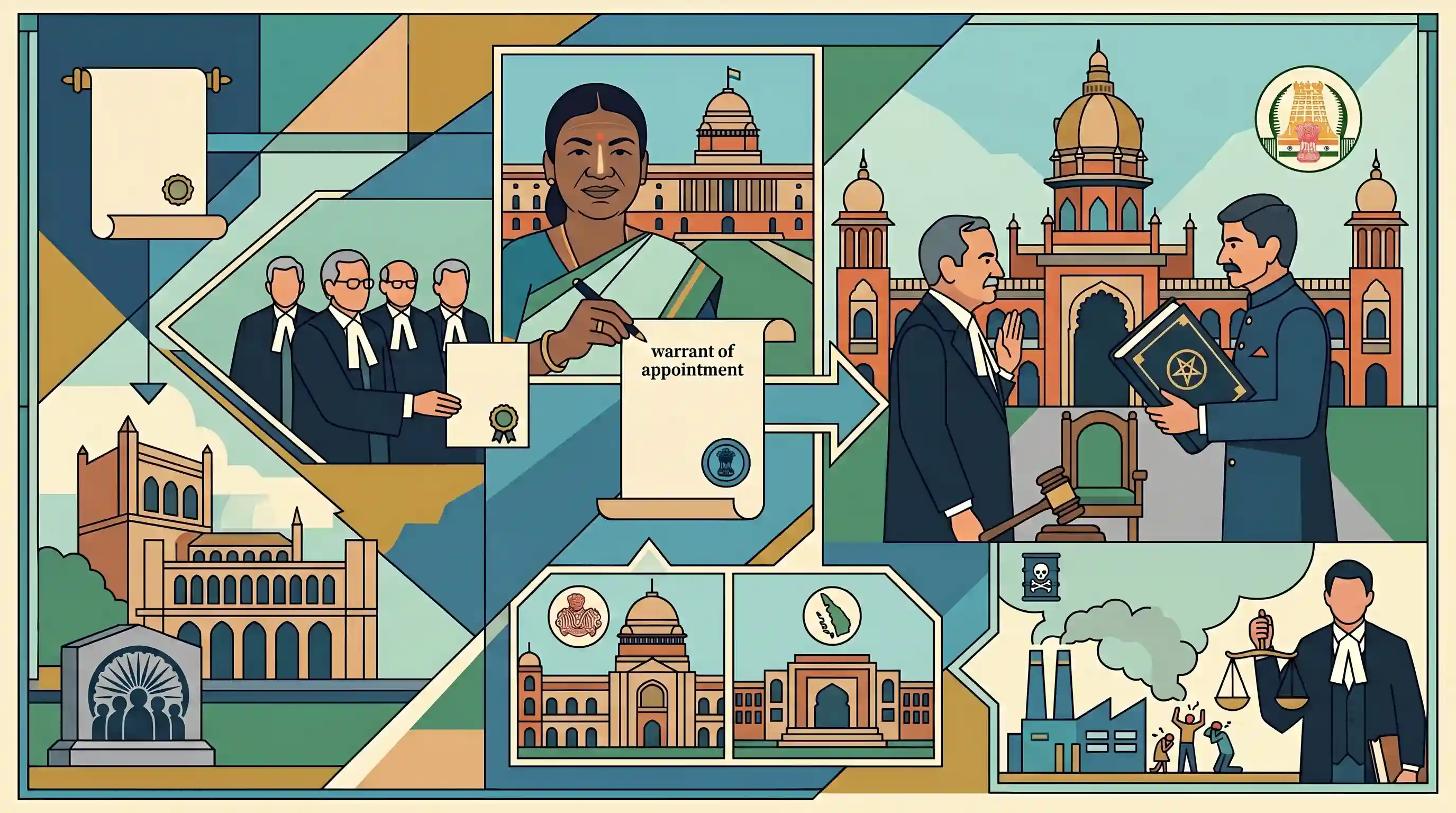
The article reports the swearing-in of Justice S.A. Dharmadhikari as the 55th Chief Justice of the Madras High Court. The oath was administered by Tamil Nadu Governor R.N. Ravi in Chennai, following a warrant of appointment issued by President Droupadi Murmu on the recommendation of the Supreme Court Collegium. Justice Dharmadhikari, who has previously served in the Madhya Pradesh and Kerala High Courts, is the 55th Chief Justice of this historic chartered high court established in 1862. His legal career includes serving as counsel for the victims of the Bhopal Gas Tragedy.
Key Points
- Justice S.A. Dharmadhikari was sworn in as the 55th Chief Justice of the Madras High Court.
- Tamil Nadu Governor R.N. Ravi administered the oath after President Droupadi Murmu issued the warrant of appointment.
- His appointment was recommended by a Supreme Court Collegium that included CJI Surya Kant, Justice Vikram Nath, and Justice J.K. Maheshwari.
- The Madras High Court is one of the historic chartered High Courts in India, having been established in August 1862.
- Justice Dharmadhikari previously served as a judge in the Madhya Pradesh and Kerala High Courts, and notably represented victims of the Bhopal Gas Tragedy as counsel for the welfare commissioner.
Important Terms
Madras High Court

One of India's three original "chartered" High Courts, established in 1862. It holds jurisdiction over Tamil Nadu and Puducherry and operates from a historic Indo-Saracenic complex in Chennai.
UPSC context
GS Paper II: Judiciary. Tests knowledge of India's oldest judicial institutions and the evolution of High Courts under the British Crown.
Supreme Court Collegium
A non-constitutional system evolved through Supreme Court judgments (Three Judges Cases) where the Chief Justice of India and senior-most judges recommend appointments and transfers of judges.
UPSC context
GS Paper II: Appointment to Constitutional posts. Tests understanding of judicial independence versus executive interference in the appointment process.
Warrant of Appointment
A formal order issued by the President of India under Article 217 for High Courts (or Article 124 for the SC) to officially appoint a judge.
UPSC context
GS Paper II: Constitutional Bodies. Focuses on the procedural requirements and executive-judicial balance in high-level constitutional appointments.
High Court of Madhya Pradesh
The principal civil court of original jurisdiction in Madhya Pradesh, established in 1956. It is the 'parent court' for several senior Indian judges, including Justice S.A. Dharmadhikari.
UPSC context
GS Paper II: Judiciary. Relevant for understanding the 'parent court' concept in judicial transfers and promotions within the Indian federal structure.
Kerala High Court
The highest court in the state of Kerala and the Union Territory of Lakshadweep, established in 1956, headquartered at Kochi.
UPSC context
GS Paper II: Separation of Powers. Significant for its jurisdiction over multiple administrative units and its role in judicial transfers.
Indian High Courts Act, 1861
Legislation passed by the British Parliament enabling the creation of High Courts in Calcutta, Madras, and Bombay by merging the Supreme Courts and Sadar Adalats.
UPSC context
GS Paper I & II: Historical Underpinnings. Tests knowledge of the colonial roots of India's modern judicial system and administrative history.
Prelims Trap
"The oath of office to the Chief Justice of a High Court is administered by the President of India."
While High Court Chief Justices are appointed by the President (Article 217), their oath is administered by the State Governor (Article 219), not the President.
Static Concepts Connected
How does the Collegium system differ for High Court versus Supreme Court appointments?
- SC Collegium: Comprises the CJI and four senior-most judges for recommending appointments to the Supreme Court.
- HC Collegium: Comprises the CJI and two senior-most judges for recommending High Court judges and Chief Justices.
- Constitutional Mandate: Under Article 217, the President appoints HC judges after consulting the CJI and the respective State Governor.
What is the historical significance of the Chartered High Courts in India?
- Indian High Courts Act: Passed in 1861, it authorized the British Crown to create High Courts by letters patent.
- Abolition of old courts: It abolished and replaced the dual system of Crown-established Supreme Courts and Company-established Sadar Adalats.
- First three courts: Calcutta, Bombay, and Madras High Courts were established in 1862, inheriting original civil and criminal jurisdiction.
Cross-Topic Patterns
Executive role in judicial appointments
The President's warrant of appointment versus the Governor administering the oath frequently appears in GS2 to test structural nuances of judicial independence and executive roles.
Environmental Law & Parens Patriae
The judge’s Bhopal tragedy background links to the doctrine of "parens patriae" under the Bhopal Gas Leak Act, 1985, relevant for GS2/GS3 disaster jurisprudence.

The nuanced difference between the 5-judge SC collegium and 3-judge HC collegium is highly probable for a 2026 Polity Prelims statement.
Linked PYQs · 2
Linked PYQs · 2
- 2025MainsGS2
Discuss the evolution of collegium system in India. Critically examine the advantages and disadvantages of the system of appointment of the Judges of the Supreme Court of India and that of the USA.
- 2020MainsGS3
Discuss the recent measures initiated in disaster management by the Government of India departing from the earlier reactive approach.
