Supreme Court Dissent Highlights Risks to Labour Law Safety Net
Source:The Hindu ↗
Why It Matters
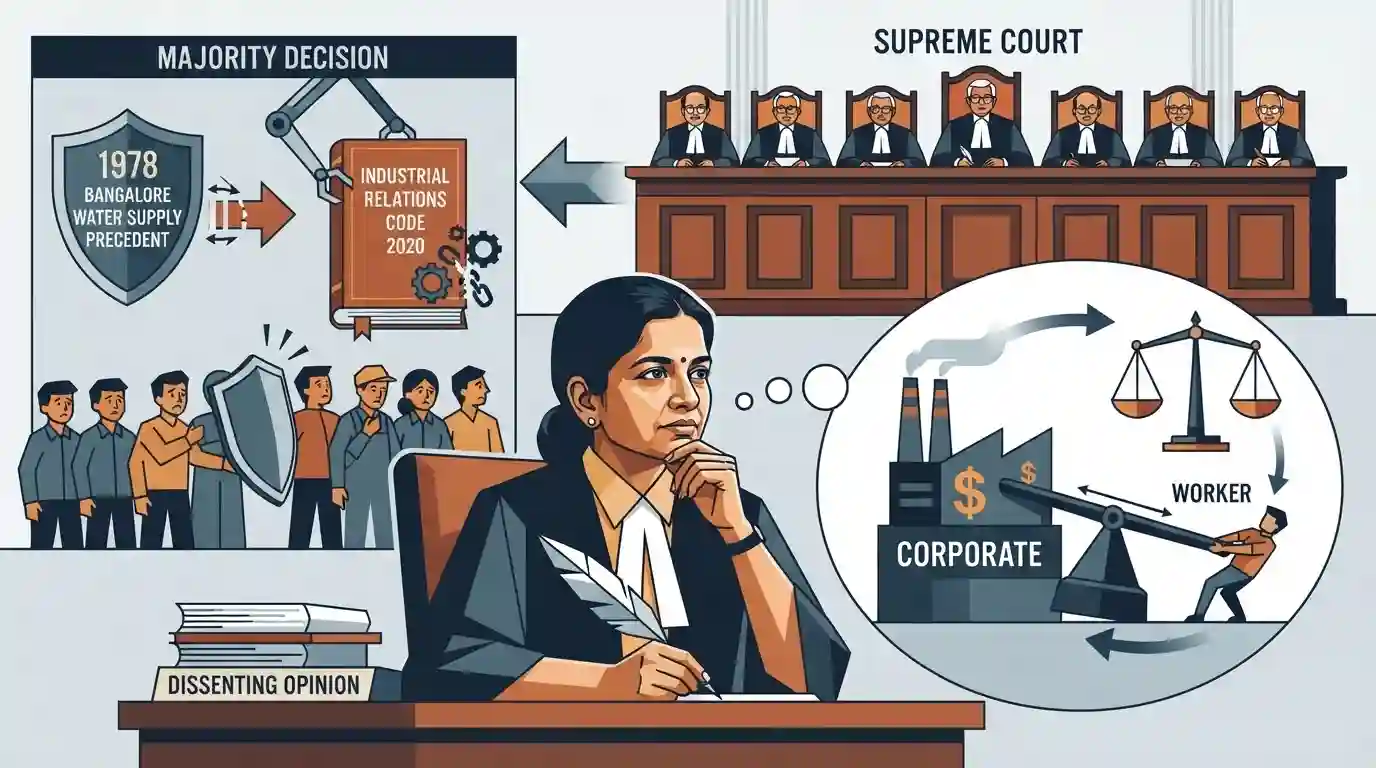
This judicial conflict highlights the friction between modern economic labor reforms (the 2020 Labour Codes) and historical labor protections. The definition of 'industry' determines which workers fall under legal protection. The decision to detach the 1978 landmark precedent from the IRC 2020 could fundamentally alter the balance of power between employers and employees in India's formal and informal sectors.
Summary
In a significant judicial development, Justice B.V. Nagarathna authored a sharp dissent against a nine-judge Supreme Court Bench's majority decision to decouple the landmark 1978 Bangalore Water Supply case from the new Industrial Relations Code (IRC) 2020. While the majority ruled that the 1978 definition of 'industry' would not act as a binding precedent for interpreting the new IRC, Justice Nagarathna warned that discarding this protective judicial legacy strips workers of a crucial legal shield, exposing them to skewed corporate bargaining power in a privatized, post-liberalization market.
Key Points
- Dissenting Warning: Justice B.V. Nagarathna delivered a 147-page dissenting opinion warning that dismantling the expansive 1978 definition of 'industry' under the new Industrial Relations Code (IRC) 2020 would unsheathe 'supercharged' corporate bargaining power and tear the labor safety net.
- The 1978 Bulwark: The landmark Bangalore Water Supply (1978) judgment's broad definition of 'industry' acted as a shield for nearly 50 years, ensuring the state did not evade welfare obligations and protecting labor rights amid post-liberalization privatization.
- Rule of Statutory Interpretation: Citing the 1880 English case 'Greaves v. Tofield', Justice Nagarathna argued that when a new statute replaces an older one with the same subject, purpose, and language, existing judicial interpretations remain highly persuasive and binding.
- Impact on IRC Section 2(p): The majority 9-judge bench ruled that the 1978 judgment would not serve as a precedent for the definition of 'industry' under the IRC, whereas the dissent insisted that rulings on the repealed 1947 Act naturally cast their shadow on the new code.
Important Terms
Industrial Relations Code 2020 (IRC)

A consolidated legislative framework amalgamating rules on trade unions, standing orders, and industrial disputes. The Supreme Court recently ruled that its definition of "industry" must be interpreted independently of older judicial precedents.
UPSC context
Crucial for GS-III (Economy) and GS-II (Polity), testing recent legislative labor reforms, dispute resolution mechanisms, and statutory worker protections.
Industrial Disputes Act 1947
A foundational Indian law establishing the framework to investigate and settle conflicts between employers and workmen. Though being replaced by the 2020 Labour Codes, its legal interpretations continue to govern pending labor disputes.
UPSC context
Important for GS-II (Social Justice) and EPFO exams to understand the historical evolution of worker rights, strikes, and dispute resolution.
Bangalore Water Supply and Sewerage Board
A 1978 landmark Supreme Court case that established a broad "triple test" to define an "industry." While it expanded labor protections, a recent ruling decoupled this precedent from interpreting the new Industrial Relations Code.
UPSC context
Vital for GS-II (Judiciary), demonstrating the doctrine of precedent, constitutional bench rulings, and the judicial evolution of labor jurisprudence.
Labour Codes
A comprehensive reform effort to consolidate multiple central labor laws into four unified codes covering wages, industrial relations, social security, and occupational safety. They attempt to simplify compliance while securing modern worker rights.
UPSC context
Significant for GS-III (Economy) and GS-II (Social Justice), assessing labor market reforms, ease of doing business, and welfare for vulnerable sections.
Prelims Trap
The 1978 Bangalore Water Supply ruling remains a binding precedent for interpreting 'industry' under the new Industrial Relations Code 2020.
The 9-judge majority expressly ruled that the 1978 precedent will NOT serve as a binding anchor for the new IRC 2020. This decoupling was the core of the dissent.
Static Concepts Connected
What was the "Triple Test" for an 'industry' in the Bangalore Water Supply case (1978)?
- Systematic Activity: The enterprise must engage in a systematic, organized activity.
- Organized Cooperation: There must be active cooperation between the employer and the employee.
- Production of Goods/Services: The activity must focus on the production or distribution of goods and services to satisfy material human wants.
Which colonial and post-independence laws does the Industrial Relations Code (IRC) 2020 subsume?
- Industrial Disputes Act: Subsumes the Industrial Disputes Act, 1947, which previously housed the heavily litigated definition of 'industry'.
- Trade Unions Act: Replaces the Trade Unions Act, 1926, which regulated the registration and rights of trade unions.
- Standing Orders Act: Subsumes the Industrial Employment (Standing Orders) Act, 1946, governing formal conditions of employment.
Cross-Topic Patterns
DPSP vs Ease of Doing Business
The judicial decoupling of the 1978 labor-protective shield aligns with India’s push for 'Ease of Doing Business', clashing directly with Article 43 (workers' living wage and conditions) of the DPSPs.
Doctrine of Precedent & Statutory Rules
The debate over applying the English 'Greaves v. Tofield' rule showcases how the Supreme Court balances legislative intent of new statutory codes against established constitutional bench legacies.

Expect a multi-statement question contrasting IRC 2020 provisions against the repealed Industrial Disputes Act and the 1978 Triple Test.
Linked PYQs · 2
Linked PYQs · 2
- 2024MainsGS3
Discuss the merits and demerits of the four 'Labour Codes' in the context of labour market reforms in India. What has been the progress so far in this regard?
- 2016MainsGS3
How globalization has led to the reduction of employment in the formal sector of the Indian economy? Is increased informalization detrimental to the development of the country?
