Justice Nagarathna calls for corporate environmental accountability
Source:Indian Express ↗
Why It Matters
This illustrates the intersection of corporate ethics, environmental conservation, and judicial oversight. It provides a highly relevant judicial quote for Mains answers in GS2 (Judiciary's role in environmental protection), GS3 (Mining and Environmental Impact), and GS4 (Corporate Ethics and CSR).
Summary
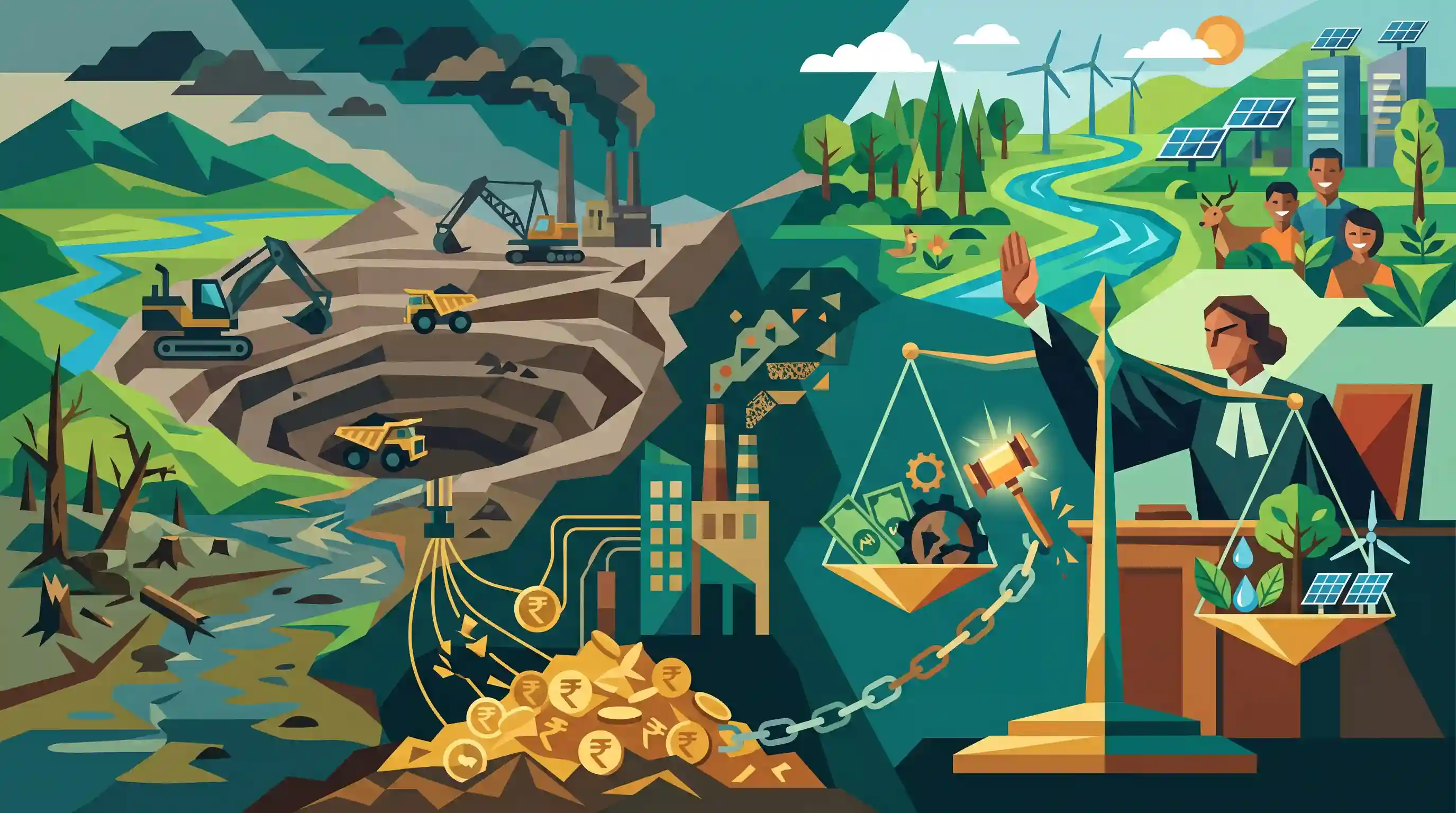
Supreme Court Justice B.V. Nagarathna has strongly advocated for corporate accountability and environmental justice, issuing a stern warning to mining industries operating in Jharkhand. Stressing that economic gains cannot be divorced from ecological impacts, she stated that 'profit should not be allowed to pretend it stands alone.' She cautioned corporations against leaving behind 'destroyed ecosystems' in their pursuit of wealth. These remarks highlight the growing judicial scrutiny of corporate activities, emphasizing the need for businesses to integrate sustainable development and Corporate Social Responsibility (CSR) into their core operations rather than treating them as secondary to profit maximization.
Key Points
- Supreme Court Justice B.V. Nagarathna emphasized the critical need for corporate accountability and environmental justice in the context of industrial operations.
- She specifically warned mining companies operating in Jharkhand against prioritizing profits while leaving behind 'destroyed ecosystems'.
- Her assertion that 'profit should not be allowed to pretend it stands alone' highlights the necessity of balancing economic growth with ecological sustainability.
- The remarks underscore the judiciary's proactive stance in holding corporations liable for environmental degradation and safeguarding the rights of local communities in resource-rich areas.
Important Terms
Corporate Social Responsibility (CSR)

A legal mandate under the Companies Act, 2013, requiring qualifying companies to spend 2% of average net profits on social and environmental development.
UPSC context
GS Paper II (Governance) and IV (Ethics); concerns corporate governance and industry's role in inclusive growth.
Sustainable Development
Development meeting current needs without compromising future generations' ability to meet theirs, balancing economic growth, social inclusion, and environmental protection.
UPSC context
GS Paper III (Environment); core framework for balancing industrialization with ecological preservation.
Polluter Pays Principle
An environmental law principle where those responsible for pollution bear the costs of remediation and compensation to prevent damage to health/environment.
UPSC context
GS Paper III (Environment); vital for questions on liability and environmental compensation mechanisms.
Environmental Justice
The fair treatment and meaningful involvement of all communities in environmental decision-making and the equitable distribution of ecological benefits and burdens.
UPSC context
GS Paper III (Social Justice/Environment); focuses on protecting marginalized groups from industrial exploitation.
Judicial Activism
Proactive role of the judiciary in protecting constitutional rights and filling governance gaps when the executive or legislature fails to act.
UPSC context
GS Paper II (Polity); explores SC's use of Public Interest Litigation for environmental protection.
Absolute Liability
A standard holding industries engaged in hazardous activities liable for any harm caused, regardless of negligence or precautions taken, without exceptions.
UPSC context
GS Paper III (Environment/Law); crucial for accountability in hazardous sectors like mining.
Supreme Court of India
India’s highest judicial body and guardian of the Constitution, which has expanded the 'Right to Life' (Article 21) to include a clean environment.
UPSC context
GS Paper II (Polity); tests the institution's role in enforcing fundamental rights and environmental jurisprudence.
Prelims Trap
"Under the Companies Act, a fixed quota of the 2% CSR funds must be spent on environmental protection."
The Companies Act mandates 2% overall CSR spending, but the internal allocation across approved themes (Schedule VII) remains entirely at the corporation's discretion.
Static Concepts Connected
What are the CSR thresholds under the Companies Act, 2013?
- Net Worth: Applies to companies with a net worth of ₹500 crore or more.
- Turnover: Applies to companies with a turnover of ₹1,000 crore or more.
- Net Profit: Applies to companies with a net profit of ₹5 crore or more.
- Mandatory Spending: Eligible companies must spend at least 2% of their average net profits from the three preceding financial years on approved activities (Schedule VII).
What is the Public Trust Doctrine in Indian environmental law?
- Core Principle: The State holds natural resources like rivers, forests, and air in trust for the public; they cannot be subject to private ownership.
- Landmark Precedent: Adopted into Indian jurisprudence via the M.C. Mehta vs. Kamal Nath case, preventing the arbitrary commercialization of ecological assets.
- State Duty: The State is legally barred from transferring public trust properties to private parties if such transfers harm public interest or the environment.
Cross-Topic Patterns
Mining in Fifth Schedule Areas
Extractive industries in states like Jharkhand must navigate not just environmental laws, but also PESA and the Forest Rights Act, linking ecological preservation directly to tribal sovereignty and Gram Sabha consent.
Anthropocentric to Ecocentric Shift
This judicial rhetoric mirrors the broader global and Indian movement (e.g., granting rivers legal personhood) that values nature intrinsically, shifting environmental law from human-centric to nature-centric.

Mains 2026 could feature a 15-marker linking the Public Trust Doctrine, ecocentric jurisprudence, and corporate accountability in mining.
Linked PYQs · 3
Linked PYQs · 3
- 2022MainsGS4
In contemporary world, corporate sector's contribution in generating wealth and employment is increasing. In doing so, they are bringing in unprecedented onslaught on the climate, environmental sustainability and living conditions of human beings. In this background, do you find that Corporate Social Responsibility (CSR) is efficient and sufficient enough to fulfill the social roles and responsibilities needed in the corporate world for which the CSR is mandated? Critically examine.
- 2025MainsGS3
Mineral resources are fundamental to the country's economy and these are exploited by mining. Why is mining considered an environmental hazard? Explain the remedial measures required to reduce the environmental hazard due to mining.
- 2022MainsGS2
“The most significant achievement of modern law in India is the constitutionalization of environmental problems by the Supreme Court.” Discuss this statement with the help of relevant case laws.
