Gender Representation Disparities in Higher Judiciary Appointments
Source:Indian Express ↗
Why It Matters
Addresses the critical issue of gender disparity in the higher judiciary and suggests constitutional solutions based on international examples. Highly relevant for GS2 questions on judicial reforms, the Collegium system, and social justice.
Summary
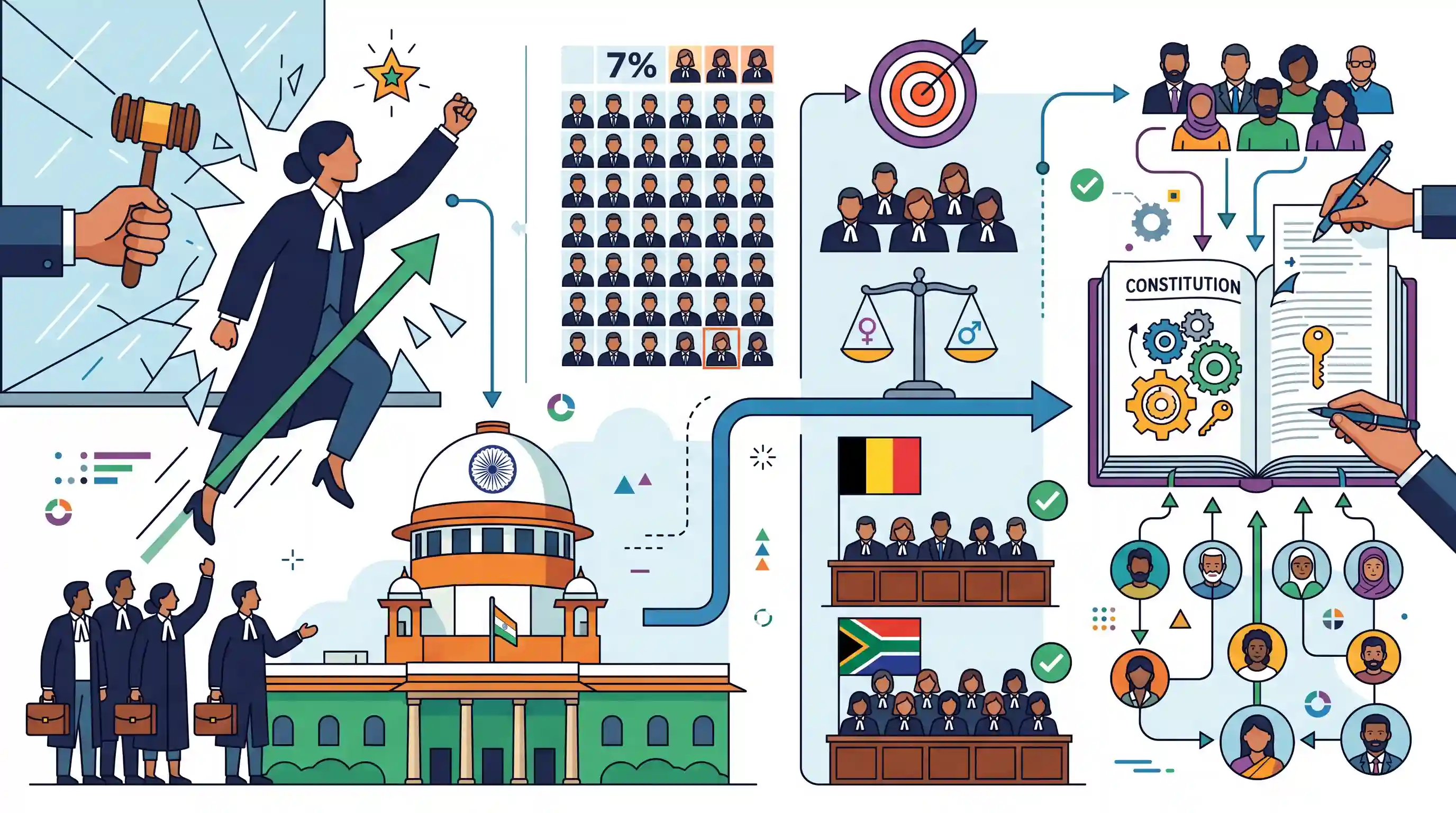
The article discusses the recent appointment of Justice V Mohana directly from the Bar to the Supreme Court of India, highlighting it as a rare achievement in breaking the legal glass ceiling. Despite this milestone, women make up only 5.4% of Supreme Court judges. The author argues for a gender quota of at least 33.3% in the higher judiciary, drawing on successful international precedents from Belgium and South Africa where constitutional mandates have ensured gender parity or majority in top courts. To achieve this, the article suggests introducing a formal policy or amending Articles 124 and 217 of the Indian Constitution to ensure that judicial appointments reflect the country's gender and caste composition.
Key Points
- Justice V Mohana is only the second woman lawyer to be directly appointed from the Bar to the Supreme Court of India.
- Women's representation in the Indian Supreme Court remains abysmally low at 5.4%, with only two female judges out of 37.
- Countries like Belgium and South Africa have utilized structural constitutional reforms and quotas to achieve equal or majority representation of women in their highest courts.
- An amendment to Articles 124 and 217 of the Constitution, or a stated written policy, is proposed to ensure a minimum 33.3% gender quota for judges in the Supreme Court and High Courts.
Important Terms
Article 124 of the Constitution

Constitutional provision governing the establishment, composition, and appointment of judges to the Supreme Court of India by the President.
UPSC context
GS Paper II: Appointments to Constitutional posts; tests knowledge of judicial appointment process and qualifications.
Article 217 of the Constitution
The article specifying the procedure for appointing High Court judges and the qualifications required for their elevation to the bench.
UPSC context
GS Paper II: Judiciary; essential for understanding the structural and procedural requirements for High Court appointments.
Collegium System
A judicial mechanism—not explicitly in the Constitution—where the Chief Justice and senior-most judges recommend names for judicial appointments and transfers.
UPSC context
GS Paper II: Separation of Powers; central to debates on judicial independence versus executive interference in appointments.
Direct Appointment from the Bar
An appointment path where a Senior Advocate is elevated straight to the Supreme Court without prior service as a High Court judge.
UPSC context
GS Paper II: Judiciary; tests understanding of Article 124(3)(b) regarding qualifications for Supreme Court judges.
Glass Ceiling
An unacknowledged, invisible barrier to advancement in a profession, specifically preventing women and minorities from reaching top-tier leadership or judicial positions.
UPSC context
GS Paper I & II: Social Justice; relevant for essays on gender parity and diversity in state institutions.
Constitutional Court of South Africa
South Africa's apex court, cited for its 'transformative constitutionalism' and mandates requiring the judiciary to reflect racial and gender demographics.
UPSC context
GS Paper II: Comparative Constitutions; tests the ability to contrast Indian judicial diversity with international models.
Prelims Trap
"Justice V Mohana is the first woman lawyer to be directly elevated from the Bar to the Supreme Court."
She is the *second* woman (after Justice Indu Malhotra in 2018). Furthermore, the Constitution currently has no provision for reservation in the higher judiciary.
Static Concepts Connected
What are the qualifications for direct elevation to the SC from the Bar?
- Citizenship: Must be a citizen of India.
- Advocate tenure: Must have been an advocate of a High Court (or two or more such Courts in succession) for at least 10 years.
- Distinguished jurist: Alternatively, a person can be appointed if they are, in the opinion of the President, a distinguished jurist (though this has never been used for SC).
Which Constitutional articles govern higher judiciary appointments?
- Article 124: Empowers the President to appoint Supreme Court judges, currently guided by the Collegium system. Contains no demographic quotas.
- Article 217: Governs the appointment and conditions of the office of a Judge of a State High Court.
- Absence of Quotas: Currently, there is no reservation policy for caste, religion, or gender in higher judicial appointments.
Cross-Topic Patterns
Legislative vs Judicial quotas
The 106th Amendment (Nari Shakti Vandan Adhiniyam) mandates 33% reservation in the Lok Sabha and State Assemblies, intensifying debates on extending similar structural gender quotas to the higher judiciary.
Comparative constitutional law (GS2)
GS2 often tests Indian constitutional schemes against other nations. South Africa's Section 174(2), which requires its judiciary to reflect the nation's demographics, is a prime comparative model for reforms.

Expect a GS2 Mains question on gender diversity in the higher judiciary, linking the 106th Amendment to the collegium's opaque selections.
Linked PYQs · 4
Linked PYQs · 4
- 2021MainsGS2
Discuss the desirability of greater representation to women in the higher judiciary to ensure diversity, equity and inclusiveness.
- 2023MainsGS2
Explain the constitutional perspectives of Gender Justice with the help of relevant Constitutional Provisions and case laws.
- 2025MainsGS2
Discuss the evolution of collegium system in India. Critically examine the advantages and disadvantages of the system of appointment of the Judges of the Supreme Court of India and that of the USA.
- 2024MainsGS1
Distinguish between gender equality, gender equity and women's empowerment. Why is it important to take gender concerns into account in programme design and implementation?
