Justice Meenakshi Madan Rai Appointed Patna High Court Chief Justice
Source:newsonair ↗
Why It Matters
The appointment and oath-taking of high constitutional functionaries in Bihar, such as the Chief Justice of the Patna High Court and the Governor, are recurrent themes in the BPSC Prelims. Understanding the underlying constitutional provisions (Article 217, Article 219) and the specific actors involved is vital for polity and state-level current affairs.
Summary
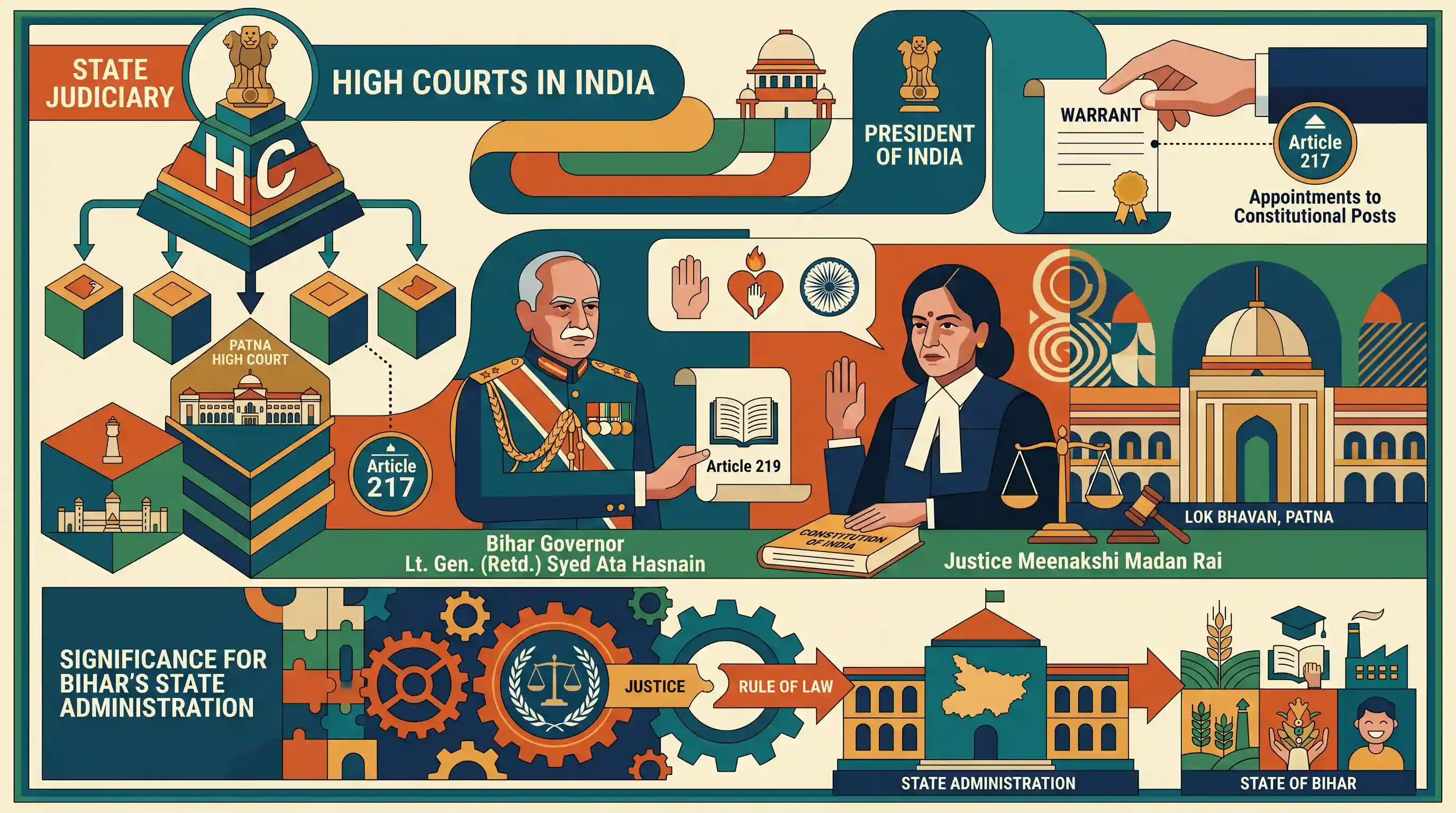
Justice Meenakshi Madan Rai took the oath of office as the Chief Justice of the Patna High Court on June 5, 2026. The oath of office and secrecy was administered by Bihar Governor Lt. Gen. (Retd.) Syed Ata Hasnain at a ceremony in Lok Bhavan, Patna. This appointment is significant for Bihar's state administration and falls under the constitutional provisions of Article 217 (appointment of High Court Judges) and Article 219 (oath of High Court Judges).
Key Points
- On June 5, 2026, Justice Meenakshi Madan Rai was sworn in as the Chief Justice of the Patna High Court.
- The oath of office and secrecy was administered by the Governor of Bihar, Lt. Gen. (Retd.) Syed Ata Hasnain, at a ceremony held at Lok Bhavan in Patna.
- Under Article 219 of the Constitution of India, every person appointed to be a Judge of a High Court must take an oath or affirmation before the Governor of the State (or a person appointed by him) before entering office.
- Under Article 217, the President of India appoints the Chief Justice of a High Court in consultation with the Chief Justice of India and the Governor of the State.
- This development is highly relevant to BPSC Prelims, which frequently tests topics regarding the constitutional positions of the State Governor, the judiciary, and significant appointments in Bihar.
Important Terms
Constitution of India

The supreme law book of India, establishing the political framework, fundamental rights, directive principles, and duties of citizens, alongside the structure and powers of government institutions.
UPSC context
GS Paper II (Polity). Essential for analyzing the foundational legal framework, constitutionalism, amendments, and state machinery.
Indian Judiciary
The independent branch of the Indian state tasked with interpreting and applying the law, resolving disputes, and safeguarding constitutional rights through a hierarchical court structure led by the Supreme Court.
UPSC context
GS Paper II (Polity). Tests core knowledge of judicial independence, judicial review, structure, and challenges facing the legal system in India.
Patna High Court
The High Court of the state of Bihar, established in 1916, which is the principal civil court of original and appellate jurisdiction in the state, exercising judicial and administrative supervision over lower courts.
UPSC context
GS Paper II (Polity and Governance). Tests understanding of the structure, jurisdiction, and functioning of state-level higher judiciary in India.
Article 217 of the Constitution of India
A constitutional provision outlining the appointment, qualifications, tenure, and conditions of service of High Court judges, mandating that appointments be made by the President after consulting key judicial and executive authorities.
UPSC context
GS Paper II (Polity). Tests comprehension of the executive-judicial balance and appointment mechanism of the higher judiciary in India.
Article 219 of the Constitution of India
A constitutional article mandating that every person appointed as a High Court judge must make and subscribe to a formal oath or affirmation before the Governor of the State before entering office.
UPSC context
GS Paper II (Polity). Tests awareness of constitutional requirements, oath ceremonies, and the symbolic independence of state-level higher judiciary.
Governor (India)
The constitutional head of an Indian state, appointed by the President, who exercises executive powers at the state level and performs ceremonial duties, such as administering oaths to state dignitaries.
UPSC context
GS Paper II (Polity). Tests understanding of Center-State relations, executive powers of the Governor, and the office's constitutional responsibilities.
Prelims Trap
An eminent or distinguished jurist is eligible for appointment as a High Court judge under the Constitution.
Under Article 217(2), the qualification of being a 'distinguished jurist' applies strictly to Supreme Court appointments (Article 124) and is not a valid qualification for High Court judges.
Static Concepts Connected
What are the key constitutional differences in the appointment and qualification of SC and HC judges?
- Appointment authority: Both SC and HC judges are appointed by the President. High Court judges are not appointed by the Governor.
- Oath administration: SC judges take their oath before the President, whereas HC judges take their oath before the State Governor (Article 219).
- Qualification variance: A 'distinguished jurist' can be appointed to the SC, but this qualification does not exist for HC appointments.
How is the judge strength of High Courts determined compared to the Supreme Court?
- Supreme Court strength: The authority to determine and alter the sanctioned strength of the Supreme Court rests with Parliament through legislation.
- High Court strength: The strength of each High Court is determined flexibly by the President of India from time to time, depending on workload (Article 216).
Cross-Topic Patterns
Gender diversity in higher judiciary
Justice Rai's journey from Sikkim's first female HC judge to Patna's CJ highlights the ongoing debate on structural barriers and underrepresentation of women in India's higher judiciary.
Judicial federalism and transfer policies
Inter-state transfers of Chief Justices under Article 222 reflect the tension between judicial independence and executive consultation, balancing regional representation with national integration.

Expect a multi-statement question distinguishing the qualifications, oath administrators, and strength-determination of SC vs. HC judges.
Linked PYQs · 3
Linked PYQs · 3
- 2019BPSC_PRELIMSGS1
Who was the Chief Justice of the Patna High Court who administered the oath of office to Mr. Fagu Chauhan as the Governor of Bihar in July 2019?
- 2018BPSC_PRELIMSGS1
The Governor of a State is appointed by
- 2023BPSC_PRELIMSGS1
The authority to determine the number of Judges in a High Court rests with which of the following entities?
