Patna High Court Chief Justice Appointment Procedure
Source:scconline ↗
Why It Matters
BPSC regularly tests knowledge on high court appointments, Bihar judiciary leaders (such as Patna High Court Chief Justices), and relevant constitutional provisions (Article 217 and Collegium-related questions).
Summary
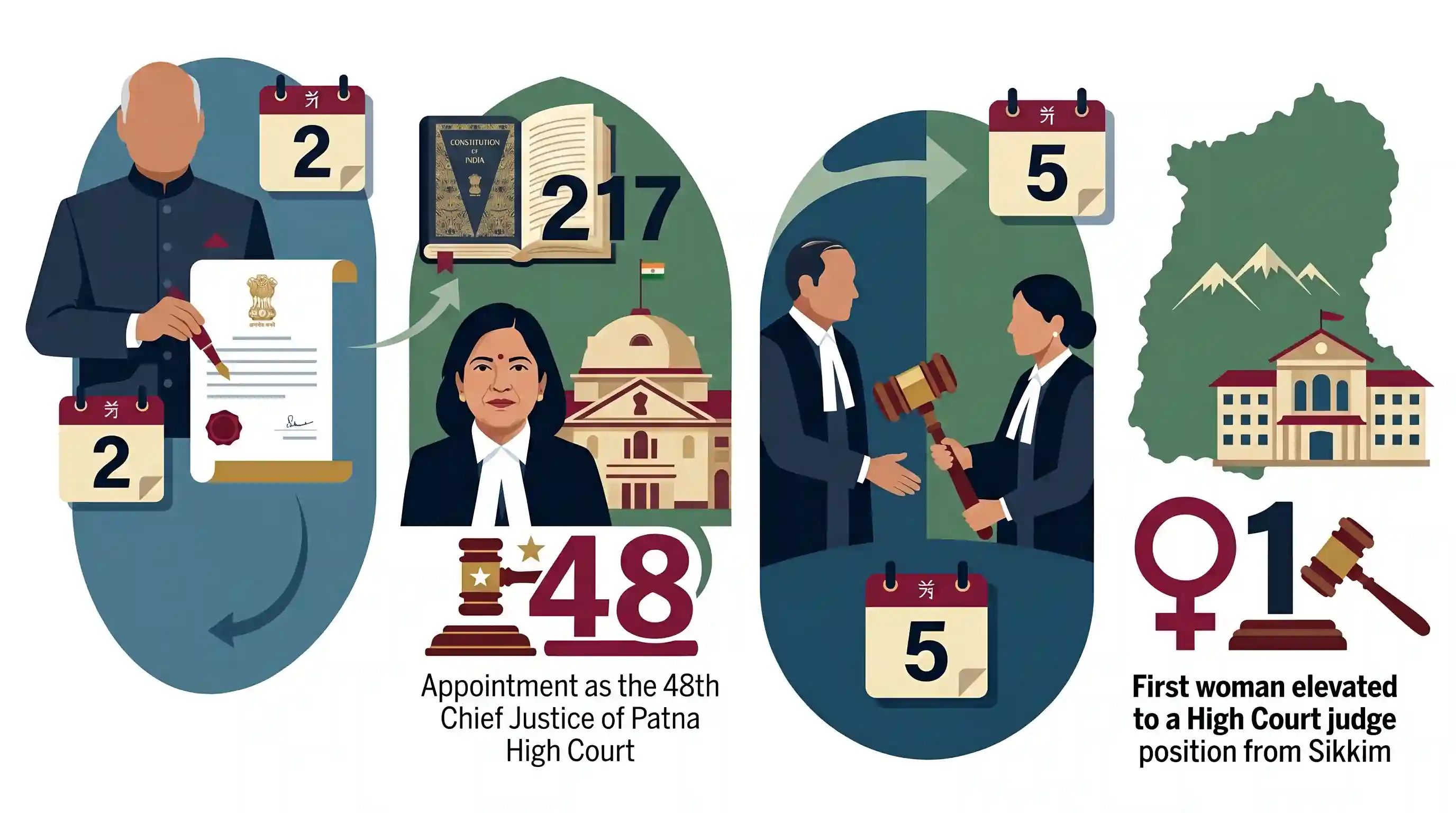
On June 2, 2026, the President of India appointed Justice Meenakshi M. Rai as the 48th Chief Justice of the Patna High Court under Article 217(1) of the Constitution. Effective June 5, 2026, she succeeds Justice Sangam Kumar Sahoo. Justice Rai, who previously served as a Judge and Acting Chief Justice at the Sikkim High Court, was the first woman from Sikkim to be elevated to a High Court judge position.
Key Points
- Appointment of 48th Chief Justice: Justice Meenakshi M. Rai has been appointed as the 48th Chief Justice of the Patna High Court.
- Constitutional Provision: The appointment was made on June 2, 2026, by the President of India exercising powers under Article 217(1) of the Indian Constitution, following the Supreme Court Collegium's recommendation on May 22, 2026.
- Succession and Timeline: She assumed charge on June 5, 2026, succeeding the retiring incumbent Chief Justice, Sangam Kumar Sahoo, who retired on June 4, 2026.
- Career Milestone: Justice Rai was previously serving as a Judge at the Sikkim High Court. She is historically significant as the first woman from Sikkim to be elevated as a High Court judge (elevated on April 15, 2015), and she also served as the Acting Chief Justice of Sikkim High Court on multiple occasions.
Important Terms
Supreme Court Collegium

A five-member body headed by the Chief Justice of India and four senior-most Supreme Court judges that recommends judicial appointments and transfers in the higher judiciary.
UPSC context
GS Paper II: Polity & Constitution. Tests understanding of judicial appointments, judicial independence, and separation of powers.
Patna High Court
The highest judicial authority in the state of Bihar, established in 1916 under a letters patent issued by the British Crown.
UPSC context
GS Paper II: State Judiciary. Tests knowledge of High Court jurisdiction, state judicial machinery, and historic administrative structures.
Sikkim High Court
The High Court for the state of Sikkim, established in 1975, which stands as one of India's smallest High Courts by judge strength.
UPSC context
GS Paper II: State Judiciary. Tests knowledge of judicial administration in smaller states and integration under federalism.
Supreme Court of India
The highest judicial court in India under the Constitution, acting as the ultimate court of appeal and protector of fundamental rights.
UPSC context
GS Paper II: Judiciary. Tests knowledge of the unified court system, original, appellate, and advisory jurisdictions.
Prelims Trap
The President can appoint a 'distinguished jurist' as a High Court judge under Article 217 of the Constitution.
While Article 124(3)(c) allows this for the Supreme Court, no 'distinguished jurist' provision currently exists for High Courts (removed by the 44th Amendment Act).
Static Concepts Connected
What are the structural differences in the constitution of Supreme Court vs High Courts?
- Judge Strength: Parliament determines the SC strength by law, while the President determines HC strength under Article 216.
- Distinguished Jurist: This criteria exists only for SC appointments; it is not applicable for High Court judge eligibility.
- Retirement Age: SC judges retire at 65 years, whereas HC judges retire at 62 years (amended by the 15th CAA, 1963).
Cross-Topic Patterns
Gender diversity in Indian judiciary
Highlights the ongoing transition toward gender representation in constitutional courts, directly linking to GS-2 debates on judicial diversity and systemic reform.
Unified judiciary vs Federal executive
The transfer of Sikkim's senior-most judge to lead Bihar's high court illustrates how a unified judiciary bridges state boundaries under central appointment powers.

Prelims 2026 may contrast HC and SC appointment criteria, specifically testing the 'distinguished jurist' clause and judge strength.
Linked PYQs · 4
Linked PYQs · 4
- 2024-EBPSC_PRELIMSGS1
Before his appointment as a judge of the Supreme Court of India in July 2024, Justice N. Kotiswar Singh was the Chief Justice of which High Court?
- 2019BPSC_PRELIMSGS1
Who was the Chief Justice of the Patna High Court who administered the oath of office to Mr. Fagu Chauhan as the Governor of Bihar in July 2019?
- 2023BPSC_PRELIMSGS1
Consider the following statements about the collegium system: 1. The Supreme Court collegium is a five-member body, which is headed by the incumbent Chief Justice of India (CJI) and comprises four other seniormost Judges of the Court at that time. 2. The Parliament by law has evolved the collegium system. 3. The Judges of the Supreme Court and High Courts are appointed only through the collegium system. 4. The collegium system was introduced in the year 1993 by Justice P. N. Bhagwati in the landmark First Judges Case.
- 2023BPSC_PRELIMSGS1
The authority to determine the number of Judges in a High Court rests with which of the following entities?
