EAT Lancet Commission Report on Sustainable Food Systems and Diets
Source:The Hindu ↗
Why It Matters
The intersection of agriculture, climate change, and food security is a highly critical theme for GS3. The article provides a nuanced view on why simply changing diets for climate goals must be balanced with socio-economic realities like food affordability and the livelihoods of farmers.
Summary
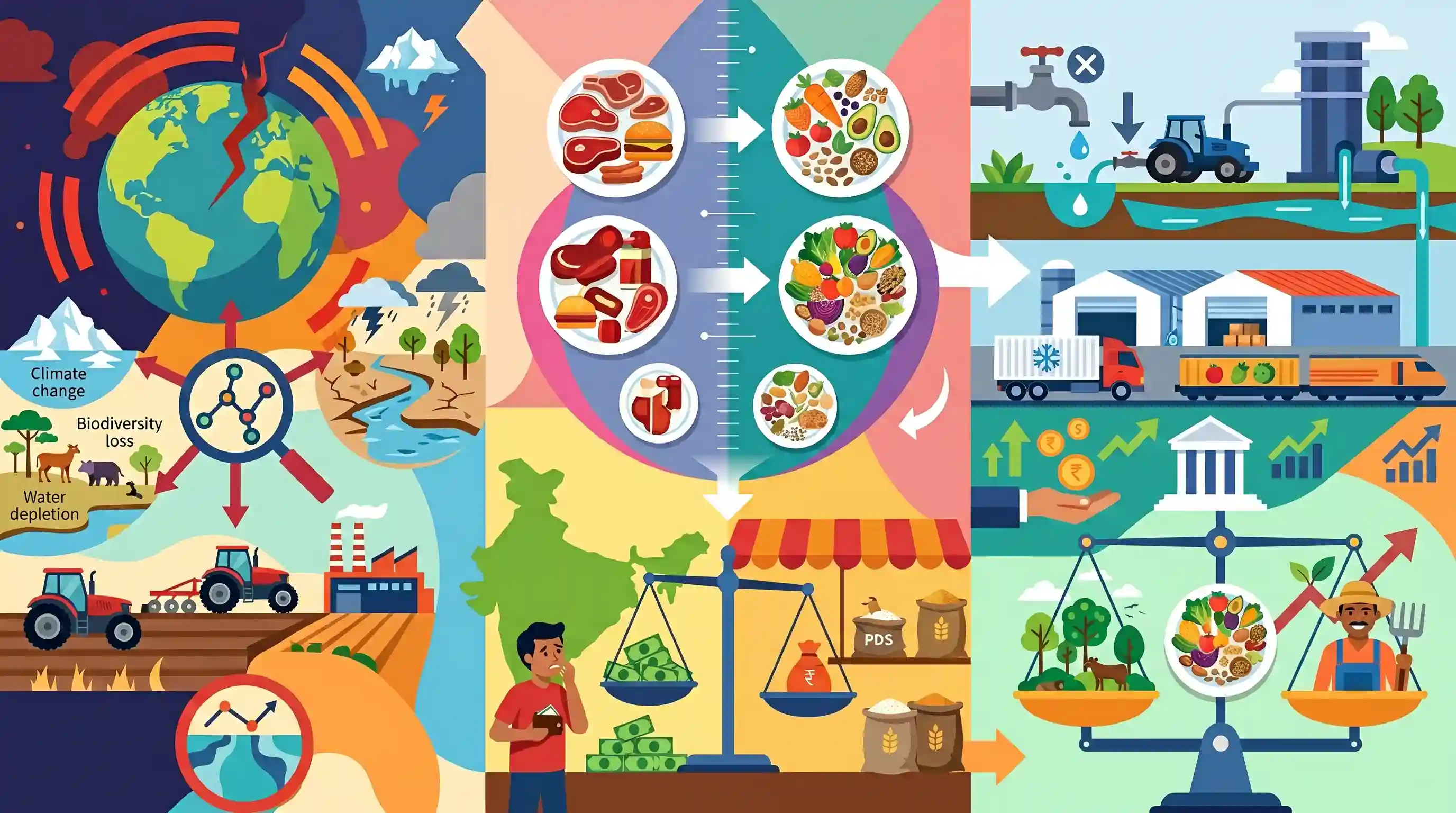
The editorial analyses the latest EAT-Lancet Commission report, which highlights the severe impact of current food systems on planetary boundaries, driving climate change, biodiversity loss, and water depletion. While dietary shifts towards more plant-based and diverse foods are recommended to mitigate emissions and resource overuse, the article notes that such a transition in India could raise food prices and affect affordability. It calls for comprehensive supply-side reforms—such as ending groundwater extraction incentives, improving cold chain infrastructure, and implementing fiscal measures—to ensure a just transition that balances environmental sustainability, nutritional security, and the rights of small producers.
Key Points
- The new EAT-Lancet Commission report identifies food systems as the central driver for overlapping climate, biodiversity, water, and pollution crises.
- Food from animals accounts for most agricultural emissions, whereas grain production dominates nitrogen, phosphorus, and water usage, leaving a massive global nitrogen surplus.
- India maintains a cereal-heavy diet. Transitioning to a healthier diet of vegetables, fruits, nuts, and legumes could threaten food affordability for vulnerable populations.
- Supply-side reforms must address water stress, soil degradation, and fossil fuel reliance in cold chains and food processing.
- India needs to end implicit incentives for over-extracting groundwater and protect the rights of small producers and agricultural workers against undue corporate influence.
Important Terms
EAT-Lancet Commission

A global interdisciplinary group that defined the "Planetary Health Diet." Its 2025 report integrates social justice with environmental sustainability to provide a roadmap for healthy, just food systems.
UPSC context
GS Paper 3 (Agriculture/Environment); relevant for food system transformation and sustainable dietary transitions in India.
Planetary Boundaries
A framework of nine critical environmental thresholds (e.g., climate change, freshwater use, biodiversity) that humanity must stay within to maintain Earth's stability and avoid irreversible damage.
UPSC context
GS Paper 3 (Environment); essential for understanding ecological limits and safe operating spaces for sustainable development.
Public Distribution System (PDS)
India’s primary food security mechanism providing subsidized grains to eligible households via Fair Price Shops; jointly managed by the Central and State governments under the National Food Security Act.
UPSC context
GS Paper 3 (Food Security); critical for topics on buffer stock, subsidy management, and PDS reforms.
PM-POSHAN
Formerly the Midday Meal Scheme, this centrally sponsored scheme provides hot cooked meals to school children (Class 1-8) to improve nutrition, enrollment, and classroom hunger.
UPSC context
GS Paper 2 (Social Justice/Education); tests knowledge of health interventions and the socio-economic impacts of school-based feeding programs.
Cold Chain Infrastructure
A temperature-controlled supply chain involving refrigerated storage and transport designed to preserve perishables like fruits and vegetables, reducing post-harvest losses and stabilizing market prices.
UPSC context
GS Paper 3 (Agriculture/Infrastructure); focuses on supply chain management, food processing, and doubling farmer income through technology.
Prelims Trap
Livestock is the primary driver of all planetary boundary breaches within the global agricultural sector.
While livestock dominates greenhouse gas emissions (methane), the mass cultivation of grains actually dominates nitrogen, phosphorus, and freshwater usage, driving massive ecological imbalances.
Static Concepts Connected
What is the Planetary Boundaries framework?
- Core Concept: Nine interconnected Earth system processes (e.g., climate change, biosphere integrity) that regulate planetary stability.
- Irreversible Breaches: Crossing these limits increases the risk of generating large-scale, abrupt, or irreversible environmental changes.
- Agricultural Impact: Global food systems currently drive the breach of at least five boundaries, heavily impacting biochemical flows (nitrogen/phosphorus).
How do agricultural policies inadvertently drive India's groundwater depletion?
- Incentivized Cropping: Assured procurement and Minimum Support Prices (MSP) encourage the cultivation of water-guzzling crops like paddy and sugarcane in semi-arid regions.
- Power Subsidies: Free or heavily subsidized electricity reduces the marginal cost of groundwater extraction to near zero for farmers.
- Aquifer Depletion: This combination systematically drives the over-exploitation of aquifers, creating severe water stress in states like Punjab and Maharashtra.
Cross-Topic Patterns
PDS diversification & Climate Adaptation
India's cereal-heavy PDS contributes to dietary imbalances and groundwater depletion. Incorporating millets (Shree Anna) into the PDS perfectly links nutritional security with climate-resilient agriculture.
Input Subsidies vs. Ecological Sustainability
The clash between implicit input subsidies (free electricity, cheap urea) and planetary health highlights the classic GS3 conflict between short-term agricultural output and long-term ecological conservation.

Expect a 2026 Prelims question linking agricultural sub-sectors (livestock vs. cereals) to specific ecological impacts like nitrogen surplus.
Linked PYQs · 5
Linked PYQs · 5
- 2022MainsGS3
Discuss global warming and mention its effects on the global climate. Explain the control measures to bring down the level of greenhouse gases which cause global warming, in the light of the Kyoto Protocol, 1997.
- 2022MainsGS3
What are the major challenges of Public Distribution System (PDS) in India ? How can it be made effective and transparent ?
- 2018MainsGS1
The ideal solution of depleting ground water resources in India is water harvesting system." How can it be made effective in urban areas?
- 2025MainsGS3
Elaborate the scope and significance of supply chain management of agricultural commodities in India.
- 2020MainsGS3
What are the challenges and opportunities of food processing sector in the country? How can income of the farmers be substantially increased by encouraging food processing?
