Supreme Court judge raises concerns on collegium approvals
Source:Indian Express ↗
ఇది ఎందుకు ముఖ్యం
It directly concerns the separation of powers, judicial independence, and institutional friction between the executive and judiciary over judicial appointments.
సారాంశం
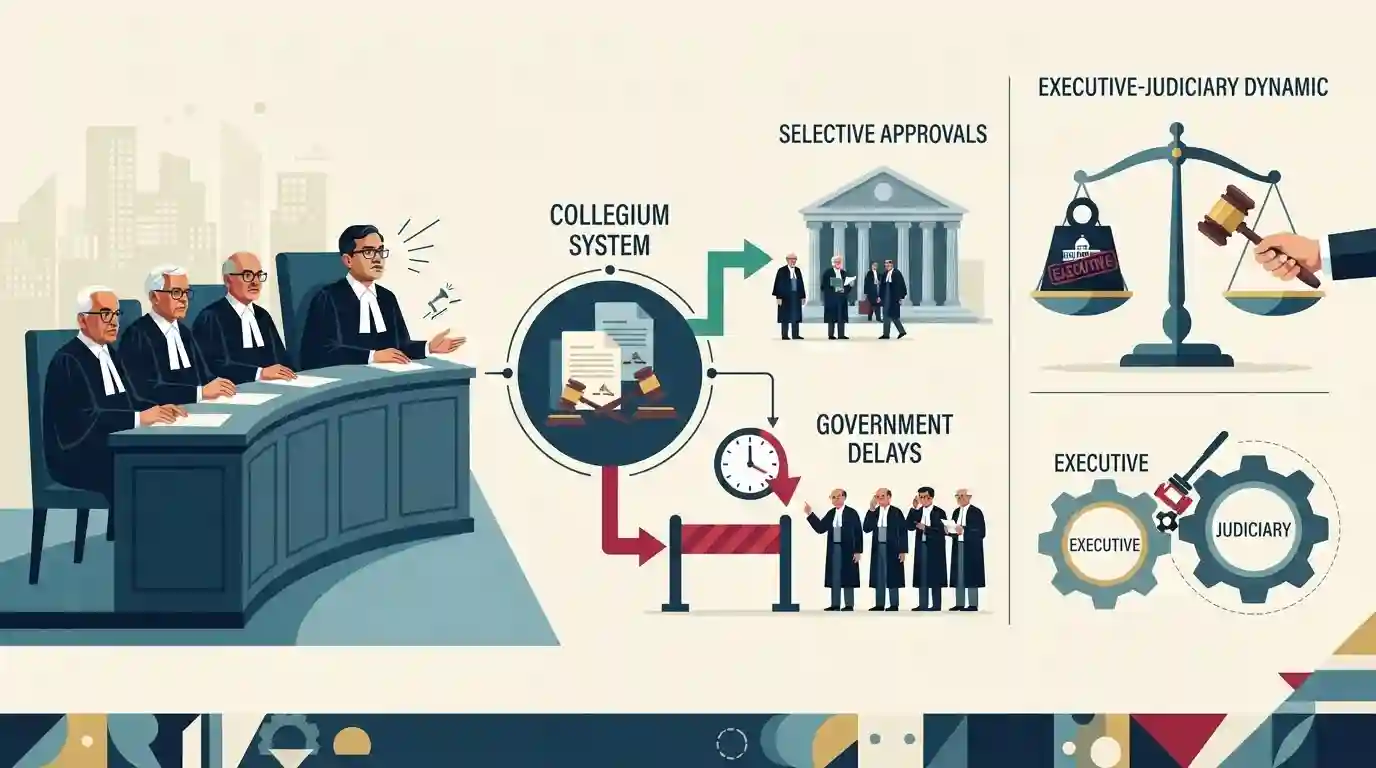
Justice Dipankar Datta of the Supreme Court addressed issues related to the Collegium system, highlighting concerns over selective approvals and government delays in judicial appointments, which reignites debates on the executive-judiciary dynamic in India.
ముఖ్య అంశాలు
- Justice Dipankar Datta raised concerns regarding the selective approval or delays by the government in acting upon recommendations made by the Supreme Court Collegium.
- The debate touches upon the checks and balances between the executive and the judiciary in the appointment of judges to higher courts.
- Delays in processing Collegium recommendations impact judicial vacancies and the overall administration of justice.
ముఖ్యమైన పదాలు
Supreme Court Collegium

The apex judicial body in India comprising the Chief Justice of India and four senior-most judges, responsible for recommending appointments and transfers of judges to the Supreme Court and High Courts.
UPSC context
UPSC Prelims/Mains (GS Paper II): Tests understanding of judicial independence, separation of powers, and the mechanics of judicial appointments in India.
Supreme Court of India
The highest constitutional court of India, functioning as the final court of appeal, guarantor of fundamental rights, and federal court under Part V of the Constitution.
UPSC context
UPSC Prelims/Mains (GS Paper II): Tests knowledge of constitutional structure, jurisdiction, judicial review, and the checks and balances in India's governance.
అనుసంధానమైన స్థిర భావనలు
How did the Supreme Court Collegium system evolve through the Three Judges Cases?
- 1st Judge Case: First Judge Case (1982) ruled that 'consultation' does not mean 'concurrence', giving primacy to the Central Executive in appointments.
- 2nd Judge Case: Second Judge Case (1993) introduced the Collegium system, ruling that 'consultation' with the CJI meant concurrence, giving primacy to the judiciary.
- 3rd Judge Case: Third Judge Case (1998) expanded the Collegium to a body of the CJI and four senior-most judges for Supreme Court appointments.
అంతర-అంశ నమూనాలు
Judiciary vs. Executive Institutional Autonomy
The friction over judicial appointments directly parallels institutional debates on administrative independence and accountability across India's constitutional bodies.

Expect a statement-based prelims question on the evolution of the Collegium through the Three Judges Cases and Article 124/217.
అనుసంధాన PYQలు · 3
అనుసంధాన PYQలు · 3
- 2025MainsGS2
Discuss the evolution of collegium system in India. Critically examine the advantages and disadvantages of the system of appointment of the Judges of the Supreme Court of India and that of the USA.
- 2023MainsGS2
“Constitutionally guaranteed judicial independence is a prerequisite of democracy.” Comment.
- 2017MainsGS2
Critically examine the Supreme Court's judgement on 'National Judicial Appointments Commission Act, 2014' with reference to appointment of judges of higher judiciary in India.
