Appointment of Next Chief Justice of India and Seniority Convention
Source:The Hindu ↗
Why It Matters
The appointment of the Chief Justice of India is a key constitutional event. Understanding the collegium system, the convention of seniority, and the constitutional provisions relating to the tenure and retirement of Supreme Court judges (Article 124) are foundational concepts for the Polity section in both Prelims and Mains.
Summary
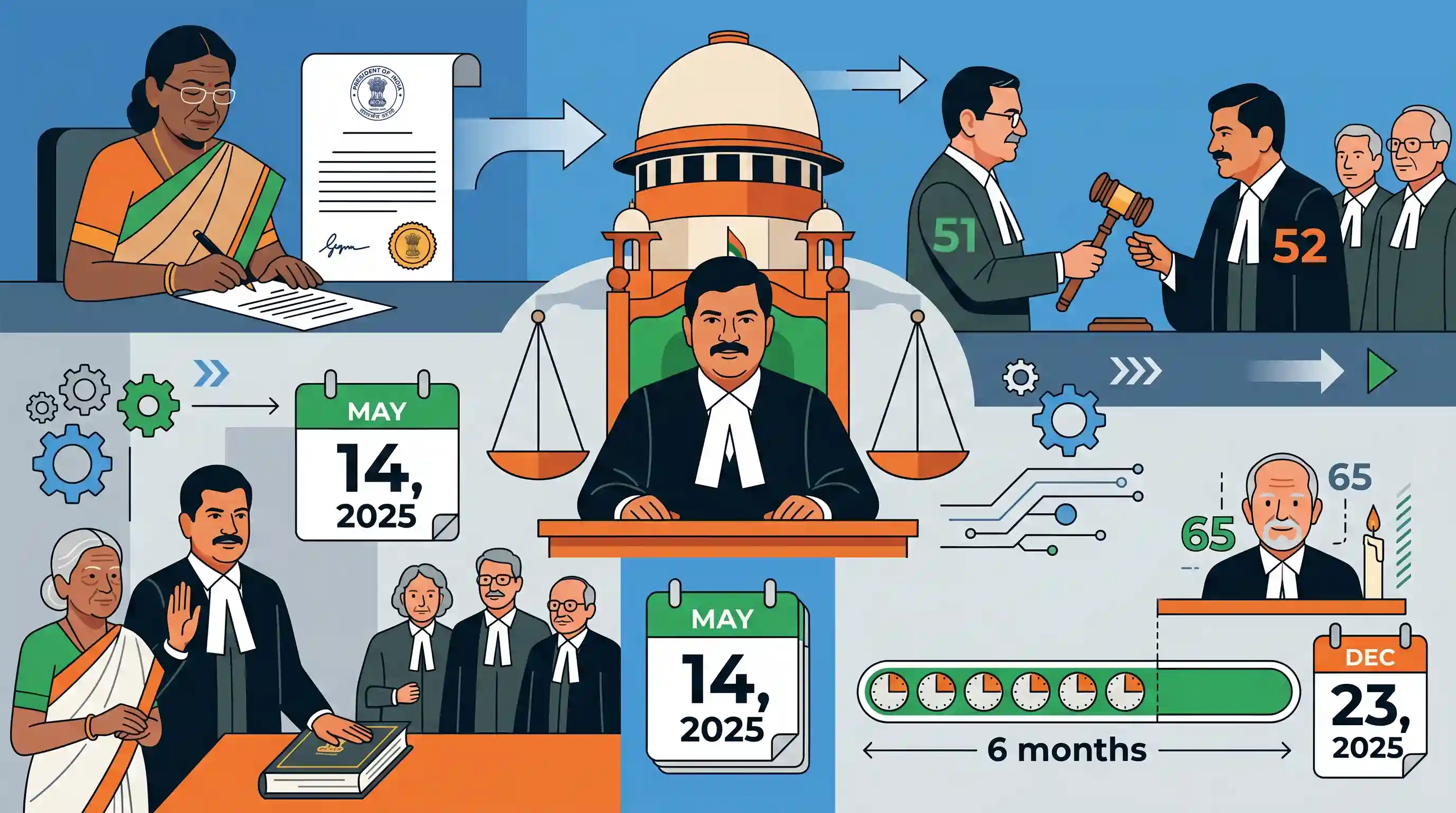
President Droupadi Murmu has appointed Justice B.R. Gavai as the 52nd Chief Justice of India (CJI), succeeding Justice Sanjiv Khanna. He will take oath on May 14, 2025, after being recommended by the outgoing CJI per the standard seniority convention. Justice Gavai will serve a relatively short tenure of six months, retiring on December 23, 2025, when he reaches the constitutional retirement age of 65 for Supreme Court judges.
Key Points
- Justice B.R. Gavai has been officially appointed as the 52nd Chief Justice of India by President Droupadi Murmu.
- He will assume office on May 14, 2025, succeeding the incumbent CJI, Justice Sanjiv Khanna.
- Justice Gavai's appointment follows the established convention of elevating the senior-most Supreme Court judge to the position of CJI.
- He will have a brief tenure of just over six months, as he is scheduled to demit office on December 23, 2025, upon reaching the mandatory retirement age of 65.
Important Terms
Chief Justice of India (CJI)

The head of the Indian judiciary and the Supreme Court, appointed by the President. They serve as the 'Master of the Roster,' assigning cases to benches.
UPSC context
GS Paper II: Constitutional Posts and Judiciary. Essential for understanding judicial hierarchy and administrative powers of the CJI.
Seniority Convention
A traditional practice where the senior-most judge of the Supreme Court is appointed as the CJI to ensure judicial independence and minimize political interference.
UPSC context
GS Paper II: Appointment of Judges. Relevant for debates on judicial independence versus executive discretion in appointments.
Article 124
The constitutional article governing the establishment, composition, and appointment process of the Supreme Court and its judges by the President of India.
UPSC context
GS Paper II: Indian Constitution. A core article for any question regarding the structure and functioning of the apex court.
Collegium System
The judge-led system for appointing and transferring judges to the Supreme Court and High Courts, established through the 'Three Judges Cases'.
UPSC context
GS Paper II: Judiciary. Frequently tested in the context of judicial reforms and the separation of powers.
Supreme Court of India
The highest judicial authority and final court of appeal in India, acting as the guardian of the Constitution and fundamental rights.
UPSC context
GS Paper II: Judiciary. Key for understanding judicial review, basic structure doctrine, and original jurisdiction.
Retirement Age of SC Judges
The age of 65 years, at which Supreme Court judges must mandatorily retire as specified under Article 124(2) of the Constitution.
UPSC context
GS Paper II: Indian Polity. Important for comparing Indian judicial service conditions with those of other democracies.
Prelims Trap
The Constitution mandates that the senior-most judge of the Supreme Court must be appointed as the Chief Justice of India.
The seniority principle is an established convention codified in the Memorandum of Procedure (MoP) and affirmed by the Second Judges Case, not an explicit constitutional provision.
Static Concepts Connected
How is the Chief Justice of India appointed?
- Constitutional basis: Article 124(2) empowers the President to appoint SC judges, but lacks specific procedures for selecting the CJI.
- Seniority convention: Solidified by the Second Judges Case (1993), the established convention dictates that the senior-most SC judge is appointed CJI.
- Memorandum of Procedure: Guides the executive process; the Union Law Minister seeks the outgoing CJI's recommendation approximately one month prior to their retirement.
What are the tenure conditions for a Supreme Court Judge?
- Retirement age: Article 124(2) caps the retirement age at 65 years. The Constitution prescribes no fixed minimum age or minimum tenure duration.
- Removal process: Can only be removed by a Presidential order following an address by Parliament supported by a special majority (proved misbehaviour or incapacity).
Cross-Topic Patterns
Short tenures & Judicial administration
Frequent changes in the CJI office are debated regarding their impact on Collegium continuity, master of roster stability, and long-term administrative reforms in the judiciary.
Executive-Judiciary MoP friction
The operation of the Memorandum of Procedure (MoP) connects directly to ongoing separation-of-powers debates, the history of the NJAC, and the Basic Structure doctrine.

Expect a Prelims question testing the difference between explicit constitutional text (Article 124) and conventions (MoP, seniority) for CJI.
Linked PYQs · 3
Linked PYQs · 3
- 2025MainsGS2
Discuss the evolution of collegium system in India. Critically examine the advantages and disadvantages of the system of appointment of the Judges of the Supreme Court of India and that of the USA.
- 2017MainsGS2
Critically examine the Supreme Court's judgement on 'National Judicial Appointments Commission Act, 2014' with reference to appointment of judges of higher judiciary in India.
- 2021PrelimsGS1
With reference to Indian judiciary, consider the following statements : 1. Any retired judge of the Supreme Court of India can be called back to sit and act as a Supreme Court judge by the Chief Justice of India with prior permission of the President of India. 2. A High Court in India has the power to review its own judgement as the Supreme Court does. Which of the statements given above is/are correct?
