ICJ Genocide Convention Ruling on Myanmar and International Law
Source:The Hindu ↗
Why It Matters
It is crucial for understanding international humanitarian law, the jurisdiction and role of the International Court of Justice (ICJ) in human rights violations, and India's strategic calculations in its neighborhood policy regarding Myanmar.
Summary
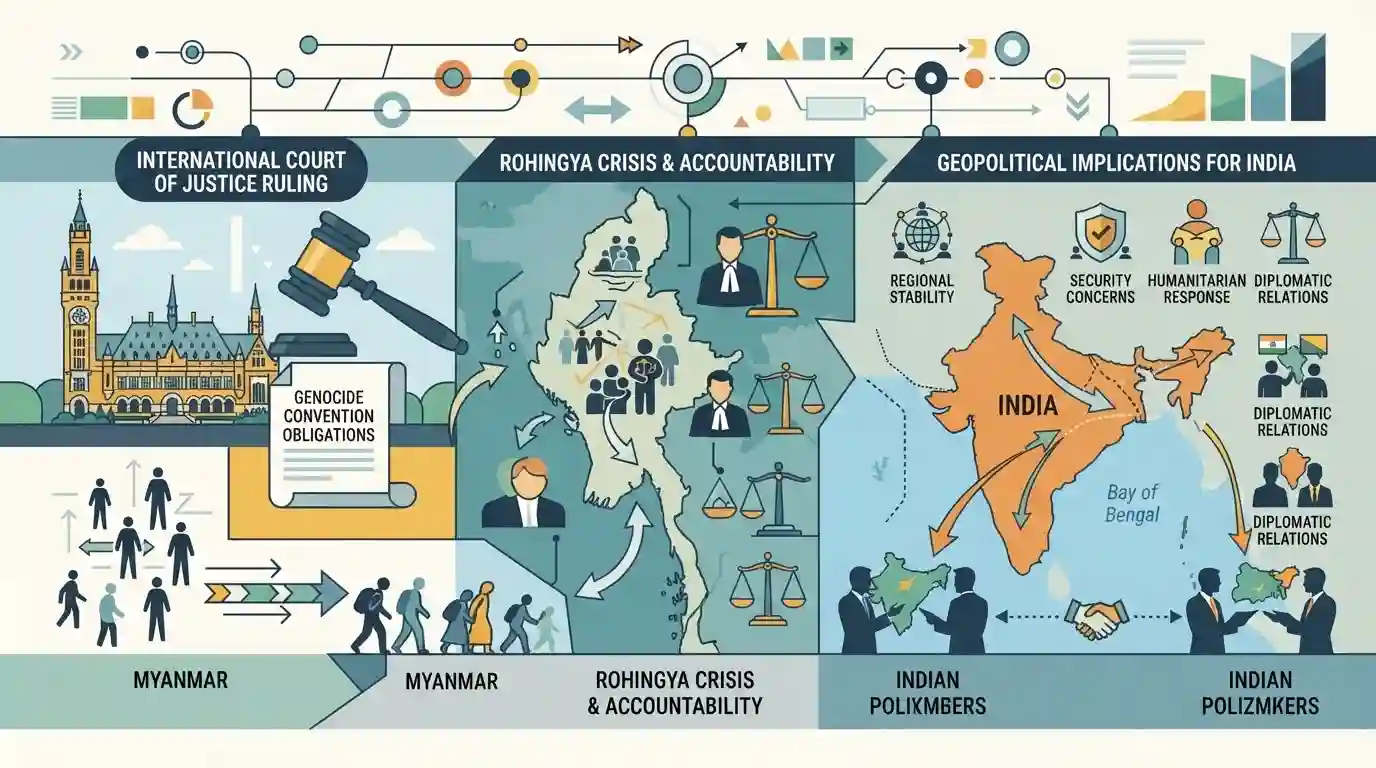
An editorial examining the International Court of Justice ruling regarding Myanmar's obligations under the Genocide Convention vis-a-vis the Rohingya crisis, highlighting international accountability and geopolitical implications for neighboring countries like India.
Key Points
- The International Court of Justice (ICJ) ruled on preliminary objections in the case brought by Gambia against Myanmar under the 1948 Genocide Convention.
- The ICJ's decision reaffirms that states parties to the Genocide Convention have obligations erga omnes partes to prevent and punish genocide, allowing a non-injured state like Gambia to bring a claim.
- The ruling marks an important step toward accountability for atrocities committed against the Rohingya minority in Myanmar, notwithstanding the domestic political turmoil and military junta's rule.
- India faces delicate diplomatic choices regarding Myanmar given its strategic interests, border security concerns, and the humanitarian dimensions of the Rohingya crisis.
Important Terms
International Court of Justice (ICJ)

The principal judicial organ of the United Nations, based in The Hague, which settles legal disputes between states and gives advisory opinions on legal questions referred by authorized UN organs.
UPSC context
UPSC Prelims & Mains (GS Paper II: International Relations/Institutions). Tests understanding of UN organs, state accountability, and international law.
Genocide Convention
A 1948 international treaty defining genocide as acts committed with intent to destroy, in whole or in part, a national, ethnical, racial, or religious group, obligating state parties to prevent and punish it.
UPSC context
UPSC Prelims & Mains (GS Paper II: International Law, Human Rights). Tests knowledge of treaties, state obligations, and humanitarian norms.
International Criminal Court (ICC)
A permanent international court established by the Rome Statute to prosecute individuals for international crimes including genocide, war crimes, crimes against humanity, and aggression.
UPSC context
UPSC Prelims & Mains (GS Paper II). Tests institutional distinctions from the ICJ and India's non-membership stance regarding the Rome Statute.
Prelims Trap
only a state specially injured by an alleged breach of the Genocide Convention can institute proceedings against another state at the ICJ.
Only states directly injured or physically impacted by genocide can institute proceedings against a violating state at the ICJ.
Static Concepts Connected
What is the distinction between ICJ advisory opinions and contentious cases regarding legal bindingness?
- Binding Nature: Contentious cases involve legal disputes between sovereign states; decisions are binding only on the parties to the specific case.
- Advisory Nature: Advisory opinions are rendered upon request by authorized UN organs and specialized agencies; they are non-binding.
- Judicial Weight: Both types of pronouncements carry immense authoritative weight and contribute significantly to the progressive development of international law.
Cross-Topic Patterns
ICJ Erga Omnes Partes & UNCLOS Disputes
Gambia bringing proceedings against Myanmar under the Genocide Convention demonstrates how non-injured states use erga omnes partes obligations, a principle that also underpins state accountability in UNCLOS maritime disputes.
Rohingya Crisis and Act East Policy
India's balancing act between international human rights obligations and strategic infrastructure projects like Kaladan illustrates the friction points within the Act East Policy.

ICJ jurisdiction on erga omnes partes and non-injured state standing under the Genocide Convention is prime material for a prelims statement.
Linked PYQs · 1
Linked PYQs · 1
- 2016MainsGS2
Evaluate the economic and strategic dimensions of India's Look East Policy in the context of the post Cold War international scenario.
