Calcutta High Court Rules on Evidentiary Value of Relative Witnesses
Source:timesofindia-indiatimes ↗
Why It Matters
Important for understanding judicial pronouncements by the Calcutta High Court concerning evidence law and criminal trial procedures relevant to West Bengal.
Summary
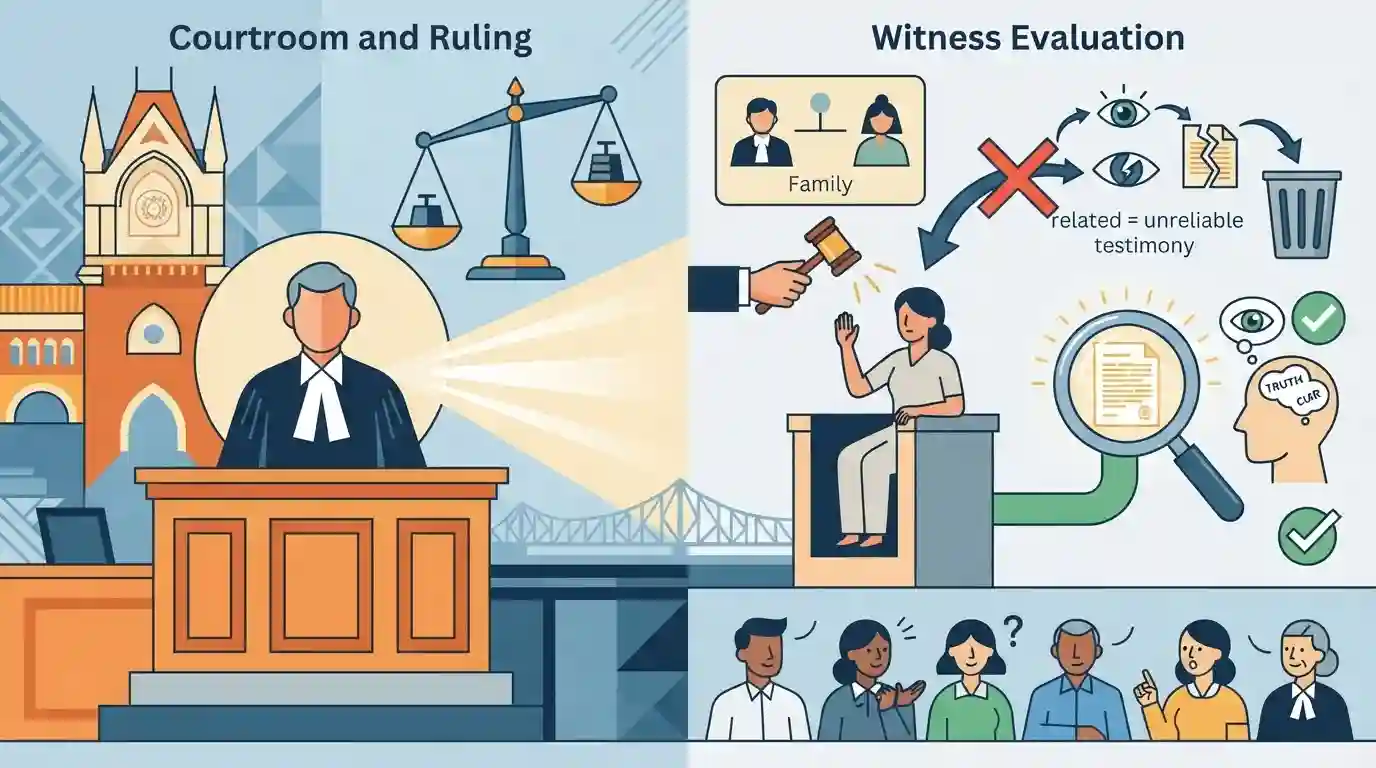
The Calcutta High Court has clarified in a ruling that the testimony of a witness cannot be discarded or disbelieved solely on the ground that the witness is a relative of the victim, reinforcing standard legal principles regarding the evaluation of related witness testimony.
Key Points
- The Calcutta High Court ruled that testimony of a witness cannot be disbelieved merely because they are a relative of the victim.
- The court emphasized that the evidence of a related witness must be scrutinized carefully rather than being outright rejected.
- The judgment reinforces established criminal jurisprudence principles regarding interested and related witnesses.
Important Terms
Calcutta High Court

The constitutional court of West Bengal and Andaman and Nicobar Islands, exercising original, appellate, and writ jurisdiction under Articles 226 and 227 of the Constitution of India.
UPSC context
WBCS Paper V (Indian Polity & Judiciary) and legal current affairs; tests understanding of state high court rulings and criminal jurisprudence.
Indian Evidence Act
The foundational 1872 statute governing the admissibility of evidence, witness competency, and judicial procedures in Indian courts, recently replaced by the Bharatiya Sakshya Adhiniyam.
UPSC context
WBCS Paper V (Indian Polity and Criminal Law); tests core legal provisions regarding witness credibility and criminal trials.
Bharatiya Sakshya Adhiniyam
The modern criminal code enacted in 2023 to replace the colonial-era Indian Evidence Act, governing laws of evidence, witness competency, and judicial standards in India.
UPSC context
WBCS Paper V (Criminal Jurisprudence & Recent Legal Reforms); tests awareness of India's newly overhauled criminal justice statutes.
Prelims Trap
Testimony of a relative can be discarded outright because they are an interested witness.
Aspirants often confuse 'related witness' with 'interested witness'. Law does not automatically discard a relative's testimony, whereas an interested witness's testimony is viewed with greater suspicion.
Static Concepts Connected
What is the difference between a related witness and an interested witness in Indian law?
- Related Witness: A related witness is tied by blood or marriage to the victim but has no direct motive to falsely implicate an innocent person, often being the only natural witness.
- Interested Witness: An interested witness is one who has a direct personal stake, animosity, or motive in seeing the accused convicted or falsely implicated.
- Judicial Scrutiny: Courts do not reject related witnesses outright, but scrutinize their testimony with care and caution; interested testimony requires even stricter corroboration.
Cross-Topic Patterns
Related vs. Interested Witness Distinction
In Indian criminal jurisprudence, related witnesses are distinguished from interested witnesses, a distinction crucial for prelims statements on evidence evaluation under the Bharatiya Sakshya Adhiniyam.

Calcutta HC rulings on criminal jurisprudence frequently appear in WBCS Mains Paper IV or polity statement-based prelims questions.
Linked PYQs · 1
Linked PYQs · 1
- 2020WBCS_PRELIMSGS1
'Chancellor' of the State-run Universities in West Bengal is
