Jupiter Dust Ring and Planetesimal Formation in Solar System
Source:Indian Express ↗
Why It Matters
Understanding the origin and evolution of the solar system is a core component of the UPSC Science & Technology syllabus. The role of gas giants, protoplanetary disks, and the composition of meteorites (like carbonaceous chondrites) are important foundational concepts for both Prelims and Mains.
Summary
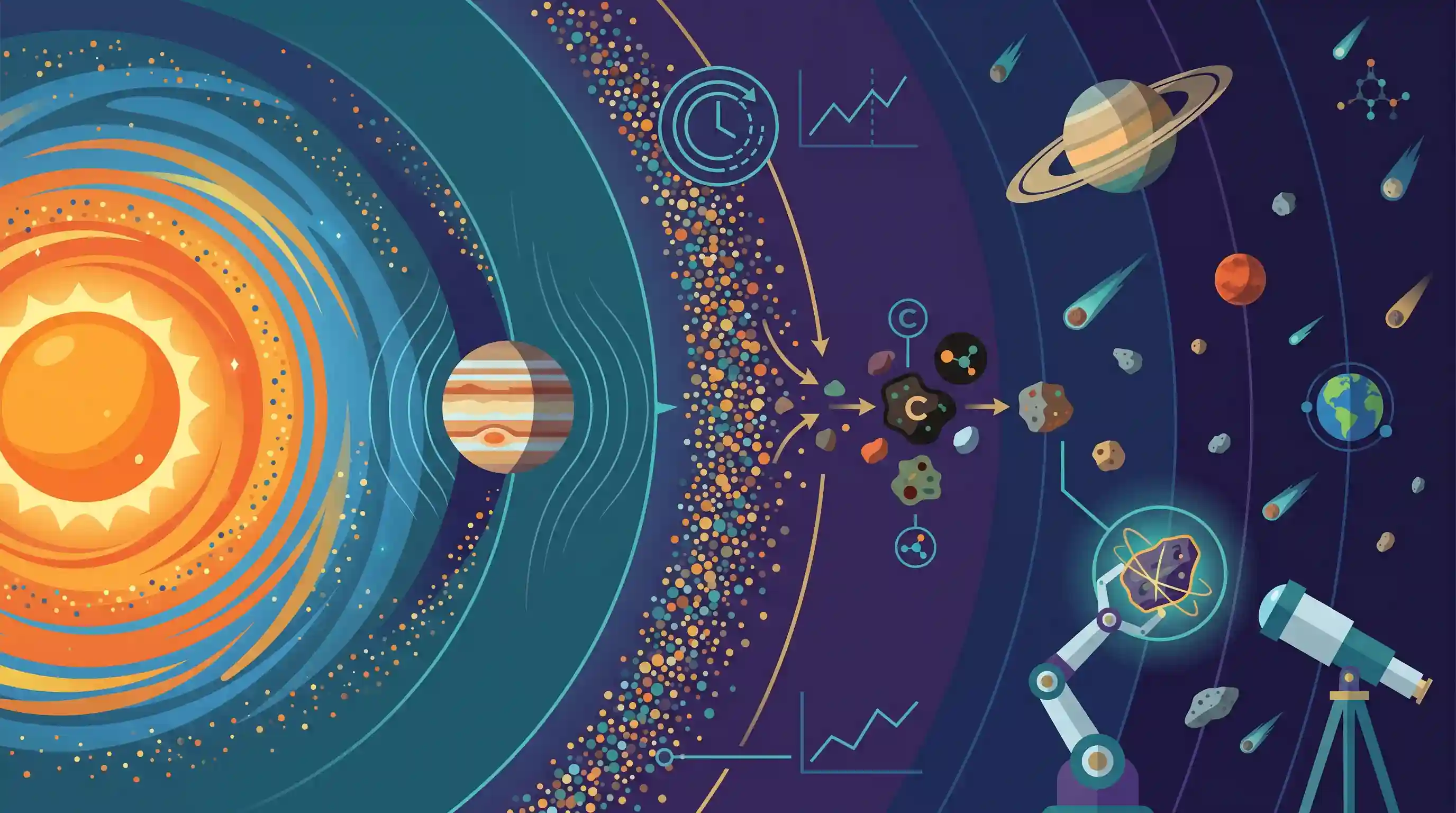
A recent study by the Max Planck Institute for Solar System Research indicates that a 'dust trap' located beyond Jupiter's orbit served as a major breeding ground for planetesimals—the foundational building blocks of the solar system. By carving a gap in the protoplanetary disk, Jupiter's gravity created a high-pressure ring where dust particles accumulated and coalesced over two million years. This process explains the formation of diverse planetesimals, including those that eventually became carbonaceous chondrites (carbon-rich meteorites) which hold critical clues to our solar system's origins.
Key Points
- A new study reveals that a 'dust trap' just outside Jupiter's orbit acted as a long-term breeding ground for planetesimals, the building blocks of planets, asteroids, and comets.
- Jupiter's immense gravity carved a gap in the surrounding protoplanetary disk of gas and dust, creating a high-pressure zone that trapped dust particles and facilitated their merger into planetesimals.
- This planetesimal formation process in the dust trap lasted for approximately two million years, producing celestial bodies with diverse chemical compositions.
- The findings successfully replicate the properties of carbonaceous chondrites, which are carbon-rich meteorites found on Earth that serve as pristine relics of the early solar system.
- The research bridges the gap between laboratory meteorite analysis and computer simulations of early solar system evolution.
Important Terms
Planetesimal

Kilometer-scale rocky or icy bodies formed by the accretion of dust and pebbles. They are the foundational building blocks that collide and merge to form planets and asteroids in a solar system.
UPSC context
Relevant for GS I (Geography - Origin of Earth) and GS III (Space Technology). It tests early solar system evolution and planetary formation theories.
Carbonaceous Chondrites
Primitive, carbon-rich stony meteorites that have undergone minimal thermal alteration since the solar system's birth. They contain water and organic compounds, offering vital clues to the origin of life and planets.
UPSC context
GS III (Science & Technology - Space). Examined in the context of astrobiology and the chemical composition of early solar system materials.
Protoplanetary Disk
A rotating circumstellar disk of dense gas and dust surrounding a newly formed star. It provides the material reservoir from which planets, moons, and other celestial bodies eventually emerge.
UPSC context
Important for GS III (Space Exploration). Tests knowledge of star system development and the ingredients required for planetary system formation.
Dust Trap
A high-pressure region within a protoplanetary disk where gas drag slows inward-drifting dust grains. This allows particles to accumulate and coalesce into planetesimals rather than falling into the central star.
UPSC context
Critical for GS III (Planetary Science). Explains the mechanical "missing link" in how tiny dust grains survive to become kilometer-sized rocky bodies.
Accretion
The process of gradual growth or accumulation of matter. In astronomy, it refers to the gathering of gas and dust into larger celestial bodies like planetesimals and planetary cores via gravity.
UPSC context
GS I (Physical Geography). It is the primary mechanism discussed in NCERT/UPSC theories regarding the origin and evolution of the Earth and solar system.
Max Planck Institute for Solar System Research (MPS)
A premier German research organization specializing in solar and planetary science. It conducts advanced computer simulations and spacecraft-based observations to study the history and dynamics of our solar system.
UPSC context
GS III (Current Affairs/Science). Highlights the role of premier international institutes in advancing global understanding of space and planetary origins.
Prelims Trap
"Carbonaceous chondrites are rocky fragments of melted planetary cores from the early solar system."
Carbonaceous chondrites are primitive, completely un-melted stony meteorites from the early solar nebula. They contain preserved organics, unlike differentiated planetary cores which have undergone intense heating.
Static Concepts Connected
What are Carbonaceous Chondrites and why are they significant?
- Primitive relics: They are un-melted, primitive stony meteorites that preserve the original dust and gas composition of the early solar nebula.
- Organic-rich: They contain high levels of carbon, volatile compounds, water, and even complex organic molecules like amino acids.
- Asteroid belt origin: Most of these meteorites found on Earth originate from the main asteroid belt located between Mars and Jupiter.
What is the difference between a Protoplanetary Disk and a Planetesimal?
- Protoplanetary Disk: A rotating circumstellar disk of dense gas and dust surrounding a newly formed star, providing raw materials for planets.
- Planetesimals: Solid celestial bodies (kilometers in size) formed when dust in the disk collides and coalesces; they are planetary building blocks.
Cross-Topic Patterns
Asteroid sample return missions
NASA's OSIRIS-REx (Bennu) and Japan's Hayabusa2 (Ryugu) explicitly targeted carbonaceous asteroids to retrieve the exact pristine planetesimal material described in this Jupiter study.
Origins of Earth's water
Because carbonaceous chondrites are rich in water and organics, Jupiter's "dust trap" mechanisms directly connect to theories explaining how Earth received its early oceans and building blocks for life.

Expect a Prelims question linking carbonaceous chondrites, asteroid return missions (OSIRIS-REx), and the origins of Earth's water.
Linked PYQs · 2
Linked PYQs · 2
- 1997PrelimsGS1
The group of small pieces of rock revolving round the sun between the orbits of Mars and Jupiter are called
- 2009PrelimsGS1
Which one of the following planets has largest number of natural satellites or moons?
