Rising Fuel and Transport Costs Threaten Inflation Targets
Source:Indian Express ↗
Why It Matters
Understanding the dynamics of retail inflation, how specific sub-categories like transport and LPG drive headline CPI, and the impact of geopolitical supply-side shocks on RBI's monetary policy tools is critical for both Prelims (conceptual questions on CPI/WPI and monetary tools) and Mains (macroeconomic stability and policy challenges).
Summary
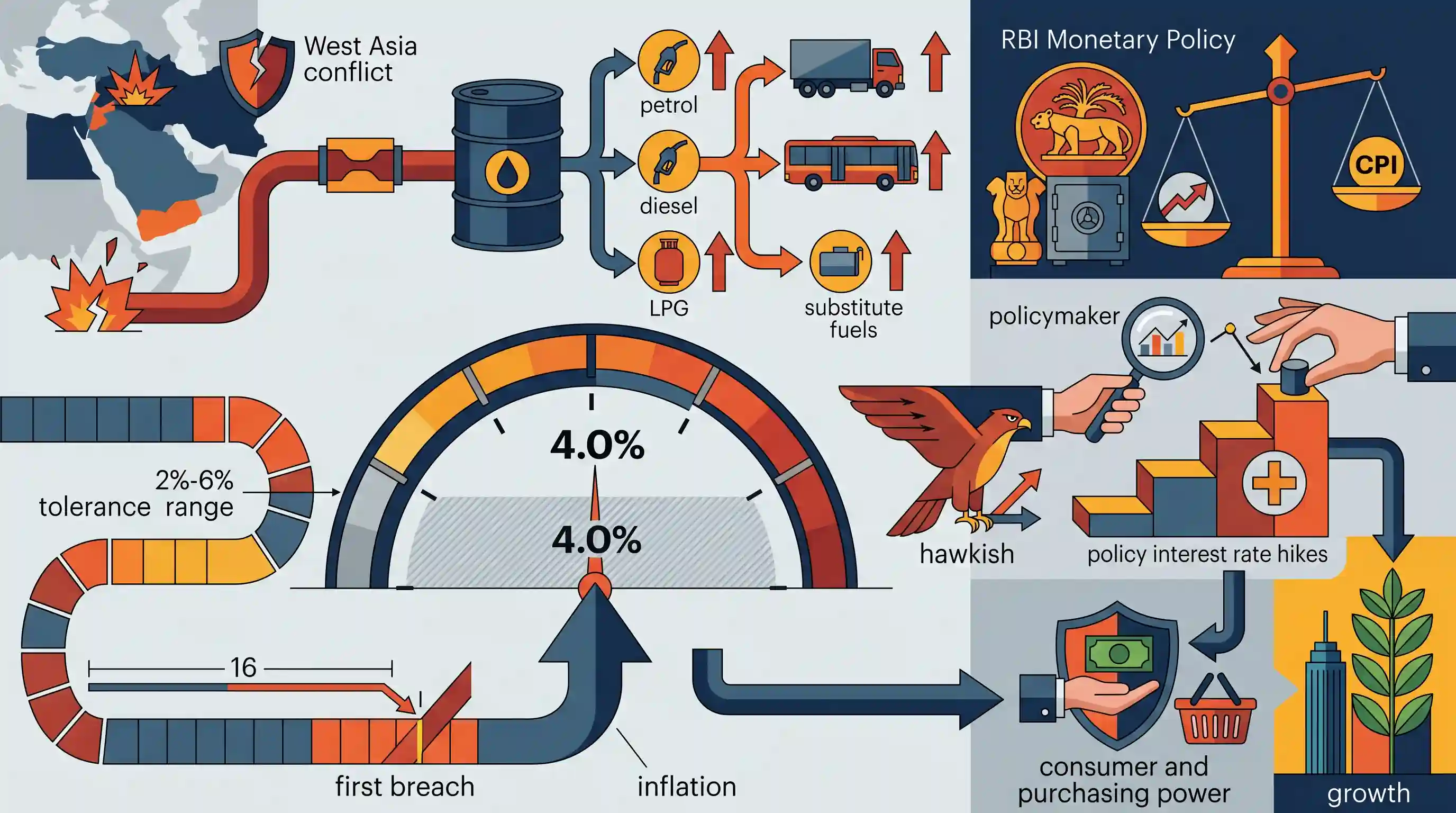
The article highlights that India's retail inflation (CPI) is expected to reach 4.25% in June 2026, breaching the Reserve Bank of India’s (RBI) primary 4.0% target for the first time in 16 months. This surge is driven by supply-side shocks from the West Asia conflict, driving up fuel (petrol, diesel, and LPG) prices and subsequently elevating transport and substitute fuel inflation. Although the projection remains within the statutory 2%-6% tolerance band, escalating geopolitical tensions may compel the RBI to retain a highly cautious, hawkish monetary stance, with potential interest rate hikes later in the year to protect real consumer purchasing power and growth.
Key Points
- June 2026 retail inflation is estimated by CMIE to reach 4.25%, breaching the RBI's target of 4.0% for the first time in 16 months (up from 3.93% in May 2026).
- The primary driver is transport inflation (9% weight in CPI), which is projected to grow by 4.6% in June due to May's fuel hikes (petrol/diesel) triggered by the West Asia conflict, rising input costs in automobiles, and increased travel fares.
- Fuel and power inflation is rising, with average domestic LPG prices increasing to Rs 947 per 14.2 kg cylinder (up by over Rs 80 since March), which has conversely driven up substitute fuel costs (firewood, dung cakes) and lifted the electricity, gas, and other fuels inflation to 1.9% in June.
- Persistent high inflation acts as a drag on real economic growth by eroding consumer purchasing power and reducing real consumption.
- While 4.25% is within the RBI's wider 2% to 6% comfort band, geopolitical hostilities (e.g., US-Iran tensions) could prompt the central bank to remain highly cautious and potentially raise interest rates later in the year to prevent spiraling price levels.
Important Terms
Consumer Price Index (CPI)

A macroeconomic indicator measuring the average change over time in retail prices of a representative basket of goods and services consumed by households, reflecting retail-level inflation.
UPSC context
GS Paper III: crucial for understanding retail-level price changes, consumption baskets, and the formulation of monetary policy.
Flexible Inflation Targeting (FIT)
India's statutory monetary policy framework under which the RBI's Monetary Policy Committee targets a 4% CPI-based retail inflation rate within a tolerance band of 2% to 6%.
UPSC context
GS Paper III: tests knowledge of Monetary Policy Committee (MPC) operations, price stability, and economic growth trade-offs.
Reserve Bank of India (RBI)
India’s central banking institution established in 1935, responsible for formulating monetary policy, issuing currency, supervising the banking sector, and safeguarding financial and macroeconomic stability.
UPSC context
GS Paper III & II: essential for questions on monetary policy instruments, banking regulations, and external macroeconomic shocks.
Supply-side Inflation
Inflation driven by an increase in production costs or supply chain disruptions rather than excess consumer demand, forcing businesses to pass higher input costs to consumers.
UPSC context
GS Paper III: tests understanding of cost-push dynamics, supply-chain bottlenecks, and limitations of interest rate hikes.
Centre for Monitoring Indian Economy (CMIE)
An independent, private Indian economic think tank and business intelligence firm that collects and analyses key data on macroeconomic indicators, employment, and household consumption.
UPSC context
GS Paper III: relevant for alternative data sources, unemployment tracking, and understanding private sector economic indicators.
Prelims Trap
A breach of the 4% inflation target for three consecutive quarters constitutes a statutory failure of the monetary policy framework.
Statutory failure under Section 45ZN occurs only when inflation falls outside the 2%-6% tolerance band for three consecutive quarters, not the 4% midpoint.
Static Concepts Connected
What constitutes a statutory "failure" of the monetary policy framework in India?
- Legal Basis: Governed by Section 45ZN of the RBI Act, 1934, when CPI inflation breaches the tolerance limits.
- Failure Condition: Average inflation remaining outside the 2% to 6% statutory tolerance band for three consecutive quarters.
- Mandated Outcome: The RBI must submit an explanatory report and remedial action plan to the central government.
How is Core Inflation distinguished from Headline CPI?
- Headline CPI: Measures total inflation in the economy, including highly volatile components like food and fuel.
- Core Inflation: Excludes food, beverages, and fuel/light components to capture underlying, demand-driven price trends.
- Policy Utility: Provides a clearer picture of long-term price stability as it is insulated from temporary supply-side shocks.
Cross-Topic Patterns
Crude Volatility & Monetary Autonomy
Geopolitical shocks in West Asia directly feed into domestic transport and fuel inflation, constraining RBI's monetary easing cycles despite stable domestic demand.
Engel's Law & CPI Weight Revisions
The 2024 CPI base-year revision reduced food weight to 36.75%, reflecting Engel's Law where rising household incomes structurally reduce the proportional expenditure on food.

UPSC may test the statutory details of RBI's monetary policy failure alongside the structural shifts in the new 2024 CPI basket.
Linked PYQs · 4
Linked PYQs · 4
- 2020PrelimsGS1
Consider the following statements: 1. The weightage of food in Consumer Price Index (CPI) is higher than that in Wholesale Price Index (WPI). 2. The WPI does not capture changes in the prices of services, which CPI does. 3. Reserve Bank of India has now adopted WPI as its key measure of inflation and to decide on changing the key policy rates. Which of the statements given above is/are correct?
- 2022PrelimsGS1
With reference to the Indian economy, consider the following statements: 1. If the inflation is too high, Reserve Bank of India (RBI) is likely to buy government securities. 2. If the rupee is rapidly depreciating, RBI is likely to sell dollars in the market. 3. If interest rates in the USA or European Union were to fall, that is likely to induce RBI to buy dollars. Which of the statements given above are correct?
- 2024MainsGS3
What are the causes of persistent high food inflation in India? Comment on the effectiveness of the monetary policy of the RBI to control this type of inflation.
- 2021PrelimsGS1
With reference to Indian economy, demand-pull inflation can be caused/ increased by which of the following? 1. Expansionary policies 2. Fiscal stimulus 3. Inflation-indexing wages 4. Higher purchasing power 5. Rising interest rates Select the correct answer using the code given below.
