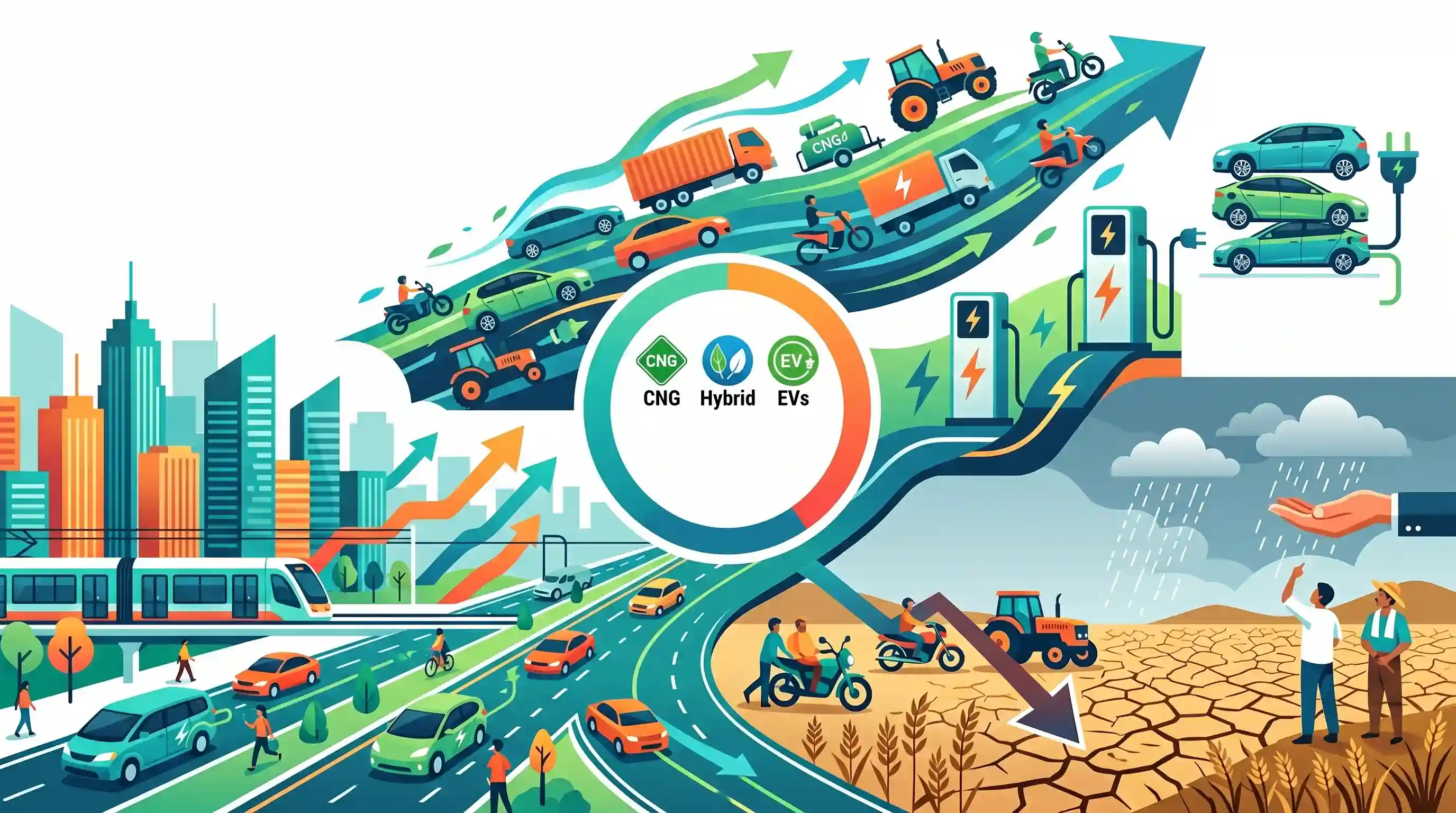
Automobile retail sales growth and clean fuel adoption trends
Source:The Hindu ↗
Why It Matters
This article provides crucial quantitative insights into the health of the Indian manufacturing sector, the consumer demand landscape, and the clean energy transition. The high rate of alternative-fuel adoption (over 40% in PVs) directly relates to UPSC topics on decarbonization and India's net-zero commitments. Furthermore, the divergence between urban and rural two-wheeler demand illustrates the structural dependency of the rural economy on monsoon patterns, a recurring theme in GS3 economic planning and agriculture.
Summary
According to data from the Federation of Automobile Dealers Associations (FADA), India's auto retail sales grew by 21.83% year-on-year in June 2026, driven by passenger vehicles, tractors, and two-wheelers. The data highlights a significant milestone in clean mobility, with alternative-fuel vehicles (CNG, Hybrids, and EVs) comprising over 40% of passenger vehicle sales, and total monthly EV sales crossing 3 lakh units. However, a delayed southwest monsoon led to a month-on-month contraction in rural two-wheeler demand, exposing a divergence between urban and rural consumption patterns.
Key Points
- India's auto retail sales grew by 21.83% year-on-year (YoY) in June 2026, reaching 25.57 lakh units.
- Alternative-fuel passenger vehicles (combining CNG, Hybrid, and EV) crossed the 40% penetration mark for the first time, reaching 40.35%.
- Total electric vehicle (EV) sales across all segments reached a record monthly high of 3,06,220 units, bringing overall EV penetration in the retail market to 12.5%.
- A distinct urban-rural demand divergence was observed in two-wheeler sales, with urban retail growing 4.25% month-on-month (MoM) while rural sales contracted by 4.55% MoM due to a delayed and uneven southwest monsoon.
- The Passenger Vehicle (PV) segment registered a strong 28.63% YoY growth, whereas wheeled construction equipment declined 40.94% YoY due to a high base.
Important Terms
Faster Adoption and Manufacturing of Hybrid and Electric Vehicles (FAME)

A flagship Central Government scheme under the National Electric Mobility Mission Plan aimed at promoting clean mobility by providing financial subsidies for purchasing electric/hybrid vehicles and building charging infrastructure.
UPSC context
GS Paper III (Infrastructure: Energy); tests government policies promoting electric vehicles, clean mobility, and sustainable development.
Production Linked Incentive (PLI) Scheme
A key industrial policy offering domestic and foreign manufacturers financial rewards (4–6%) based on incremental sales of Indian-made goods over a base year to scale up manufacturing.
UPSC context
GS Paper III (Indian Economy, Industrial Policy); tests strategies for boosting domestic manufacturing, self-reliance, and job creation.
Federation of Automobile Dealers Associations (FADA)
The apex national body representing India's automobile retail industry. Established in 1964, it tracks monthly retail data, represents dealer interests, and advocates on auto policy.
UPSC context
GS Paper III (Indian Economy); tests knowledge of retail economic indicators, consumption trends, and automobile sector growth.
Prelims Trap
The PM E-DRIVE scheme provides financial incentives and subsidies across all electric vehicle categories, including private passenger cars.
The PM E-DRIVE scheme, which replaced FAME-II, deliberately excludes private passenger electric cars from its subsidy ambit to prioritize public transport, two-wheelers, and commercial freight.
Static Concepts Connected
What are the functional differences between Mild, Strong, and Plug-in Hybrid vehicles?
- Mild Hybrids (MHEV): Electric motor assists the combustion engine but cannot propel the vehicle independently on electric power alone.
- Strong Hybrids (FHEV): Equipped with larger batteries and motors that allow the vehicle to run purely on electricity for short distances.
- Plug-in Hybrids (PHEV): Incorporate much larger batteries that can be charged via an external power outlet, offering extended pure-electric range.
How does the Domestic Value Addition (DVA) mandate operate under India's Auto PLI?
- Minimum Threshold: Eligible automakers must achieve a minimum of 50% domestic localization to claim financial incentives.
- Strategic Objective: Aims to systematically reduce import reliance on critical sub-assemblies like lithium-ion cells and electronic control units.
- Phased Integration: Works alongside graded basic customs duties on imported parts to force local assembly and supply chain resilience.
Cross-Topic Patterns
Two-Wheelers as Rural Consumption Proxies
Tractor and two-wheeler sales act as critical high-frequency indicators of rural economic health, linking spatial monsoon distribution to overall GDP growth and private consumption.
Phased Manufacturing vs. Trade Liberalization
Domestic value addition rules (50% DVA) and basic customs duties on EV components balance industrial self-reliance with global green trade commitments.

PM E-DRIVE target segments and PLI Domestic Value Addition (DVA) requirements are highly likely to be tested together in 2026.
Linked PYQs · 3
Linked PYQs · 3
- 2025PrelimsGS1
Consider the following types of vehicles : I. Full battery electric vehicles II. Hydrogen fuel cell vehicles III. Fuel cell-electric hybrid vehicles How many of the above are considered as alternative powertrain vehicles?
- 2023MainsGS3
The adoption of electric vehicles is rapidly growing worldwide. How do electric vehicles contribute to reducing carbon emissions and what are the key benefits they offer compared to traditional combustion engine vehicles?
- 2025MainsGS3
Discuss the rationale of the Production Linked Incentive (PLI) scheme. What are its achievements? In what way can the functioning and outcomes of the scheme be improved?
