Historical Retrospective on June 3 Declaration and Partition
Source:Indian Express ↗
Why It Matters
The Mountbatten Plan is a cornerstone of India's modern history syllabus. Understanding the mechanics of the partition (referendums, Boundary Commission) and the nuanced reasons why key leaders and parties accepted the division is crucial for both Prelims (factual questions on committees and provisions) and Mains (analytical questions on the freedom struggle and its climax).
Summary
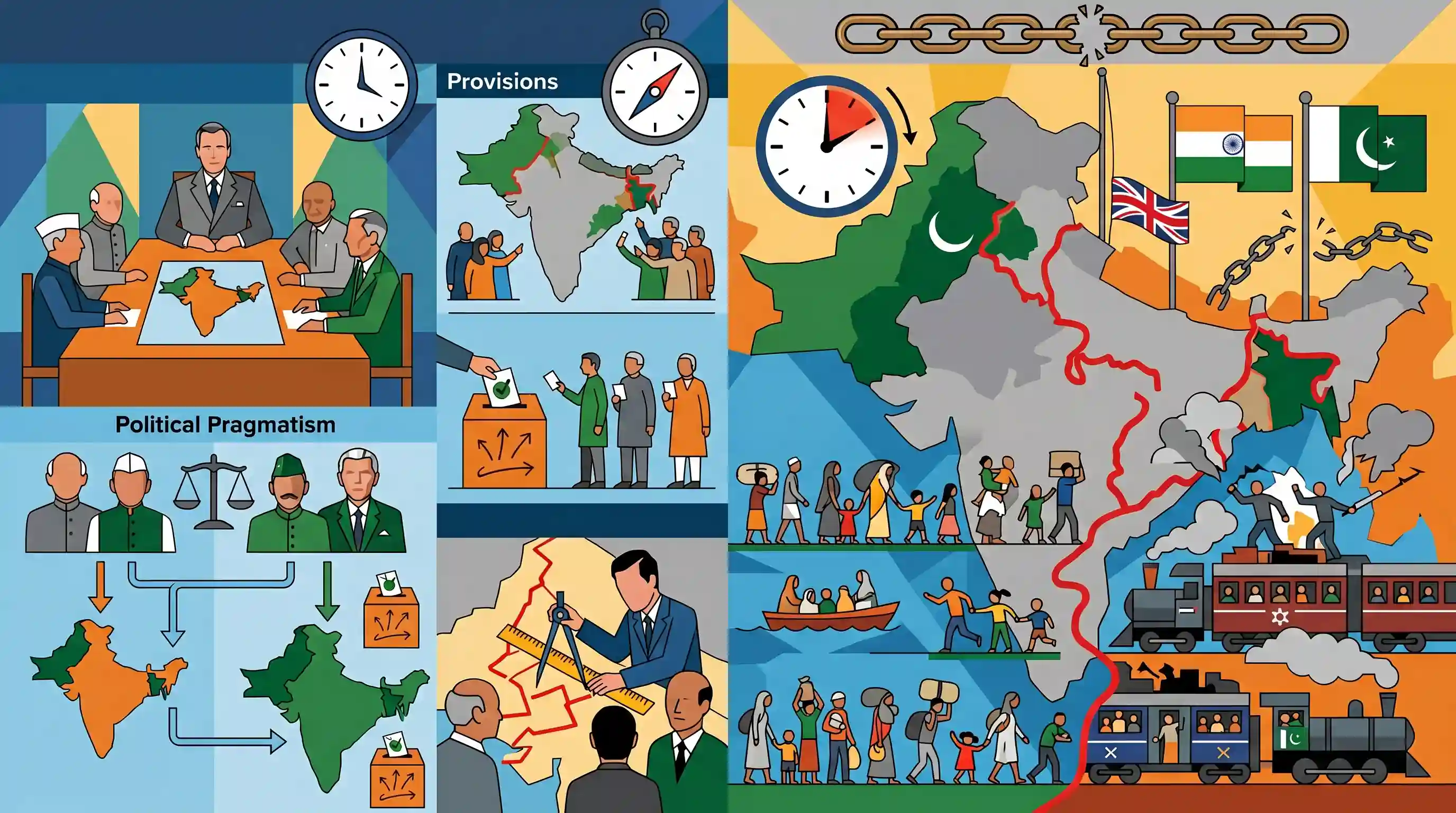
The article provides a historical retrospective on the June 3 Declaration of 1947, widely known as the Mountbatten Plan, which laid the framework for the partition of British India. It details the plan's core provisions, such as assembly votes for partitioning Punjab and Bengal, referendums in specific districts, and the establishment of a Boundary Commission. It analyzes the political pragmatism behind its acceptance: the Congress viewed a smaller, cohesive India as preferable to endless obstruction by the Muslim League in a united India, while the League secured its goal of an independent Pakistan. The expedited transfer of power, while ending colonial rule, also precipitated tragic mass migration and communal bloodshed.
Key Points
- The Mountbatten Plan, announced on June 3, 1947, formally proposed the partition of British India into two independent dominions: India and Pakistan.
- The plan mandated legislative assembly votes in Punjab and Bengal to decide on partition, while referendums were to be held in the NWFP and Sylhet district of Assam.
- A Boundary Commission was to be established to demarcate the borders of the partitioned provinces, and princely states were given the choice to accede to either dominion.
- The Indian National Congress accepted the plan, persuaded by Sardar Patel and Jawaharlal Nehru, to prevent a weak center and the balkanization of India.
- The Muslim League accepted the plan as it guaranteed a sovereign Pakistan, fulfilling its core objective, despite Jinnah's initial reluctance to partition Punjab and Bengal.
- The transfer of power was advanced to August 15, 1947, which led to hasty implementation, resulting in unprecedented communal violence and mass migration.
Important Terms
Mountbatten Plan

Proposed the partition of British India into two dominions, India and Pakistan, on June 3, 1947. It established separate constituent assemblies and a Boundary Commission for Punjab and Bengal.
UPSC context
GS Paper 1: Freedom Struggle. Tests knowledge of the final transition of power and the logistics of partition.
Plan Balkan
An early proposal by Mountbatten to transfer power to individual provinces rather than a central government. Rejected by Nehru as it threatened the national unity of India.
UPSC context
GS Paper 1. Vital for understanding why the Congress prioritized a strong central government over provincial autonomy.
Indian Independence Act 1947
The British legislation that formalised the Mountbatten Plan, ending British rule on August 15, 1947. It abolished the title of Emperor of India and granted dominion status.
UPSC context
GS Paper 2: Constitutional History. Marks the formal legal end of colonial rule and the start of the Indian Constitution's evolution.
Boundary Commission
A body led by Cyril Radcliffe tasked with partitioning Punjab and Bengal based on religious majorities. Its late report contributed to confusion and mass communal violence during partition.
UPSC context
GS Paper 1. Tests understanding of the sudden, contested nature of borders and the subsequent communal violence.
Cabinet Mission Plan
A 1946 British initiative seeking a united, three-tier federal India. Its failure led to the 'Direct Action Day' and eventually forced the acceptance of partition.
UPSC context
GS Paper 1 & 2. Essential for comparing 'United India' vs. 'Partition' constitutional frameworks.
Muslim League
A political party that advocated for a separate Muslim state. Under Jinnah's leadership, it secured the creation of Pakistan via the Mountbatten Plan after rejecting earlier unified proposals.
UPSC context
GS Paper 1. Essential for analyzing the communal politics and the demand for Pakistan during the 1940s.
Prelims Trap
"Referendums were held in Sindh and the entire province of Assam to decide their accession."
Referendums were restricted only to the North-West Frontier Province (NWFP) and the Sylhet district of Assam. Sindh’s accession was decided by its legislative assembly, not by a popular referendum.
Static Concepts Connected
How did the Mountbatten Plan differ from the 1946 Cabinet Mission Plan?
- Partition vs Union: The Cabinet Mission explicitly rejected a sovereign Pakistan, proposing a united India. The Mountbatten Plan formally accepted and executed the partition into two dominions.
- Central Authority: Congress accepted Mountbatten’s partition to secure a strong central government, discarding the Cabinet Mission's decentralized framework of a weak center and compulsory provincial grouping.
What was the mandate and structure of the Boundary Commission?
- Dual Commissions: Two separate commissions were formed for Punjab and Bengal, each comprising two Congress and two Muslim League nominees, chaired by Sir Cyril Radcliffe.
- Ambiguous Mandate: Tasked to demarcate borders based on contiguous religious majorities, but also instructed to consider ambiguous "other factors" like railway lines, rivers, and irrigation networks.
Cross-Topic Patterns
Integration of Princely States
The Mountbatten Plan's lapse of British paramountcy directly necessitated Sardar Patel’s rapid diplomatic campaign using the Instrument of Accession to prevent the political Balkanization of India.
Border enclaves and the 100th CAA
The hasty boundary lines drawn by the Radcliffe Commission left complex territorial enclaves in Bengal, which were only fully resolved through the 100th Constitutional Amendment Act of 2015.

Chronology of 1946-47 events (Cabinet Mission, Attlee's statement, Mountbatten Plan, Independence Act) is highly probable in 2026 prelims.
Linked PYQs · 4
Linked PYQs · 4
- 2014PrelimsGS1
The Radcliffe Committee was appointed to
- 2015PrelimsGS1
With reference to the Cabinet Mission, which of the following statements is/are correct? 1. It recommended a federal government. 2. It enlarged the powers of the Indian courts. 3. It provided for more Indians in the ICS. Select the correct answer using the code given below.
- 2016PrelimsGS1
The plan of Sir Stafford Cripps envisaged that after the Second World War
- 2025MainsGS1
Trace India's consolidation process during early phase of independence in terms of polity, economy, education and international relations.
