Digital payment security upgrades and energy policy transitions
Source:The Hindu ↗
Why It Matters
Provides crucial updates on digital public infrastructure (UPI) security enhancements and energy transition policies (LPG to PNG), both frequent themes in GS3. The link between domestic energy rationing and West Asian geopolitics is highly relevant for Mains analysis.
Summary
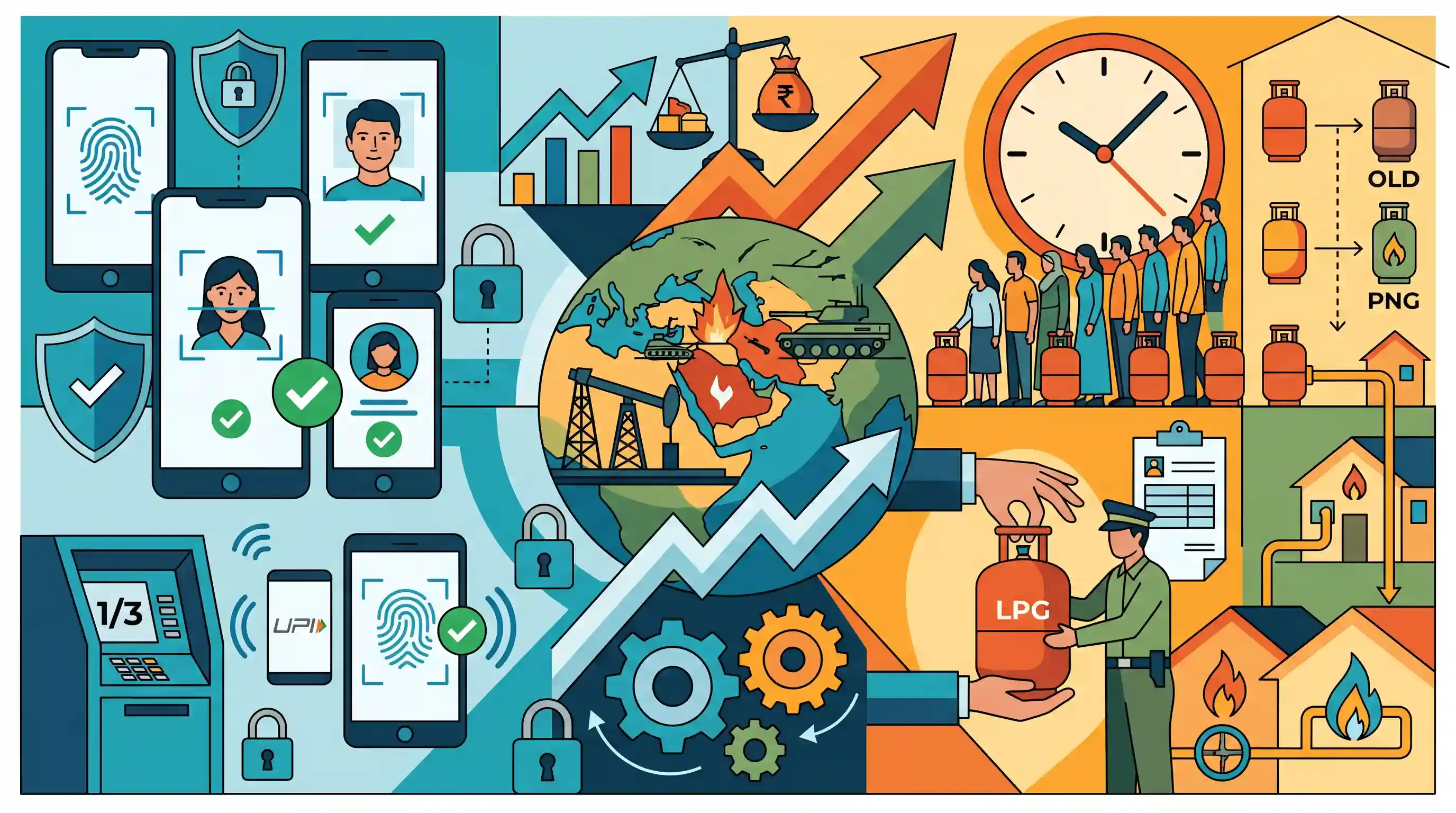
Effective June 1, 2026, new regulations will overhaul the Unified Payment Interface (UPI) and Liquid Petroleum Gas (LPG) frameworks in India. To enhance cybersecurity, high-value UPI transactions will necessitate biometric or two-factor authentication, and apps must pre-verify recipient names. Additionally, UPI cardless transactions will count against free ATM withdrawal quotas. In the energy sector, strict guidelines have been introduced to accelerate the transition from LPG to Piped Natural Gas (PNG), including mandatory surrender of LPG connections within 30 days of acquiring PNG and extended wait times for LPG refills. These energy rationing measures are partly driven by surging fuel prices stemming from the geopolitical crisis in West Asia.
Key Points
- High-value UPI transactions now require biometric or two-factor authentication to prevent financial scams.
- Pre-transaction name verification will be mandatory on UPI apps to stop misdirected payments.
- UPI cardless ATM transactions will count towards monthly free withdrawal limits, inviting fees if exceeded.
- Consumers switching to Piped Natural Gas (PNG) must terminate their Liquid Petroleum Gas (LPG) connections within 30 days.
- Oil Marketing Companies have extended the refill lock-in period for LPG cylinders to 25 days in urban areas and 45 days in rural areas.
- LPG restrictions aim to manage supply as energy prices rise due to the ongoing crisis in West Asia.
Important Terms
Unified Payment Interface (UPI)

A real-time, 24/7 payment system enabling instant bank-to-bank transfers via mobile apps. Developed by NPCI, it serves as a global benchmark for Digital Public Infrastructure (DPI) and financial inclusion in India.
UPSC context
GS Paper III (Economy/Science & Tech); tests knowledge of Digital Public Infrastructure (DPI) and financial formalization.
NPCI (National Payments Corporation of India)
An umbrella organization founded by the RBI and IBA in 2008 to operate retail payment and settlement systems. It manages critical infrastructure like UPI, RuPay, and IMPS to promote a cashless economy.
UPSC context
GS Paper III (Economy); tests understanding of institutional frameworks governing India's retail payments and financial inclusion.
Piped Natural Gas (PNG)
Methane-based fuel delivered via underground pipelines. It is safer (lighter than air) and more cost-effective than cylinder-based LPG, aiming to enhance energy security and reduce India's import dependency on fossil fuels.
UPSC context
GS Paper III (Infrastructure/Energy); tests analytical capability on energy security, transition to cleaner fuels, and reducing import dependency.
One Household, One Connection
A government mandate prohibiting households from holding both LPG and PNG connections simultaneously. It aims to prevent fuel hoarding, ensure equitable distribution, and curb black marketing of subsidized cylinders.
UPSC context
GS Paper II (Governance); tests understanding of administrative measures for resource management and subsidy rationalization.
Oil Marketing Companies (OMCs)
Public sector enterprises (e.g., IOCL, BPCL, HPCL) responsible for refining and distributing petroleum products. They implement energy security policies, manage LPG subsidies, and facilitate the national transition to piped natural gas.
UPSC context
GS Paper III (Economy); tests knowledge of the downstream petroleum sector and the role of PSUs in national energy security.
Two-Factor Authentication (2FA)
A security process requiring two distinct forms of identification to authorize access or transactions. In UPI, it mitigates cyber fraud for high-value transfers, ensuring the integrity of the digital payment ecosystem.
UPSC context
GS Paper III (Cybersecurity/Economy); tests knowledge of digital safety standards and measures to mitigate financial fraud.
Prelims Trap
"Biometric authentication is now mandatory for all UPI transactions to enhance digital security."
UPSC frequently uses absolute terms to set traps. The new guidelines only mandate biometric or two-factor authentication for high-value transactions, not for every small peer-to-peer transfer.
Static Concepts Connected
What are the key retail payment systems managed by NPCI?
- UPI: Instant real-time payment system facilitating inter-bank peer-to-peer and person-to-merchant transactions.
- RuPay & AePS: Indigenous card payment network and the Aadhaar-based system enabling financial inclusion at micro-ATMs.
- NETC (FASTag): National Electronic Toll Collection system utilizing RFID technology for seamless highway toll payments.
How does Piped Natural Gas (PNG) differ from LPG in domestic usage?
- Chemical Composition: PNG is primarily methane (lighter than air), whereas LPG is a mix of propane and butane (heavier than air).
- Supply Mechanism: PNG is supplied continuously through City Gas Distribution pipelines; LPG requires cylinder refills and physical storage.
- Safety Profile: PNG disperses quickly into the atmosphere if leaked, making it generally safer than LPG, which settles near the ground and poses a higher fire risk.
Cross-Topic Patterns
West Asia crisis & domestic energy rationing
The extension of LPG refill lock-in periods highlights India's immediate vulnerability to West Asian geopolitical shocks, directly testing the resilience of domestic energy transition goals (like the CGD network).
DPI scale vs. Cybersecurity friction
Mandating biometric checks for high-value UPI payments reflects a regulatory shift from pushing pure transaction volume to emphasizing security and fraud-mitigation within India's Digital Public Infrastructure (DPI).

Expect a 2026 prelims question mixing NPCI's regulatory scope, ICCW ATM limits, and new UPI biometric mandates in a single MCQ.
Linked PYQs · 5
Linked PYQs · 5
- 2017PrelimsGS1
Which of the following is a most likely consequence of implementing the 'Unified Payments Interface (UPI)'?
- 2025PrelimsGS1
Consider the following countries : I. United Arab Emirates II. France III. Germany IV. Singapore V. Bangladesh How many countries amongst the above are there other than India where international merchant payments are accepted under UPI?
- 2018PrelimsGS1
With reference to digital payments, consider the following statements: 1. BHIM app allows the user to transfer money to anyone with a UPI-enabled bank account. 2. While a chip-pin debit card has four factors of authentication, BHIM app has only two factors of authentication. Which of the statements given above is/are correct?
- 2018MainsGS3
“Access to affordable, reliable, sustainable and modern energy is the sine qua non to achieve Sustainable Development Goals (SDGs).” Comment on the progress made in India in this regard.
- 2025MainsGS2
"Energy security constitutes the dominant kingpin of India's foreign policy, and is linked with India's overarching influence in Middle Eastern countries.” How would you integrate energy security with India's foreign policy trajectories in the coming years?
