Nationwide Trade Union Strike Protests New Labour Codes
Source:The Hindu ↗
Why It Matters
The event highlights the significant friction between organized labor and the government over structural labor reforms (the four labour codes) and underscores systemic economic issues like jobless growth and youth unemployment, which are critical themes in the GS Paper 3 syllabus.
Summary
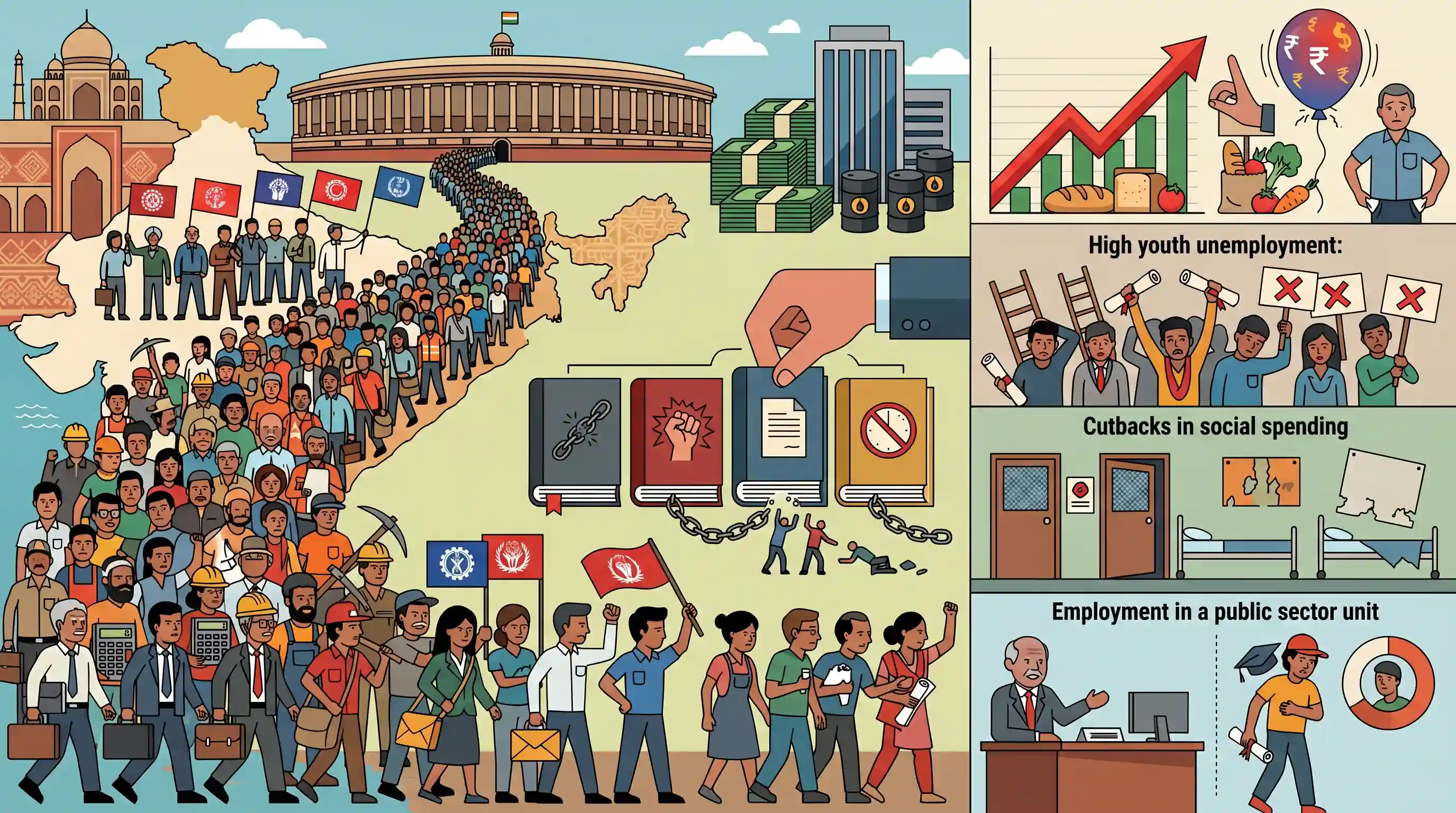
A forum of 10 central trade unions called for a nationwide strike ('Bharat Bandh') on July 9, drawing participation from over 25 crore workers across sectors like banking, mining, and postal services. The strike protests the government's alleged pro-corporate policies, particularly the impending implementation of four new labour codes that unions argue will weaken collective bargaining. Furthermore, the unions expressed alarm over severe macroeconomic challenges, including high youth unemployment, rising inflation, and cutbacks in social sector spending. The practice of recruiting retired personnel in public sector units rather than hiring young job seekers was specifically criticized as damaging to India's demographic dividend.
Key Points
- A massive general strike ('Bharat Bandh') involving over 25 crore workers across multiple sectors was called by a forum of 10 central trade unions to protest government policies.
- The strike specifically opposes the imposition of four new labour codes, which trade unions argue weaken collective bargaining and favor employers under the guise of 'ease of doing business'.
- Unions raised macroeconomic concerns, including rising unemployment, inflation, wage depression, and reductions in social sector spending.
- The protest highlighted the government's practice of rehiring retired personnel in public sector entities instead of offering regular appointments to the youth, thereby undermining India's demographic dividend.
Important Terms
Four Labour Codes

Four unified legislations—Wage, Industrial Relations, Social Security, and Occupational Safety—consolidating 29 central labour laws to modernise regulations, simplify compliance, and expand worker social security.
UPSC context
GS II (Government Policies) & GS III (Economy). Tests understanding of labour market reforms, formalisation, and worker rights in industrial relations.
Central Trade Union Organisations (CTUOs)
National-level trade union federations recognised by the Ministry of Labour. Criteria include a verified membership of 500,000+ across at least four states and four industries.
UPSC context
GS II (Pressure Groups). Tests the role of organised labour as a stakeholder in policy-making and governance.
Demographic Dividend
Economic growth potential arising when a population's working-age share (15–64) is larger than its dependent share. India’s window is projected to last until 2055.
UPSC context
GS I (Population) & GS III (Employment). Tests analysis of human capital as an economic asset versus a "demographic burden."
All India Trade Union Congress (AITUC)
India's oldest central trade union, founded in 1920 by Lala Lajpat Rai and others. It historically linked labour welfare with the national freedom struggle.
UPSC context
GS I (Modern Indian History). Tests knowledge of historical social-economic organisations and the development of the trade union movement.
Collective Bargaining
A process of negotiation between employers and a group of employees (typically via unions) to determine wages, hours, and working conditions, balancing power dynamics.
UPSC context
GS III (Industrial Relations). Tests understanding of labour-management relations and mechanisms for maintaining industrial peace and social justice.
Prelims Trap
The Right to Strike is a Fundamental Right guaranteed under Article 19(1)(c) along with the right to form trade unions.
Forming trade unions is a fundamental right under Article 19, but the Supreme Court has repeatedly ruled that the right to strike is merely a statutory right governed by the Industrial Disputes Act, 1947.
Static Concepts Connected
What is the constitutional status of labour and trade unions in India?
- Concurrent List: Labour falls under the Concurrent List (List III), allowing both Parliament and State legislatures to enact laws on trade unions and labour welfare.
- Fundamental Right: Article 19(1)(c) guarantees citizens the right to form associations or unions, though this remains subject to reasonable restrictions.
- DPSP Integration: Article 43 directs the State to secure a living wage, safe working conditions, and a decent standard of life for all workers.
What are the four new Labour Codes and their main friction point?
- Consolidation: The government subsumed 29 archaic central labour laws into four simplified codes: Wages (2019), Industrial Relations (2020), Social Security (2020), and Occupational Safety (2020).
- Friction Point: The Industrial Relations Code raises the threshold for establishments to lay off workers without prior government permission from 100 to 300, a move heavily opposed by unions.
Cross-Topic Patterns
Labour Codes vs Ease of Doing Business
The tension between corporate flexibility (e.g., layoff thresholds) and worker security bridges GS3 industrial policy with labour welfare, remaining a recurring Mains theme.
PSU Hiring & Demographic Dividend
The trend of rehiring retirees blocks youth entry into public sector units, directly squandering India's demographic dividend and exacerbating GS3 jobless growth concerns.

The statutory 'Right to Strike' vs fundamental 'Right to Form Unions', paired with Labour's Concurrent status, is a prime Prelims trap.
Linked PYQs · 4
Linked PYQs · 4
- 2024MainsGS3
Discuss the merits and demerits of the four 'Labour Codes' in the context of labour market reforms in India. What has been the progress so far in this regard?
- 2014MainsGS3
While we flaunt India's demographic dividend, we ignore the dropping rates of employability. What are we missing while doing so? Where will the jobs that India desperately needs come from? Explain.
- 2023MainsGS3
Most of the unemployment in India is structural in nature. Examine the methodology adopted to compute unemployment in the country and suggest improvements.
- 2022MainsGS2
Besides the welfare schemes, India needs deft management of inflation and unemployment to serve the poor and the underprivileged sections of the society. Discuss.
