Landslides hit Lakhwar hydroelectric dam site on Yamuna River
Source:sandrp ↗
Why It Matters
The incident highlights the ecological fragility of the Himalayas and the environmental risks associated with large hydropower projects. For UKPSC Prelims, matching dams with their respective rivers and understanding the environmental issues facing Uttarakhand are recurring, high-yield themes.
Summary
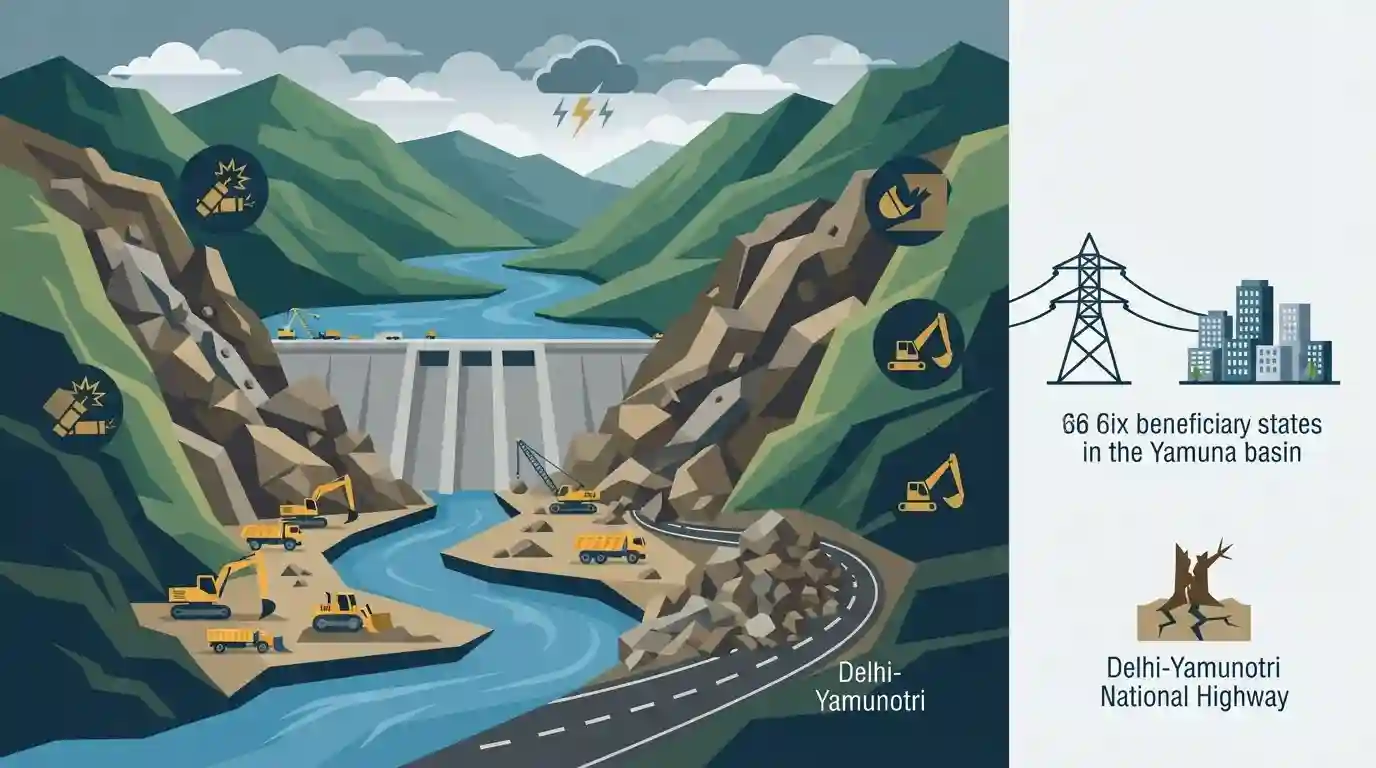
In July 2026, two massive landslides struck the Lakhwar Multipurpose Project dam site on the Yamuna River in Dehradun, Uttarakhand, within three days. The landslides buried construction machinery and blocked the critical Delhi-Yamunotri National Highway. The incidents have renewed alarms over the environmental viability of large-scale hydroelectric projects in the fragile Himalayan terrain. Experts attribute the increased frequency of such disasters to excessive use of explosives, unchecked excavation, and extreme weather events triggered by climate change. The project, which benefits six states in the Yamuna basin, underscores the tension between infrastructure development and ecological stability in Uttarakhand.
Key Points
- Two major landslides hit the under-construction 300 MW Lakhwar Multipurpose Project on the Yamuna River in July 2026 within a span of three days.
- The incidents disrupted the Delhi-Yamunotri National Highway and buried construction machinery at the site.
- The Lakhwar project is a massive multi-state initiative spanning six Yamuna basin states: Uttarakhand, Uttar Pradesh, Haryana, Rajasthan, Delhi, and Himachal Pradesh.
- Environmentalists highlight that excessive blasting, deep excavation, and intense rainfall linked to climate change are exacerbating geological vulnerabilities in the fragile Himalayan ecosystem.
Important Terms
Lakhwar Multipurpose Project

A 300 MW hydroelectric project under construction on the Yamuna River in Dehradun. It features a 204m-high concrete gravity dam designed to provide peaking power, flood control, and regulated water supply to six Yamuna basin states.
UPSC context
GS-3 (Infrastructure/Environment). Highlights inter-state water sharing, Himalayan ecological vulnerabilities, and tensions between development and disaster management.
Vyasi Hydroelectric Project
A 120 MW run-of-the-river power project on the Yamuna River in Uttarakhand, located downstream of Lakhwar Dam. It includes an 86m-high concrete gravity dam and forms a key component of the larger Lakhwar-Vyasi hydroelectric cascade complex.
UPSC context
GS-3 (Environment). Tests knowledge of run-of-the-river hydropower viability, displacement issues, and the cumulative ecological impact of dam cascades.
Katapathar Barrage
A balancing barrage planned on the Yamuna River downstream of the Vyasi project. It is designed to regulate varying water outflows from the Lakhwar and Vyasi power stations, ensuring a steady downstream flow for agricultural and drinking needs.
UPSC context
GS-1 (Water Resources) and GS-3. Demonstrates integrated river basin management and the ecological consequences of repeated river impoundment.
South Asia Network on Dams, Rivers and People (SANDRP)
The South Asia Network on Dams, Rivers and People is an informal network researching and advocating on issues related to rivers, local communities, and the environmental, governance, and social impacts of large-scale water infrastructure.
UPSC context
GS-2 (Role of Civil Society) and GS-3 (Environment). Exemplifies NGO advocacy in monitoring environmental clearances, river ecology, and infrastructure governance.
Prelims Trap
The Lakhwar Multipurpose Project is built on the Ganga river and its benefits are limited exclusively to Himalayan states.
The project is built on the Yamuna river. Furthermore, its six beneficiary states include non-Himalayan entities like Rajasthan, Haryana, Delhi, and Uttar Pradesh.
Static Concepts Connected
Why are Himalayan dams highly susceptible to RIS and LLOFs?
- Unconsolidated Geology: The Himalayas are young fold mountains with fragile, sedimentary rock structures prone to mass wasting upon deep excavation and blasting.
- Reservoir-Induced Seismicity (RIS): The massive weight of impounded water in large reservoirs can alter tectonic stresses in already active fault zones, triggering localized earthquakes.
- LLOF Risk: Construction-induced landslides can block river channels, forming temporary lakes that eventually breach, unleashing devastating downstream Landslide Lake Outburst Floods.
How is the Yamuna river water managed among the Upper Basin states?
- 1994 MoU Framework: A landmark 1994 agreement divided the Upper Yamuna water among six states: Uttarakhand, Uttar Pradesh, Himachal Pradesh, Haryana, Rajasthan, and Delhi.
- Upper Yamuna River Board: A subordinate office under the Ministry of Jal Shakti regulates and implements the water allocation and monitors multi-state projects like Lakhwar and Renukaji.
Cross-Topic Patterns
Hydropower Push vs. Himalayan Ecology
India's renewable energy targets drive massive dam construction in Uttarakhand, conflicting with the region's high seismic vulnerability and carrying capacity. This trade-off is a frequent GS3 theme.
Inter-State River Basin Cooperation
Projects like Lakhwar, benefiting six diverse states, serve as vital case studies of cooperative federalism, linking river basin geography with constitutional mechanisms like Article 262 and River Boards.

Lakhwar’s 6-state beneficiary model combined with Himalayan LLOF/RIS vulnerabilities makes it prime for a 2026 multi-statement Prelims question.
Linked PYQs · 4
Linked PYQs · 4
- 2024UKPSC_PRELIMSGS1
Match the hydroelectric projects with the river on which they are constructed : | Name of Project | River | |---|---| | A. Koteshwar | 1. Asan | | B. Kulhal | 2. Alaknanda | | C. Tapoban Vishnugad | 3. Bhagirathi | | D. Vishnuprayag | 4. Dhalui | A B C D
- 2016UKPSC_PRELIMSGS1
The biggest Hydro-Electric Project of Uttarakhand State is:
- 2025UKPSC_PRELIMSGS1
Which of the following is the correct order of rivers from west to east in Uttarakhand?
- 2007UKPSC_PRELIMSGS1
Which of the following is not an effect of Deforestation in India?
