Floods damage hydel project in Ravi basin
Source:sandrp ↗
Why It Matters
This case highlights the ecological and infrastructural vulnerabilities in the Himalayan region due to hydroelectric projects. It is directly relevant for questions on the river systems of Himachal Pradesh (specifically the tributaries of the Ravi river) and the environmental impact assessments of development projects in fragile terrains.
Summary
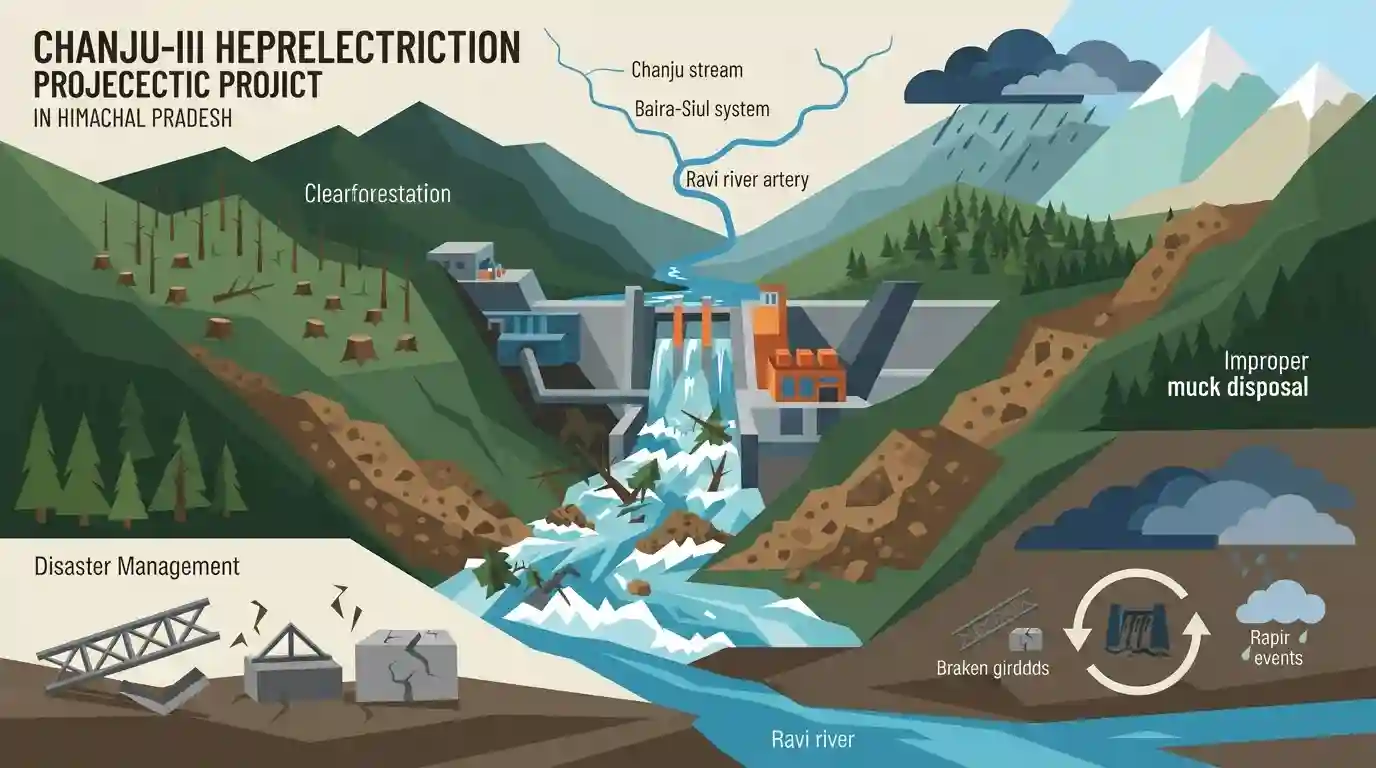
The article details the severe damage inflicted by July 2026 flash floods on the under-construction Chanju-III Hydroelectric Project (HEP) in Himachal Pradesh's Chamba district. Located on the Chanju stream—a tributary of the Baira-Siul-Ravi river system—the 48 MW project being built by HPPCL has a history of environmental mismanagement, including massive deforestation and improper muck disposal. The recurrent disasters at the site highlight the growing conflict between large-scale infrastructure development and ecological stability in the fragile Himalayan terrain.
Key Points
- A flash flood in July 2026 caused extensive damage to the under-construction 48 MW Chanju-III Hydroelectric Project in the Churah subdivision of Chamba district, Himachal Pradesh.
- The Chanju stream, on which the project is being built, is a tributary of the Baira river, which itself feeds the Siul river, a major tributary of the Ravi river.
- The project, executed by Himachal Pradesh Power Corporation Ltd (HPPCL), has faced severe environmental criticism for massive tree felling, direct muck dumping into streams, and inducing landslides and rockfalls in a fragile ecosystem.
- The recent flood swept away retaining walls, approach roads, and machinery, emphasizing the vulnerability of the region's run-of-the-river HEPs to extreme weather events and poor environmental management.
Important Terms
Chanju-III Hydroelectric Project (HEP)

A 48 MW under-construction run-of-the-river hydroelectric project being built by HPPCL on the Chanju stream, a tributary of the Ravi basin in Himachal Pradesh's Chamba district, frequently impacted by flash floods.
UPSC context
GS Paper I (Geography: Water Resources) and GS Paper III (Disaster Management, Environmental Impact Assessment of Himalayan infrastructure).
Chanju-I HEP
A commissioned 36 MW run-of-the-river hydroelectric power plant on the Chanju stream in Chamba district, Himachal Pradesh, operating since 2017 in the Ravi river basin.
UPSC context
GS Paper I (Indian Geography: River Basins and drainage systems) and GS Paper III (Renewable Energy infrastructure).
Chanju-II HEP
A commissioned 19.8 MW run-of-the-river hydroelectric project located on the Chanju stream in the Chamba district of Himachal Pradesh, contributing to the state’s micro-hydro grid since 2021.
UPSC context
GS Paper I (Geography: River Systems of India) and GS Paper III (Infrastructural development and environment conflicts).
Deothal Chanju HEP
A proposed 30 MW run-of-the-river hydroelectric project in the clearances and pre-construction stage on the Deothal Nallah/Chanju stream in Chamba, Himachal Pradesh, developed by HPPCL.
UPSC context
GS Paper III (Infrastructural development, environmental clearance procedures, and clean energy development).
Himachal Pradesh Power Corporation Ltd (HPPCL)
A state government undertaking incorporated in 2006 to plan, promote, and develop hydroelectric, solar, and other power generation projects in Himachal Pradesh.
UPSC context
GS Paper III (Infrastructure, Energy Sector, and State Public Sector Undertakings role in clean energy transition).
South Asia Network on Dams, Rivers and People (SANDRP)
An informal network of organizations and individuals that monitors river systems, advocating for environmental compliance, local livelihoods, and sustainable water resources management in India.
UPSC context
GS Paper III (Environmental Conservation, River Governance, and civil society role in environmental advocacy).
Prelims Trap
Run-of-the-river (RoR) hydroelectric projects are ecologically benign in high-altitude zones because they bypass reservoir-induced seismicity.
While RoR projects avoid submergence from massive dams, their construction footprint (blasting tunnels, slope cutting, and muck dumping) heavily triggers severe landslide and flash flood hazards.
Static Concepts Connected
What is the origin and drainage structure of the Ravi River?
- Source and Origin: Originates in the Bara Bhangal region of Kangra district, Himachal Pradesh, from glacial streams like Bhadal and Tantgari.
- Course: Flows through Chamba valley, enters Punjab plains near Madhopur, and eventually joins the Chenab River in Pakistan.
- Tributary Network: Major tributaries include Budhil, Nai, Siawa, and Siul (which is fed by the Baira and Chanju streams).
How do MCT and STDS affect Himalayan project safety?
- Tectonic Framework: The Main Central Thrust and South Tibetan Detachment System are highly active, seismically volatile fault zones in the Himalayas.
- Geotechnical Risks: Infrastructure in these zones faces high risk of rockbursts, underground water ingress, and shear-zone failures during tunneling.
Cross-Topic Patterns
Infrastructure vs. Himalayan Slope Stability
Links infrastructure development with disaster management. Blasting for tunnels (HRT) in active tectonic zones like MCT/STDS directly compromises slope stability, escalating landslide frequencies.
Indus Waters Treaty & River Ecology
Under the Indus Waters Treaty (1960), Ravi's waters belong to India. However, harnessing this potential via hydro-projects faces acute ecological limits in fragile high-altitude river basins.

Prelims 2026 may map West-flowing/Indus tributaries (Ravi, Siul, Baira) against Himalayan fault lines (MCT) and run-of-the-river risks.
Linked PYQs · 2
Linked PYQs · 2
- 2010HPAS_PRELIMSGS1
Siul stream is a tributary of river :
- 2018HPAS_PRELIMSGS1
The impacts caused by construction of dams and reservoirs include all, except :
