Constitutional Morality and Counter-Majoritarian Judicial Role
Source:The Hindu ↗
Why It Matters
This topic directly addresses the evolving nature of judicial pronouncements in India and the clash between constitutional morality and public morality. It is highly relevant for GS Paper 2 (Judiciary, Constitutional features) and GS Paper 4 (Objectivity, Constitutional ethics, and Impartiality).
Summary
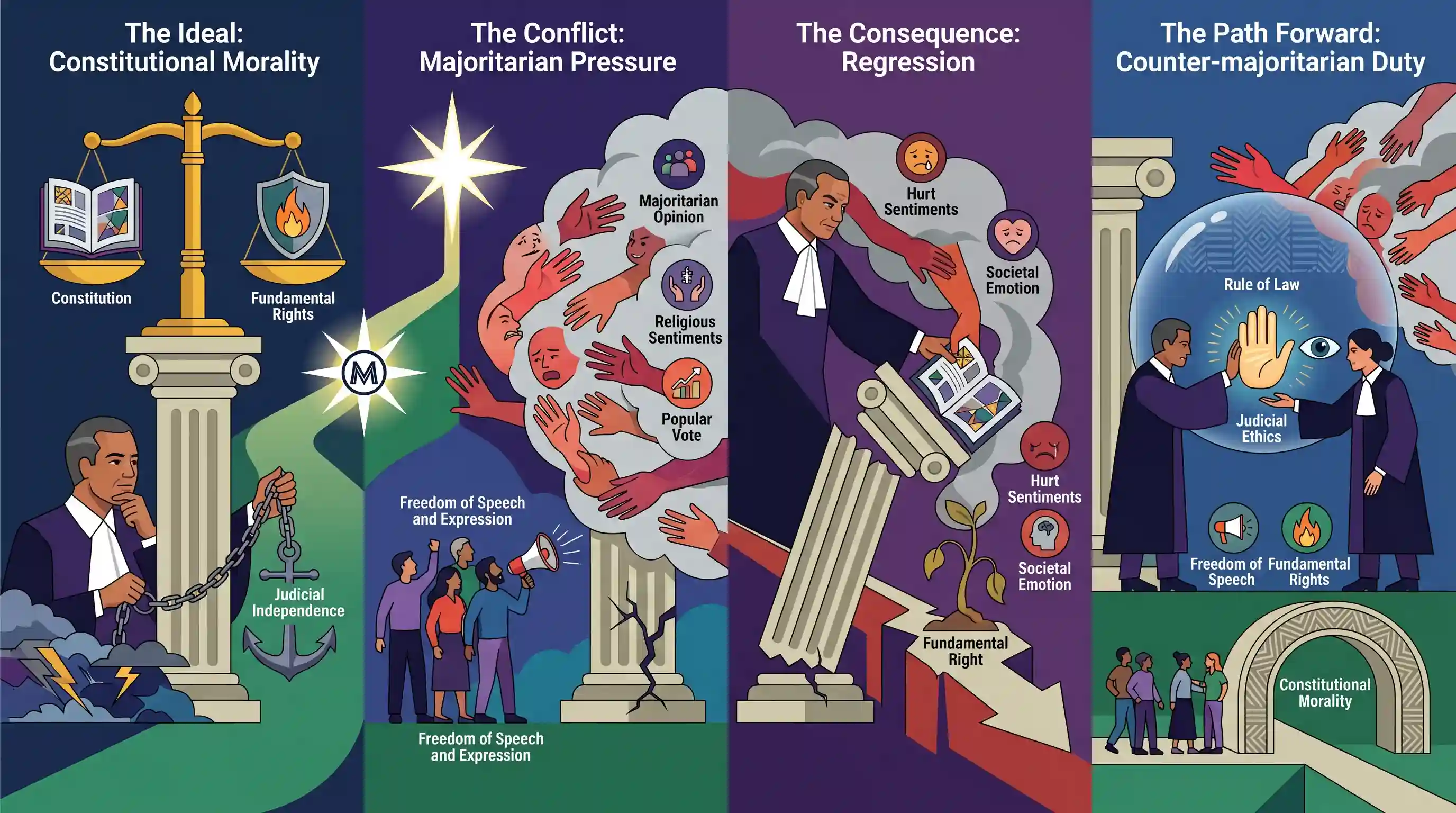
The article argues that the judiciary's increasing sensitivity to public and religious sentiments is a regressive trend. It highlights that the courts are meant to be counter-majoritarian bodies guided by constitutional morality rather than majoritarian opinions or societal emotions. When judicial pronouncements prioritize 'hurt sentiments' over fundamental rights, it compromises the rule of law, freedom of speech, and the core ethical mandate of judicial objectivity.
Key Points
- The judiciary's increasing tendency to base rulings or observations on public, religious, or majoritarian sentiments is a regressive trend that undermines the rule of law.
- Courts are designed to be counter-majoritarian institutions tasked with protecting individual liberties against mob mentality and populist pressures.
- When judges prioritize societal sentiments over constitutional morality, it threatens fundamental rights, particularly the freedom of speech and expression.
- True judicial independence requires judges to remain objective, impartial, and guided strictly by constitutional ethics rather than fleeting societal emotions.
Important Terms
Constitutional Morality

Adherence to the core values, spirit, and ethical vision of the Constitution (like liberty and equality) rather than just its literal text or prevailing societal morality.
UPSC context
GS Paper II & IV. Tests understanding of constitutionalism versus majoritarian impulses in judicial decision-making.
Article 19(1)(a)
Guarantees all citizens the right to express views freely through speech, writing, or media, subject to 'reasonable restrictions' like public order, decency, or morality under Article 19(2).
UPSC context
GS Paper II (Fundamental Rights). Key for debates on dissent, media freedom, and the 'chilling effect' of legal actions.
Counter-majoritarian Role
The judiciary's duty to protect individual and minority rights by checking the impulses of the majority or the elected government when they infringe on constitutional guarantees.
UPSC context
GS Paper II (Judiciary). Critical for analyzing the judiciary's mandate to uphold the Constitution against popular or political pressure.
Rule of Law
A foundational principle stating that the law is supreme, everyone is equal before it, and no one (including the state) is above it; recognized as 'Basic Structure'.
UPSC context
GS Paper II (Polity/Governance). Foundational for understanding judicial review and the limits on arbitrary state power.
Judicial Independence
The institutional and functional autonomy of the judiciary from the executive and legislature, ensuring adjudication is performed 'without fear or favour'.
UPSC context
GS Paper II (Judiciary). Essential for questions on separation of powers and the protection of civil liberties.
Chilling Effect
A psychological or legal deterrent where the threat of legal sanction or public backlash causes individuals to self-censor and refrain from exercising legitimate free speech.
UPSC context
GS Paper II & IV. Relevant to discussions on the misuse of defamation, sedition, or hurt sentiments to stifle criticism.
Prelims Trap
"Restrictions on Article 19 can be constitutionally justified on the grounds of protecting public sentiments."
Article 19(2) restricts speech on grounds of "decency or morality" and "public order," but "public sentiments" is not an explicitly recognized constitutional restriction.
Static Concepts Connected
What is the Supreme Court's 'counter-majoritarian' role?
- Rights Protection: The judiciary safeguards individual liberties and minority rights against the tyranny of the majority or populist legislative actions.
- Constitutional Ethics: Judicial rulings must rely on constitutional ethics (equality, justice) rather than prevailing societal prejudices, traditions, or majoritarian sentiments.
How did B.R. Ambedkar define 'Constitutional Morality'?
- Cultivated Trait: Ambedkar argued it is not a natural instinct but a trait that must be actively cultivated to prevent democracy from yielding to traditional hierarchy.
- Paramount Reverence: It implies strict adherence to constitutional forms, ideals, and processes over personal, religious, or societal moral compasses.
Cross-Topic Patterns
Free Speech vs. Section 295A IPC
The judiciary's sensitivity to "hurt sentiments" directly impacts the weaponization of IPC Section 295A (outraging religious feelings) against the constitutional guarantees of free speech.
Essential Religious Practices vs. Article 14
This connects to GS-1/GS-2 debates on religious freedom (Article 25) vs. equality (Article 14), famously seen in the Sabarimala case where constitutional morality overrode traditional public morality.

Expect a GS-2 Mains question evaluating the Supreme Court's 'counter-majoritarian' mandate against rising populist sentiments.
Linked PYQs · 5
Linked PYQs · 5
- 2025MainsGS2
"Constitutional morality is the fulcrum which acts as an essential check upon the high functionaries and citizens alike...." In view of the above observation of the Supreme Court, explain the concept of constitutional morality and its application to ensure balance between judicial independence and judicial accountability in India.
- 2021MainsGS2
‘Constitutional Morality’ is rooted in the Constitution itself and is founded on its essential facets. Explain the doctrine of ‘Constitutional Morality’ with the help of relevant judicial decisions.
- 2014MainsGS2
What do you understand by the concept "freedom of speech and expression"? Does it cover hate speech also ? Why do the films in India stand on a slightly different plane from other forms of expression ? Discuss.
- 2025MainsGS4
"Constitutional morality is not a natural sentiment but a product of civil education and adherance of the rule of law." Examine the significance of constitutional morality for public servant highlighting the role in promoting good governance and ensuring accountability in public administration.
- 2022MainsGS4
Discuss the significance of 'Constitutional morality' in the context of Indian governance.
