Judicial Impeachment Process and Accountability Loopholes
Source:The Hindu ↗
Why It Matters
Understanding the mechanisms of judicial accountability is crucial for UPSC aspirants. The impeachment process highlights the delicate balance between judicial independence and accountability, and the identified loophole points to potential areas for future constitutional and legislative reforms.
Summary
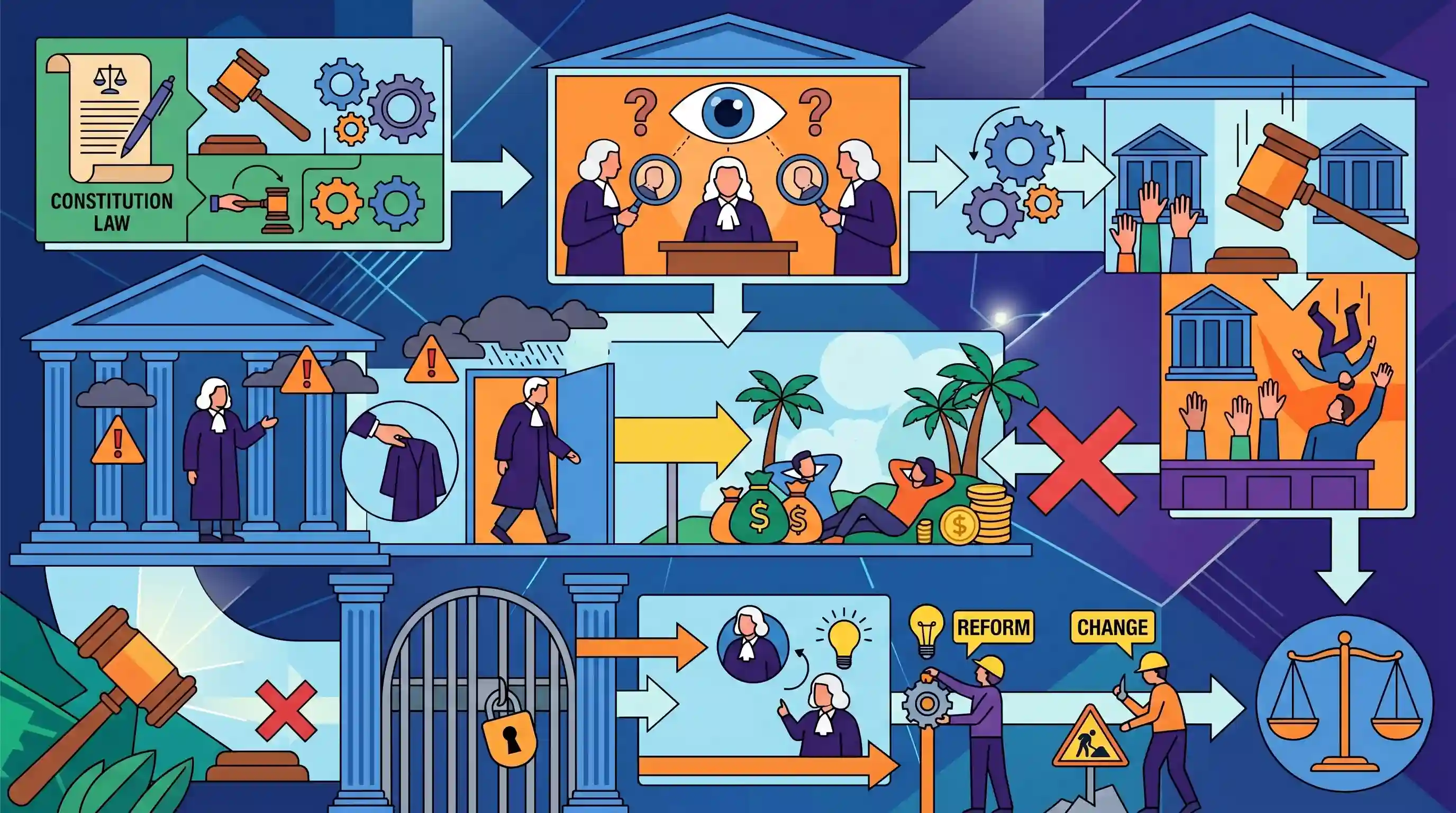
The article critically examines the process of judicial removal in India, governed by the Constitution and the Judges (Inquiry) Act, 1968. While the law mandates a rigorous, multi-step procedure to ensure judicial independence, it suffers from a significant loophole: judges facing impeachment can resign before the inquiry concludes or the parliamentary vote takes place. This aborts the impeachment process, shielding the judge from formal findings of 'proved misbehaviour' or 'incapacity' and often preserving post-retirement benefits. This loophole undermines the mechanism of judicial accountability, suggesting a pressing need for legislative reform to address premature resignations during pending impeachment motions.
Key Points
- The removal of Supreme Court and High Court judges in India is governed by Article 124(4) of the Constitution and the Judges (Inquiry) Act, 1968, which lay out a stringent process involving an inquiry committee and a special parliamentary majority.
- A critical loophole in the current legal framework allows judges facing impeachment to resign before the inquiry concludes or Parliament votes, effectively halting the proceedings.
- This premature resignation prevents a formal recording of 'proved misbehaviour' or 'incapacity', allowing the judge to avoid the stigma of impeachment and potentially retain retirement benefits.
- The article emphasizes the need to reform the judicial removal mechanism to ensure greater judicial accountability and close the existing loophole.
Important Terms
Judges (Inquiry) Act, 1968

The 1968 law regulating the investigation and proof of misbehaviour or incapacity of Supreme Court and High Court judges, operationalising Article 124(5) of the Constitution through a statutory inquiry committee.
UPSC context
GS Paper II: Polity. Crucial for understanding the statutory mechanism for judicial removal and the balance between independence and accountability.
Article 124(4)
Constitutional provision mandating that a Supreme Court judge can only be removed by Presidential order following a parliamentary address supported by a special majority for 'proved misbehaviour' or 'incapacity'.
UPSC context
GS Paper II: Constitutional Provisions. Tests knowledge of the rigid removal process and the security of tenure for the higher judiciary.
Judicial Accountability
The principle that judges must be answerable for their conduct and decisions, ensuring integrity and public trust without compromising the constitutional independence required for impartial adjudication.
UPSC context
GS Paper II: Judiciary. A key theme in reforms; tests the ability to analyze the 'who judges the judges' dilemma.
Proved Misbehaviour or Incapacity
The specific constitutional grounds for judicial removal; 'misbehaviour' includes willful misconduct or corruption, while 'incapacity' refers to physical or mental inability to perform judicial duties.
UPSC context
GS Paper II: Polity. Core grounds for impeachment; tests precise legal terminology and its interpretation by Parliament.
Special Majority
A voting requirement for judicial removal: a majority of the total membership of each House and a majority of at least two-thirds of the members present and voting.
UPSC context
GS Paper II: Parliament. Tests technical understanding of parliamentary voting procedures used for major constitutional actions.
In-House Procedure
A 1999 protocol allowing the Chief Justice of India to investigate complaints against judges internally; often used to advise resignation for serious misconduct before formal impeachment begins.
UPSC context
GS Paper II: Judicial Reforms. Relevant for discussing mechanisms that exist outside the formal 'removal' loophole mentioned in the article.
Prelims Trap
The Constitution of India details the procedure and the 3-member inquiry committee for the removal of a Supreme Court judge.
The Constitution only specifies the grounds and required majority. The detailed procedure (number of signatories, inquiry committee) is in the statutory Judges (Inquiry) Act, 1968.
Static Concepts Connected
What is the statutory procedure for removing a Supreme Court Judge in India?
- Initiation: A removal motion requires signatures of 100 Lok Sabha or 50 Rajya Sabha members before submission to the Presiding Officer.
- Investigation: If admitted, a 3-member committee (an SC judge, an HC Chief Justice, and a distinguished jurist) investigates the charges.
- Parliamentary Vote: The motion must be passed by a special majority (majority of total membership and 2/3rd present and voting) in both Houses.
- Presidential Order: The President formally issues the removal order after Parliament passes the motion.
How do constitutional provisions differentiate between resignation and removal of a SC Judge?
- Voluntary Resignation: Under Article 124(2)(a), a judge may resign voluntarily by writing to the President; this requires no parliamentary inquiry.
- Formal Removal: Governed by Article 124(4), requiring a finding of "proved misbehaviour or incapacity" and a complex parliamentary process.
- Impact on Benefits: Resignation preserves post-retirement benefits like pensions, whereas successful impeachment strips the judge of these benefits.
Cross-Topic Patterns
Judicial Independence vs. Accountability
The tension between insulating judges from political pressure (strict removal rules) and ensuring accountability (exploiting resignation loopholes) is a core GS-2 theme for Mains.
Constitutional vs. Statutory Frameworks
UPSC frequently tests the exact boundary between what is explicitly enshrined in the Constitution versus what is delegated to parliamentary statutes.

Expect a Prelims question differentiating what is written in the Constitution (grounds/majority) vs the Judges Inquiry Act (procedure).
Linked PYQs · 2
Linked PYQs · 2
- 2019PrelimsGS1
Consider the following statements: 1. The motion to impeach a Judge of the Supreme Court of India cannot be rejected by the Speaker of the Lok Sabha as per the Judges (Inquiry) Act, 1968. 2. The Constitution of India defines and gives details of what constitutes 'incapacity and proved misbehaviour' of the Judges of the Supreme Court of India. 3. The details of the process of impeachment of the Judges of the Supreme Court of India are given in the Judges (Inquiry) Act, 1968. 4. If the motion for the impeachment of a Judge is taken up for voting, the law requires the motion to be backed by each House of the Parliament and supported by a majority of total membership of that House and by not less than two-thirds of total members of that House present and voting. Which of the statements given above is/are correct?
- 2023MainsGS2
“Constitutionally guaranteed judicial independence is a prerequisite of democracy.” Comment.
