Judicial Infrastructure Development and Access to Justice
Source:The Hindu ↗
Why It Matters
Provides a practical example of executive-judiciary cooperation in strengthening judicial infrastructure, which is a major bottleneck in tackling India's massive case pendency and ensuring effective access to justice. It also reinforces the constitutional principle of the separation of powers.
Summary
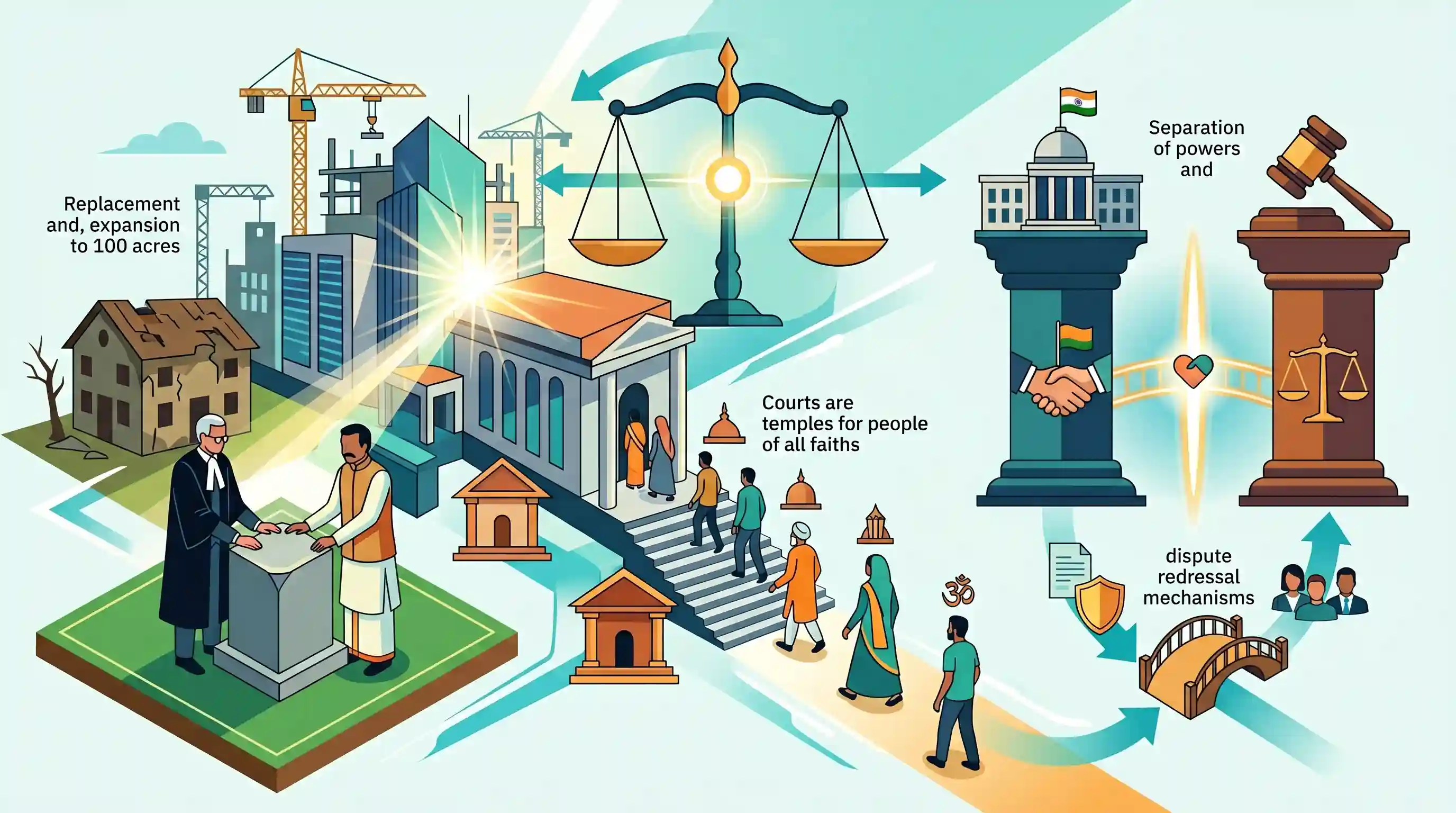
During the foundation stone laying ceremony for the new Telangana High Court Zone II in Hyderabad, Supreme Court Judge Surya Kant declared that strengthening judicial infrastructure is essential for the efficient delivery of justice. Telangana Chief Minister A. Revanth Reddy supported this by comparing courts to temples for people of all faiths and underscoring the critical need for separation of powers and mutual respect among the state's organs. The state government has provided 100 acres of land to build a modern campus, replacing the 100-year-old existing High Court building, showcasing a collaborative effort to enhance access to justice while respecting judicial independence.
Key Points
- Supreme Court Judge Surya Kant emphasized that robust judicial infrastructure is an essential prerequisite for the effective delivery of justice, not merely an optional upgrade.
- Telangana Chief Minister A. Revanth Reddy reiterated the importance of the separation of powers and the necessity for mutual respect among the legislature, executive, and judiciary.
- The collaboration between the state government (providing 100 acres of land and funding) and the judiciary exemplifies the executive's role in facilitating judicial independence and access to justice.
- The new High Court campus in Hyderabad aims to replace a century-old building that is inadequate for current judicial demands, thereby aiming to reduce case pendency through modernized facilities.
Important Terms
Judicial Infrastructure

The physical (courtrooms, residential units) and digital (e-courts) resources necessary for the judiciary to function effectively and reduce case pendency.
UPSC context
GS II: Judiciary; critical for addressing pendency and improving the efficiency of the justice delivery system.
Separation of Powers
The constitutional doctrine dividing government authority into the Legislature, Executive, and Judiciary to provide checks and balances and prevent arbitrary power.
UPSC context
GS II: Constitutional Features; tested as a fundamental principle and part of the Basic Structure doctrine.
Access to Justice
A fundamental right (Articles 14 and 21) ensuring citizens can seek and obtain legal remedies through formal or informal justice institutions.
UPSC context
GS II: Social Justice; tests knowledge of legal aid, Article 39A, and inclusive judicial reach.
High Court
The highest judicial authority at the state level (Articles 214-231), acting as a court of record and protector of fundamental rights.
UPSC context
GS II: State Legislature and Judiciary; focuses on its writ jurisdiction (Article 226) and administrative control over subordinate courts.
Independence of Judiciary
The constitutional principle ensuring the judiciary remains free from influence by the executive or legislature to maintain the rule of law.
UPSC context
GS II: Structure and functioning of the Judiciary; essential for fair adjudication and upholding constitutional values.
Chief Justice of India
The head of the Indian federal judiciary and the Supreme Court, responsible for administrative leadership and presiding over constitutional benches.
UPSC context
GS II: Constitutional Posts; tests understanding of the 'Master of Roster' role and appointment procedures.
Prelims Trap
"The Indian Judiciary holds complete financial autonomy and constitutional authority to independently fund its infrastructure."
Land allocation and funding for High Courts and subordinate courts depend heavily on State executives and Centre-State CSS mechanisms, lacking independent judicial budgetary autonomy.
Static Concepts Connected
How does Article 50 address the separation of powers?
- DPSP Mandate: Article 50 directs the State to take steps to separate the judiciary from the executive in the public services of the State.
- Basic Structure: This functional separation ensures judicial independence, which the Supreme Court has recognized as an integral part of the Constitution's basic structure.
- Practical Interdependence: Despite this separation, the judiciary must rely on the executive for financial resources, land allocation, and infrastructural development, requiring collaborative governance.
What is the funding framework for subordinate judicial infrastructure?
- CSS Mechanism: Infrastructure development is primarily funded via a Centrally Sponsored Scheme (CSS) where costs are shared between the Centre and States (usually 60:40).
- Fund Lapsing: Allocated funds frequently lapse because State governments fail to release their matching financial share or structurally underutilize the central funds.
- NJIAI Proposal: The Supreme Court proposed the National Judicial Infrastructure Authority of India (NJIAI) to independently manage these budgets and prevent fund lapsing.
Cross-Topic Patterns
Fiscal Federalism + Access to Justice
The chronic lapse of Centrally Sponsored Scheme (CSS) funds by States directly exacerbates the 5-crore case pendency, linking fiscal federalism friction with the fundamental right to access justice.
Digital Public Goods + Judicial Efficiency
Physical infrastructure bottlenecks are being heavily supplemented by digital infrastructure via Phase-III of the e-Courts Project, pushing paperless courts, digital records, and e-Sewa Kendras.

Expect a multi-statement prelims question on judicial infrastructure funding, linking the CSS mechanism, Article 50, and NJIAI proposal.
Linked PYQs · 2
Linked PYQs · 2
- 2023MainsGS2
“Constitutionally guaranteed judicial independence is a prerequisite of democracy.” Comment.
- 2020MainsGS2
Judicial Legislation is antithetical to the doctrine of separation of powers as envisaged in the Indian Constitution. In this context justify the filing of large number of public interest petitions praying for issuing guidelines to executive authorities.
